 Tel:
Tel:  Email:
  WhatsApp:
 Description
Key Technical Specifications
| Parameter | Specification | Notes |
|---|---|---|
| Control Method | Digital Signal Processor (DSP) | High-speed vector control |
| Bandwidth | 1256 rad/sec (approx. 200 Hz) | Extremely fast response for tension/position |
| Communication | SERCOS Interface (IEC/EN61491) | Fiber optic real-time serial link |
| Feedback Types | Resolver, Incremental Encoder, Absolute | Supports up to 1M pulses/rev encoders |
| Speed Range | 1:2000 (Analog Ref), 1:8000 (Digital) | High precision at low speeds |
| Load Regulation | ±0.0125% (0-100% Load) | Stiff speed control |
| Main Power | 3-Phase AC (Voltage varies by sub-model) | Check rating plate on specific unit |
| Control Power | Independent Supply | Allows parameter editing with mains off |
| Protection | DC Bus Fuses, IGBT Protection | Internal fusing requires board-level repair |
| Network Options | DeviceNet, ControlNet, CC-Link | Via option cards |
Field Engineer’s Perspective
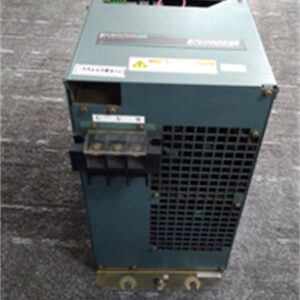
If you are dealing with the RELIANCE VZ7000 UVZ701E, you are likely maintaining a piece of industrial history—probably a high-end web handling line, a printing press, or a complex multi-axis gantry that was installed in the late 90s or early 2000s. This isn’t your standard variable frequency drive (VFD); it’s a servo system designed for synchronization. The “UVZ” designation usually points to the specific voltage class and form factor within the VZ7000 family.The standout feature here is the SERCOS interface. While modern drives use Ethernet/IP or Profinet, this beast used fiber optics for deterministic, real-time data transfer between the controller and the drive. It’s rock solid against electrical noise, which is why these units survived decades in noisy paper mills. The DSP inside provides a bandwidth of 1256 rad/sec, which is overkill for a fan but essential if you are trying to keep tension constant on a roll of film moving at 500 feet per minute. Just be aware: finding firmware updates or manuals is becoming a treasure hunt.
Quality SOP & Tech Pitfalls
The Lab Report (SOP)
Since these are obsolete, buying a “refurbished” unit is risky unless they actually tested it. Here is what a proper repair shop should do:
- Capacitor Reforming: These units sit on shelves for years. We apply voltage slowly to reform the electrolytic capacitors on the DC bus. If we ramp up too fast, they vent.
- Optical Test: We check the SERCOS fiber ports (Tx/Rx) with a light meter. Dirty connectors are the #1 cause of “Comm Loss” faults.
- IGBT Dynamic Test: We run the motor through acceleration/deceleration ramps to ensure the power blocks aren’t suffering from thermal fatigue cracks.
- Encoder Emulation: We simulate a 1M pulse encoder signal to verify the feedback circuit can handle the high-frequency input without dropping counts.
The Engineer’s Warning (Pitfalls)
The biggest headache with the VZ7000 is the Control Power vs. Main Power architecture.
The drive allows you to power up the control board (logic) while the main contactor (motor power) is off. This is great for debugging, but if you don’t understand the sequence, you will get confused.
Field Horror Story: A technician replaced a blown fuse on the main power section but forgot that the control logic has its own separate fusing. He powered up, saw the keypad light up, and assumed it was ready. He enabled the drive, and nothing happened because the internal “Ready” relay wasn’t latched due to a missing control voltage phase. Always check the auxiliary power terminals, not just the main L1/L2/L3.
Installation & Configuration Guide
- Pre-Installation Check
- ⚠️ CRITICAL: Verify the SERCOS ring topology. Is this drive the “Master” or a “Slave” in the fiber loop? If you break the ring, the whole machine stops.
- Check the rating plate. The UVZ701E comes in different voltage ratings. Ensure your incoming AC matches the sticker exactly.
- Mounting & Wiring
- Mount vertically. These drives rely on convection and forced air. Mounting sideways traps heat in the heatsink fins.
- Connect the fiber optic cables carefully. Do not kink the cable tighter than the minimum bend radius (usually 30mm). Clean the ends with an alcohol swab.
- Power-Up Sequence
- Apply Control Power first. The display should activate.
- Check parameters. Specifically, look at the “Motor Code” or “Tuning Parameters.” If these were lost during a battery backup failure, the drive will oscillate or fault immediately.
- Auto-Tuning
- Run the inertia identification routine (if available in your firmware version). The DSP needs to know the load inertia to tune the PI gains correctly. Without this, the axis will be sluggish or whine loudly.
Compatible Replacement Models
| Compatibility Tier | Model Number | Notes |
|---|---|---|
| ✅ Direct Replacement | RELIANCE VZ7000 (Same P/N) | Hard to find. Look for “New Surplus” or “Certified Rebuilt” with a warranty. |
| ⚠️ Modern Upgrade | Baldor/ABB Mentor II | Requires mechanical retrofit (new footprint) and complete re-wiring of control logic. Not a drop-in. |
| ❌ Avoid | Reliance GV3000 | Looks similar, but it is a general-purpose AC drive, not a servo. It lacks the SERCOS card and bandwidth. |
Frequently Asked Questions (FAQ)
Q: My display says “Fiber Loss” or “SERCOS Fault”. How do I fix it?
It’s almost always a dirty connector or a broken cable. Disconnect the fiber loops and clean the tips with lens cleaner. If the plastic tip is scratched, replace the cable. Also, check if the previous drive in the ring has power; if the master drops out, the slave reports a loss.Q: Can I replace this with a generic VFD?
No. The UVZ701E is a servo drive. It relies on high-resolution encoder feedback (often 1,000,000 pulses/rev) to control position and torque. A generic VFD only controls speed roughly and won’t understand the feedback signals from your motor.Q: The keypad shows values, but the motor won’t turn.
Check the “Inhibit” or “Enable” input logic. Often, there is a hardware safety interlock (like a door switch or E-stop) that must be closed before the drive accepts a speed reference. Also, verify the SERCOS ring is closed (green LED on the fiber port).Q: How do I back up the parameters?
You typically need the proprietary software (often running on old Windows 95/98 laptops via serial port) or the handheld keypad if equipped. Since this is legacy tech, make sure you have a physical copy of the parameter file saved on a floppy or USB before you touch anything.Q: Is the cooling fan user-replaceable?
Yes, usually. Most VZ7000 units use standard square muffin fans. However, accessing them often requires removing the front cover, which exposes live DC bus capacitors. Discharge the unit for 15 minutes before opening the case.