
 Tel:
Tel:  Email:
  WhatsApp:
 Description
Key Technical Specifications
| Parameter | Specification |
|---|---|
| Part Number | RH917GY (Also listed as P0917GY) |
| Module Type | Voltage Monitor / Contact Sensing Input |
| Channel Count | 16 Discrete Inputs |
| Input Voltage Range | 15–60V DC (Contact Sense) 120V AC / 125V DC (Monitor) 240V AC (Monitor) |
| Isolation | Channel-to-Channel and Channel-to-Bus Isolation |
| Input Impedance | Varies by Terminal Assembly (TA) configuration |
| Logic Levels | Programmable via software/TA selection |
| Power Input | 24V DC (Nominal), Range: 19–36V DC |
| Power Consumption | Approx. 8W (varies with load) |
| Operating Temp | -20°C to 60°C |
| Enclosure Rating | IP20 (Cast Aluminum Housing) |
| Dimensions | 140mm x 165mm x 45mm |
Product Introduction
In the dirty, noisy reality of a plant floor, you don’t always deal with clean 24V DC logic. Sometimes you have to interface with a 120V AC limit switch on a vibrating screen or a 240V AC relay monitoring a heater. The Foxboro FBM207C (RH917GY) is the “universal translator” for these messy voltage levels. It’s a 16-channel discrete input module designed to handle high-voltage AC and DC signals that would fry a standard PLC input card.What makes this module stand out is its flexibility. It doesn’t just read “on/off”; it can perform voltage monitoring or contact sensing depending on how you wire the Terminal Assembly (TA). I’ve used these in power plants where we needed to monitor breaker status directly from the 125V DC battery bus. The isolation on these cards is excellent—each channel is independent, so a spike on one input won’t take down the whole card. Just be aware: this is an older generation part. It does the job perfectly, but finding them requires digging into surplus stock.
Quality SOP & Tech Pitfalls (The Reality Check)
The Lab Report (SOP)
We treat high-voltage modules with extra caution. Here is our testing protocol:
- Visual Inspection: We look for burn marks near the input terminals. Since this card handles up to 240V AC, arcing is a real risk if the terminal blocks are damaged. We also check the conformal coating for signs of moisture ingress.
- Continuity & Isolation Test: Using a multimeter (Fluke 87V), we verify there is no short between channels. Then, we apply a test voltage (simulated via a calibrated source) to each of the 16 channels.
- Live Logic Test: We toggle inputs at different frequencies to ensure the module registers the state change in the controller. We specifically test the “filter time” settings to ensure noise rejection works.
- Backplane Check: We verify communication with the carrier backplane to ensure the module can report its status and faults correctly.
The Engineer’s Warning (Pitfalls)
- The Terminal Assembly (TA) Trap: The FBM207C cannot work without its specific Terminal Assembly. The TA contains the voltage dividers and optical isolators required to step down the 240V AC signal to something the electronics can read. If you buy the module but lose the TA, you have a very expensive paperweight.
- Voltage Mismatch: You cannot just wire 240V AC into any port. The wiring depends entirely on the TA model installed. If you wire 240V into a TA configured for 24V DC contact sense, you will let the magic smoke out instantly. Verify the TA part number before applying power.
- Field Disaster: A technician once replaced a bad FBM207C but didn’t tighten the terminal block screws fully. The vibration in the compressor room loosened the connection over a week, causing the “Running” status of a critical pump to flicker on and off in the DCS, eventually tripping the safety interlock. Always torque your terminals.
Installation & Configuration Guide
This is a swap guide, but accuracy is key because of the high voltages involved.
- Pre-Installation Safety
- ⚠️ DANGER: Lock Out / Tag Out (LOTO) all field wiring connected to this module. We are dealing with lethal voltages (up to 240V AC). Verify zero energy with a multimeter before touching wires.
- Take a photo of the wiring on the Terminal Assembly (TA) and the DIP switch settings (if applicable) on the old module.
- Removal
- Disconnect the field wiring harness from the Terminal Assembly. Do not pull individual wires unless necessary; unplug the connector block.
- Release the locking levers on the FBM207C module.
- Slide the module out of the chassis. The TA usually stays wired in the panel; the module slides off the back of it.
- Hardware Setup
- Inspect the TA pins. Ensure none are bent.
- Insert the new FBM207C (RH917GY) onto the TA guides. Push firmly until the backplane connector seats.
- Engage the locking levers. They must click.
- Power-Up & Commissioning
- Remove LOTO and re-energize the field wiring.
- Watch the module LEDs. A solid green “Run” light indicates healthy operation.
- Force the inputs on/off from the field (e.g., close the limit switch) and verify the status changes in the control software (ControlBuilder or similar).
- If an input reads “On” when it should be “Off,” check your common/ground wiring on the TA.

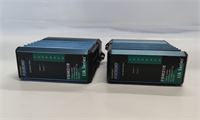
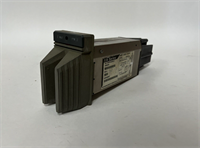
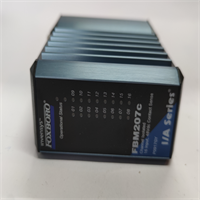
FBM207C RH917GY FOXBORO
Compatible Replacement Models
- ✅ Drop-in Replacement: FBM207C (RH917GY). This is the exact match. Note that suffix variations (like P0917GY) are generally compatible but check the revision.
- ⚠️ Functional Equivalent: FBM207B. Similar function (contact sensing), but may have different voltage ratings or isolation specs. Requires checking the datasheet and potentially changing the TA.
- ❌ System Upgrade: FBM217. This is a newer generation discrete input module. It fits the same chassis but has different wiring requirements and capabilities. Migration requires engineering effort.
Frequently Asked Questions (FAQ)
Q: Can I use this module for both AC and DC inputs?
A: Yes, but not simultaneously on the same channel without changing the configuration. The module supports 120/240V AC and up to 125V DC, but the wiring and Terminal Assembly setup determine which voltage type is being read.Q: What is the difference between “Voltage Monitor” and “Contact Sense”?
A: “Voltage Monitor” means the card watches for the presence of voltage (e.g., is the wire live?). “Contact Sense” means the card provides the excitation voltage and looks for a closure (like a dry contact switch). The FBM207C can do both depending on the setup.Q: My module shows a “Field Power Fail” alarm. What does that mean?
A: This usually means the external voltage supply feeding the inputs (the field side) is missing or below the threshold. It’s not necessarily a card failure; check your fuses or power supply on the machine side.Q: Does this module support redundancy?
A: Yes. The FBM207C can be installed in redundant pairs (A and B channels). If one module fails, the system automatically switches to the backup. You need two modules and a redundant carrier slot for this.Q: Is the RH917GY the same as P0917GY?
A: Yes, these numbers are often used interchangeably in catalogs. RH917GY is typically the ordering code or revision identifier, while P0917GY is the specific part number. They refer to the same hardware functionality.