 Tel:
Tel:  Email:
  WhatsApp:
 Description
Key Technical Specifications
| Parameter | Specification |
|---|---|
| Laser Type | Class II Helium-Neon (He-Ne) |
| Wavelength | 633 nm (Red) |
| Reference Frequency | 1.9 – 2.4 MHz |
| Max Linear Speed | 500 mm/s |
| Beam Diameter | 6 mm |
| Output Power | 1 mW (Min 120 µW) |
| Beam Height | 79.5 ± 1.0 mm |
| Warm-up Time | 90 minutes |
| MTBF | > 50,000 hours |
| Weight | 3.4 kg (7.5 lb) |
Product Introduction
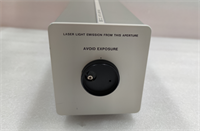
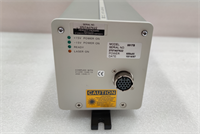
The Agilent HP 5517B is a dual-frequency helium-neon laser head designed for precision interferometry systems. It serves as the light source for measuring displacement, velocity, and position in machine tools, coordinate measuring machines (CMM), and semiconductor assembly equipment.Unlike standard laser sources, the 5517B utilizes Zeeman splitting to provide a highly stable reference frequency (1.9 to 2.4 MHz). This specific frequency range allows for linear measurement speeds up to 500 mm/s while maintaining signal stability. It is physically distinct from the 5517A, offering enhanced frequency stability for more demanding motion control applications.
Installation & Configuration Guide
Preparation (10 min)
- Verify Contents: Ensure you have the HP 5517B laser head, mounting bracket, and power cable.
- Environment: Check that the operating temperature is between -25°C and 65°C.
- Safety: Put on laser safety goggles (OD 2+ @ 633nm) before powering on. This is a Class II laser; direct eye exposure can cause retinal damage.
Removal (5–10 min)
- Power Down: Disconnect the 220VAC power supply.
- Beam Path: Mark the current beam path on the target optic to speed up alignment later.
- Unmount: Loosen the mounting bolts securing the laser head to the optical table or machine mount.
- Disconnect: Unplug the power connector carefully.
Installation (10 min)
- Mounting: Secure the HP 5517B to the control room installation point or optical breadboard. Ensure the beam height aligns with your system’s optical axis (standard height is 79.5 mm).
- Cabling: Connect the power cable to the rear panel. Ensure there is at least 12 cm of clearance behind the unit for cable bending radius.
- Alignment: Roughly align the beam toward the interferometer optics using the adjustment screws on the mount.
Power-On & Test (10 min)
- Power Up: Apply 220VAC. You will hear the internal fan spin up.
- Warm-up: Wait 90 minutes for the laser to reach thermal stability. The output power will fluctuate during this time.
- Verification: Use a power meter to check the output. It should read close to 1 mW. If it is below 120 µW after warm-up, the tube is likely failing.
Troubleshooting Quick Reference
| Symptom | Probable Cause | Action |
|---|---|---|
| No Beam / No Power | Blown fuse or loose cable | Check rear panel fuse holder. Verify 220VAC input at the connector. |
| Low Output Power (<100 µW) | End of tube life | If >100 µW, it might still work for short distances. If <50 µW, the tube requires replacement. |
| Unstable Frequency | Insufficient warm-up | Ensure the unit has been on for at least 90 minutes. |
| Measurement Noise | Mode hopping | Check for drafts or temperature spikes in the room. Verify the laser head is securely mounted. |
Dimensions, Mounting & Wiring Notes
- Dimensions: The physical footprint is compact, weighing 3.4 kg.
- Mounting: Designed for control room installation or integration into VME/PC-based systems. The base typically accepts standard 1/4″-20 or M6 mounting hardware.
- Wiring: The unit operates on 220VAC. The power connector is located on the rear panel. Ensure the ground connection is solid to prevent electrical noise from affecting the frequency stability.
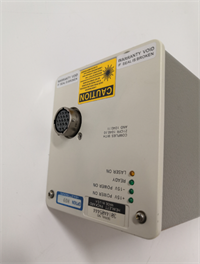
HP 5517B AGILENT
FAQ
What is the difference between the HP 5517A and 5517B?
The primary difference is the reference frequency and speed capability. The 5517A operates at 1.5–2.0 MHz, while the 5517B operates at 1.9–2.4 MHz. This allows the B model to handle faster axis speeds (up to 500 mm/s) compared to the A model.Can I use this for a 5529A Dynamic Calibrator?
Yes. The HP 5517B is specifically designed to function as part of the Agilent 5529A dynamic calibration system.How long does the laser tube last?
The Mean Time Between Failures (MTBF) is typically greater than 50,000 hours. However, output power will degrade slowly over time.I see a red light, but my interferometer reads “Signal Lost.”
This usually means the power is sufficient to see the beam, but not enough for the detector electronics. Check the power output with a meter; if it is below 120 µW, the signal-to-noise ratio is likely too low for the receiver.Does this require a specific warm-up time?
Yes. You must allow 90 minutes for the laser to stabilize. Measuring before this period results in inaccurate wavelength data due to thermal expansion of the laser cavity.