 Tel:
 Email:
 WhatsApp:
Description
Key Technical Specifications
| Parameter | Specification | Field Note |
|---|---|---|
| Processor | Intel 32-bit RISC Super Scalar (up to 150 MIPS) | Handles complex logic without breaking a sweat. |
| RAM | 16 MB SDRAM (Battery-backed) | Double the capacity of the older PM802F. |
| Flash Memory | 8 MB (32-bit words) | Stores the固化 program securely. |
| EEPROM | 16 kbit (Serial) | Holds hardware configuration and diagnostic data. |
| Power Consumption | Max 7.8 W (Basic unit only) | Keep an eye on your 24V DC cabinet budget. |
| Processing Time | < 1.0 ms (1000 binary/16-bit instructions) | Fast enough for most high-speed interlocks. |
| Communication | 2x Ethernet (DMA), 4x Fieldbus (Interrupt) | Don’t mix up the slots; Ethernet goes in the DMA slots. |
| Operating Temp | 0°C to +60°C | No forced cooling needed if mounted right. |
| Dimensions | 239 mm (W) x 202 mm (H) x 164 mm (D) | Standard AC 800F footprint. |
| Weight | 1.6 kg (Base unit) | Heavy enough to feel solid, light enough to lift. |
| Software Req. | V7.1SP2a or higher | Mandatory. Older versions won’t talk to it. |
Product Introduction
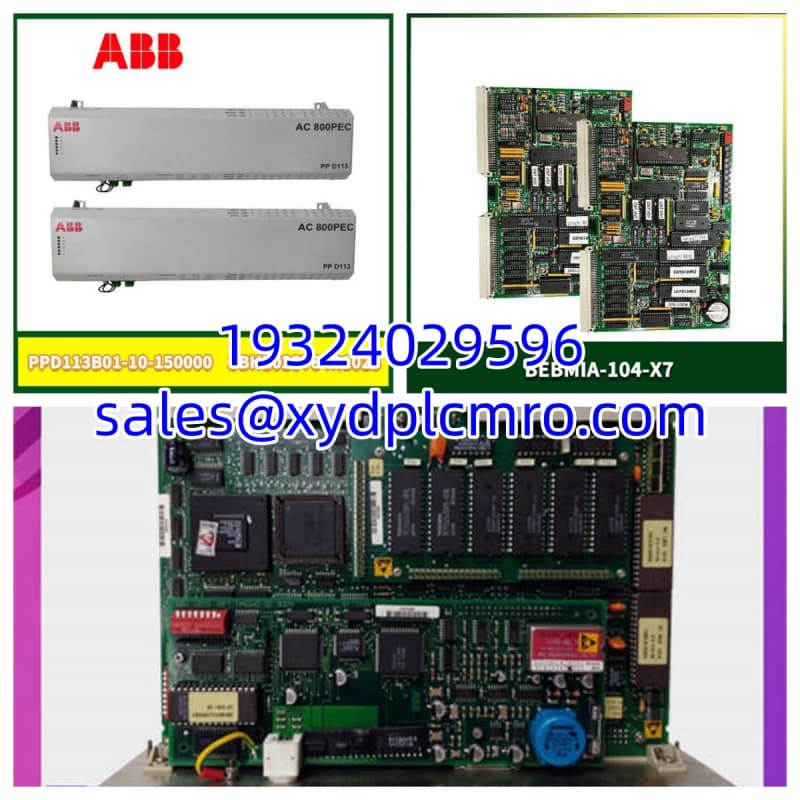
I’ve seen too many plants try to squeeze modern, massive control strategies into older hardware, only to crash the system during a peak production run. The ABB PM803F (3BDH000530R1) is the AC 800F base unit you drop in when the old PM802F just can’t handle the memory load anymore. It’s the brain of the operation, cyclically scanning fieldbus signals, crunching the numbers via the application program, and firing off commands to the actuators.Why do I keep this specific board on the shelf? Because of the memory jump. It packs 16 MB of synchronous dynamic RAM, which is a massive leap from the 4 MB static RAM in the obsolete PM802F. That means you can run much larger projects without fragmenting your logic. It’s got a dedicated watchdog to prevent OS deadlocks and monitors its own internal temperature. Just a heads-up from the field: while it’s a beast, ABB notes its raw performance is about 5-10% lower than the PM802F. It’s a trade-off for the massive memory upgrade, but in 99% of process control apps, you’ll never notice the difference.
Quality SOP & Tech Pitfalls
The Lab Report (SOP)
Before I let this leave my bench, it goes through a strict gauntlet.
- Visual & Counterfeit Check: I inspect the PCB traces, the RW 855F contact rack, and the solder joints. If the conformal coating looks cheap or tampered with, it’s dead to me.
- Live Test: I mount it on a test rack, apply clean 24V DC, and check the boot sequence. The LEDs must cycle correctly without throwing fault codes.
- Memory & EDC Check: I verify the 16 MB SDRAM is recognized and the Error Detection and Correction (EDC) unit is actively checking for 2-bit errors.
- Slot Verification: I plug known-good Ethernet and Fieldbus modules into the DMA and interrupt slots to ensure the CPU recognizes them and establishes communication.
- Sealing: Anti-static bag, desiccant, heavy-duty box.
The Engineer’s Warning (Pitfalls)
- The OS Trap: This board ships naked. No OS. I once had a junior tech swap a PM803F, power it up, and wonder why the system was dead. You must load the operating system during the software installation phase, and it requires V7.1SP2a or higher. If you try to force an older firmware version onto it, you’re just asking for a timeout loop.
- Battery Retention Drop: The PM803F uses SDRAM instead of the older static RAM. Because of the higher density, the battery retention time is shorter than the PM802F. If your plant suffers a prolonged blackout and your UPS fails, that 16 MB of precious data will vanish faster than you think. Test your UPS rigorously.
Installation & Configuration Guide
Phase 1: Pre-Installation
⚠️ Lockout/Tagout the cabinet. Do not hot-swap the CPU while the plant is running unless you have a fully redundant 1:1 setup and know exactly what you’re doing. Wait 5 minutes for the capacitors to bleed off.
Take a high-res photo of the old unit’s slot configuration. Note exactly which Ethernet and Fieldbus modules are in which slots.Phase 2: Removal
Disconnect the 24V DC power cables. Unscrew the mounting brackets. The base unit is 1.6 kg, but with modules attached, it can weigh up to 5 kg. Support the bottom as you pull it out so you don’t snap the DIN clips or drop it on your boots.Phase 3: Installation
Slide the new PM803F into the rack. Transfer the modules exactly as they were. The 2 Ethernet modules must go into the DMA slots for high-speed TCP/IP comms. The 4 Fieldbus modules go into the F1-F4 interrupt slots. Seat the RW 855F contact rack firmly.Phase 4: Power-On & Testing
Apply 24V DC. Watch the status LEDs. It will likely boot into a “no OS” or “cold start” state. Connect your engineering station via Ethernet. Download the OS (V7.1SP2a+) and the application program. Verify the CPU state changes to “Run” and that all fieldbus modules are communicating without errors.
Compatible Replacement Models
| Compatibility Tier | Model | Engineering Note |
|---|---|---|
| ✅ Drop-in Replacement | PM803F (3BDH000530R1) | Exact match. Just ensure your software is V7.1SP2a or higher. |
| ⚠️ Software Compatible | PM802F (Obsolete) | The predecessor. Only 4 MB RAM. You’ll have to strip down your project logic to fit it. Not recommended unless you’re just trying to get by temporarily. |
| ❌ Hardware Mod Required | PM851AK01 / PM860AK01 | These belong to the AC 800M family. Completely different chassis, power supplies, and backplanes. Do not even try to mix them. |
Frequently Asked Questions (FAQ)
Can I hot-swap this safely?
If you have a redundant AC 800F setup (two CPUs synced via Ethernet), yes, you can swap the secondary unit, let it sync, and then failover. If you are running a single CPU? Absolutely not. You will drop all I/O communication and likely trip your plant.What’s the deal with the performance drop compared to the PM802F?
ABB’s own documentation states the PM803F is 5-10% slower in raw processing than the PM802F. But honestly? Unless you’re running ultra-high-speed motion control or massive continuous math blocks, you won’t see it. The trade-off is getting 16 MB of RAM instead of 4 MB. For modern DCS projects, the memory is worth way more than those few percentage points of CPU speed.Do I need to buy a new battery with it?
The base unit relies on battery backup for the SDRAM. If you are buying a surplus unit, I highly recommend replacing the battery module (like the AM811F) immediately. Don’t trust an old battery with your control logic.My system isn’t recognizing the new CPU. What gives?
Check your software version. The PM803F strictly requires V7.1SP2a or higher. If your Control Builder or system software is older, it simply won’t see the hardware. Also, verify the RW 855F contact rack is seated properly; a loose connection there will cause the CPU to fail initialization.Does it support SIL 3 safety functions?
The standard PM803F is a process controller. While ABB has high-integrity variants (like the 3BHE014557R0003) that integrate safety functions, the standard 3BDH000530R1 is for standard process control. If you need certified safety logic (ESD/BMS), you need the specific high-integrity hardware and Safety Builder software.