Key Technical Specifications
| Parameter | Value |
|---|---|
| Product Type | 6U VMEbus Single-Board Computer |
| Brand | Emerson / Motorola Computer Group |
| Model | MVME6100-6E-0163 |
| Processor | PowerPC MPC7457 |
| Memory | DDR (verify against nameplate) |
| Flash Storage | Flash (verify against nameplate) |
| Bus Interface | VME64x with 2eSST support |
| Network | Dual Gigabit Ethernet |
| Expansion | PMC / PMC-X sites |
| OS Support | VxWorks, Linux (verify BSP version) |
| Documentation | Confirm with OEM Programmer’s Reference Guide |
| Condition | Surplus / spare; verify firmware and configuration |
Product Introduction
This board shows up in the worst possible moment: a VME chassis is still running a critical line, the OEM support window closed years ago, and the only thing keeping the process alive is a dusty CPU board that nobody wants to touch. The Emerson MVME6100-6E-0163 is exactly that kind of legacy workhorse. It is not a new PLC, not a modern edge controller, and not something you would design from scratch today. But in plants where VMEbus racks still handle sequencing, communications, and real-time supervision, it remains a legitimate keep-alive component.Engineers choose it because it sits in an existing VME backplane and does not force a full architecture rewrite. The MPC7457 processor, dual Gigabit Ethernet, and 2eSST VMEbus interface give it enough headroom for communication handling, data aggregation, and supervisory control. The -0163 variant is documented with DDR memory and Flash storage, but I would still verify the installed memory, firmware, and handle type before declaring it a match.
Quality SOP & Tech Pitfalls
The Lab Report (SOP)
- Visual and counterfeit inspection — board surface, connectors, handle type, and labeling checked.
- Nameplate verification — full model string, revision, serial number, and memory configuration recorded.
- Bench power-up — installed in a compatible VME test chassis to confirm boot, LED status, and self-test.
- Ethernet and serial check — network ports and console/serial interfaces verified for basic link and response.
- Memory and Flash validation — basic read/write and configuration checks performed.
- Firmware logging — firmware version, boot image, and configuration captured before anti-static packing.
The Engineer’s Warning (Pitfalls)
- Do not treat every MVME6100 as identical. The variants differ in memory and mechanical details. Swapping the wrong revision can create boot failures or configuration mismatches.
- Firmware and boot images matter more than the part number here. I have seen a “matching” MVME6100 come up clean on power but fail to join the application because the boot image, network configuration, or VME address map did not match the old board.
- These boards often live in old VME racks with oxidized backplane contacts. A marginal slot can look like a dead CPU. Always test in a known-good slot before blaming the board.
Installation & Configuration Guide
- Pre-Installation
- ️ Follow site safety and change-control procedures. Place the VME rack and associated process in a safe state.
- Photograph the installed board, slot position, handle type, jumpers, and LED status.
- Record firmware version, boot configuration, network settings, and VME address assignments.
- Removal
- Label all external cables connected to the front panel.
- Unlock the ejector handles and remove the board without forcing the backplane connector.
- Store the removed board in an anti-static bag and label it as removed-from-service.
- Installation
- Install the replacement MVME6100-6E-0163 in the same slot unless system documentation requires re-mapping.
- Verify the handle type matches the chassis and adjacent boards.
- Seat the board evenly and close the ejector handles to ensure full backplane engagement.
- Reconnect only the documented cables.
- Power-On & Testing
- Restore power to the VME chassis.
- Confirm boot sequence, LED indicators, and console output.
- Verify Ethernet link, IP configuration, and application startup.
- Check VMEbus communication, I/O mapping, and alarm status before returning the system to normal operation.
Compatible Replacement Models
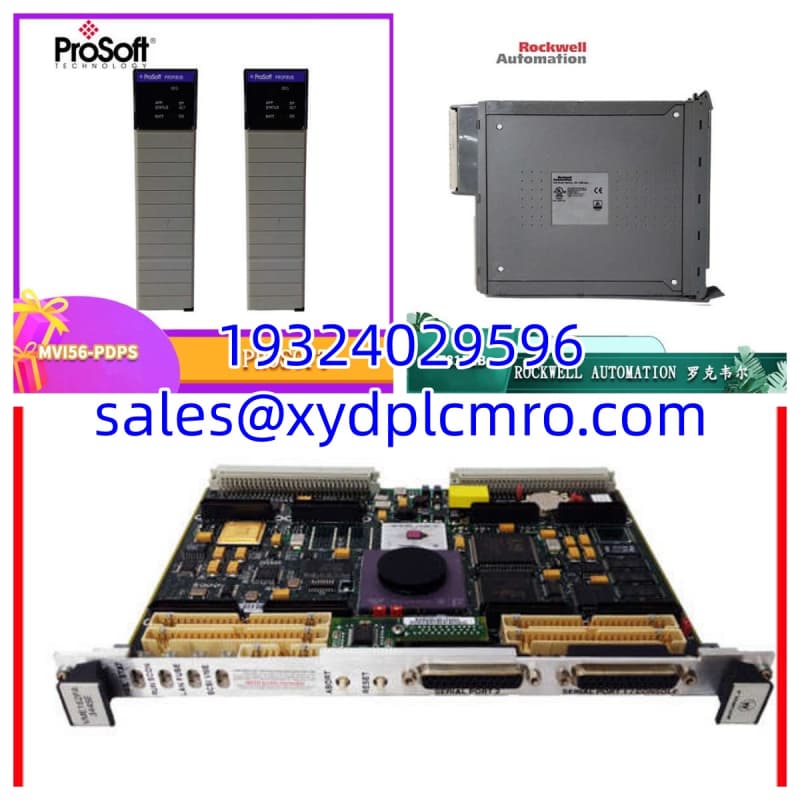
- Drop-in Replacement: Another MVME6100-6E-0163 with matching memory, firmware, and handle type. This is the lowest-risk swap.
- ️ Software Compatible: Other MVME6100 variants may function in the same chassis, but memory size, boot image, and configuration may need adjustment. Plan engineering time for verification.
- Hardware Mod Required: Non-MVME6100 processor boards, different VME form factors, or unrelated Emerson I/O modules should not be forced into the slot. A full slot map, backplane, and software review would be required.
Frequently Asked Questions (FAQ)
Q: Is the MVME6100-6E-0163 a PLC?
No. It is a VMEbus single-board computer. It can run control and communication applications, but it is not a drop-in PLC replacement unless the existing software architecture already supports it.Q: Can I hot-swap this board?
Only if the site procedure and VME chassis design explicitly allow it. Many legacy VME systems are not maintained for safe hot replacement. If the process is critical, schedule a controlled shutdown.Q: Will any MVME6100 board work as a replacement?
Not automatically. The -0163 variant is documented with DDR memory and Flash storage, but other variants differ. Mismatched memory or firmware can prevent boot or break application behavior.Q: Does it still run VxWorks?
Historically, yes. The MVME6100 family has supported VxWorks and Linux BSPs, but license status, BSP availability, and compiler compatibility must be verified with the current software package.Q: Is this still available as new original stock?
Availability varies. Most units in the market are surplus, refurbished, or verified spare inventory. Request photos of the nameplate, connectors, and firmware screen before purchase.Q: What is the most common failure mode?
Boot configuration errors, firmware mismatches, marginal VME slot contacts, and failed Ethernet links. The board itself can be healthy while the configuration or backplane connection causes the fault.Q: How do I avoid a bad swap?
Match the full model number, memory size, handle type, firmware version, and slot position. In VME systems, “same family” is not the same as “same board.”