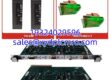
Product Introduction
A single faulty sensor input on a ship’s engine monitoring system can trigger a cascade of false alarms, distracting the watchkeeper from a genuine issue. The Kongsberg RSER200-4 is designed to prevent this by providing reliable, isolated signal conditioning at the source. It acts as the critical first step in the data acquisition chain, ensuring the K-Chief 500 system receives clean, accurate data.This module features four independent analog input channels, a practical number that balances density with channel isolation. In my experience, this 4-channel design simplifies troubleshooting; if one channel is compromised by electrical noise, it’s less likely to affect the others compared to higher-density cards. This design choice is actually quite clever for the electrically noisy environment of an engine room.

Key Technical Specifications
| Parameter | Value |
|---|---|
| Product Model | RSER200-4 |
| Manufacturer | Kongsberg Maritime |
| (Formerly Norcontrol Automation) | |
| Product Series | K-Chief 500 DCS |
| Module Type | Remote Signal Processing Module |
| Input Channels | 4 x Analog Input |
| Input Signal Type | Configurable (mA / V) |
| Channel Isolation | Yes (Channel-to-Bus) |
| Supply Voltage | 24 VDC (nominal) |
| Mounting | DIN Rail / K-Chief Rack |
| Protection Rating | IP20 |
| Operating Temp. | 0°C to 55°C |
Application Scenarios & Pain Points
The real value of a module like the RSER200-4 becomes apparent during a critical maneuver. Imagine a chief engineer trying to diagnose a slight vibration in the main engine. He needs to trust the data coming from the vibration sensors implicitly. A poorly conditioned signal from a failing input module could look like a serious mechanical fault, leading to an unnecessary and costly shutdown. This module’s job is to filter out the electrical “noise” from the harsh marine environment and present a clean, reliable signal to the control system, giving the engineer the confidence to make the right call.
- Main Engine Monitoring: It’s the go-to module for connecting critical sensors like lube oil pressure transmitters, jacket water temperature probes, and exhaust gas thermocouples. The channel isolation is vital here to prevent a ground fault on one sensor from taking down multiple readings.
- Auxiliary Generator Sets: For monitoring diesel generators, the four channels are perfectly suited for a small package of key parameters—oil pressure, coolant temperature, RPM, and battery voltage—all processed locally before being sent to the central control room.
- Tank Level Monitoring: Would you trust a single, unconditioned signal for a ballast or fuel tank level? The RSER200-4 takes the raw signal from the level gauge, conditions it, and provides a stable reading to the cargo control system, preventing costly overfill or underfill situations.
- HVAC and Refrigeration: On a container ship or cruise liner, this module can monitor temperatures and pressures in the complex HVAC and provision refrigeration systems, ensuring cargo and passenger comfort without overloading the main DCS processors.
Quality Control Process
We know that in marine automation, reliability isn’t a feature—it’s a requirement. A module that works on the bench but fails in a salty, vibrating engine room is useless. Our QC process for the Kongsberg RSER200-4 is built to simulate these realities.
- Inbound Inspection: We verify the source traceability and perform an anti-counterfeit check on the Kongsberg serial number. The unit undergoes a rigorous visual inspection for any signs of corrosion on the PCB or terminal blocks—a common issue with salvaged marine parts.
- Live Functional Test: The module is installed in a test rack with a K-Chief 500 processor. We verify the boot sequence, check all LED indicators, and confirm communication over the dual redundant CAN bus (the backbone of the K-Chief 500 system).
- Signal Conditioning Test: This is the critical step. We use a Fluke 754 process calibrator to inject precise 4-20mA and 0-10V signals into each of the four channels. We then verify that the module correctly processes and reports these values to the controller with the proper scaling and linearization.
- Isolation Verification: We perform an insulation resistance test (using a 100V megger, as per the spec) between the input channels and the bus to ensure the galvanic isolation is intact. This prevents ground loops, which are a nightmare to troubleshoot on a ship.
- Final QC & Packaging: After passing all tests, the unit is wiped clean, sealed in an anti-static bag, and packaged with sufficient bubble wrap to prevent transit damage. A QC Passed label with the date is affixed to the package.

Installation Pitfalls Guide
Swapping out a module in a live DCS is a high-stakes task. A small mistake can lead to false alarms or, worse, a loss of monitoring for critical equipment. Here are the most common pitfalls we’ve seen.
- Firmware Version Mismatch: The K-Chief 500 system is sensitive to firmware versions across its modules. A new RSER200-4 might have a newer firmware revision that the main RCU (Remote Control Unit) doesn’t recognize, causing a module fault. Always check the firmware version of the failed unit and compare it to your system’s compatibility list before commissioning the new one.
- Incorrect Channel Configuration: The input type (e.g., 4-20mA vs. 0-10V) is often configured via software in the MIMIC (Maintenance and Information and Configuration) tool. If you just plug in the new module, it might default to a generic setting. You must upload the correct configuration from the system to the new module, or your sensor readings will be nonsense.
- CAN Bus Termination: The K-Chief 500 uses a dual CAN bus for communication. While the RSER200-4 itself isn’t a termination point, disturbing the bus wiring can cause issues. Take a clear photo of the CAN bus wiring on the adjacent modules before you start. It’s easy to cross the CAN1 and CAN2 lines, which will cause communication errors across the entire network segment.
- Power Supply Sequencing: While rare, issues can arise if the 24VDC supply is unstable or if there’s a significant voltage drop on the line. If you’re replacing multiple modules, power them up one by one and verify they are recognized by the RCU before moving to the next. Don’t power up the whole rack at once and hope for the best.
- ESD Damage: It’s easy to get complacent, especially in the cramped, sometimes humid environment of a ship’s control room. But the electronics inside this module are sensitive. Skipping the wrist strap just once can fry the mainboard on first power-up. Ground yourself properly.