 Tel:
Tel:  Email:
  WhatsApp:
 Description
Key Technical Specifications
- Protection Target: Medium to Large Induction & Synchronous Motors
- Cybersecurity: AAA, RADIUS, RBAC, and Syslog (NERC CIP compliant)
- Diagnostics: Advanced motor diagnostics with high-end fault and disturbance recording
- Connectivity: Wi-Fi enabled for local configuration and diagnostics
- Logic: Extensive, user-customizable programmable logic
- Physical Design: Withdrawable (Plug-in) chassis design for simplified testing
- Configuration: Flexible configuration capabilities for various motor applications (VFD driven, cyclic loading, etc.)
- Environmental: Monitors environmental conditions to help reduce system downtime
Product Introduction
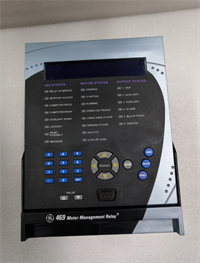
Let’s be real: when a 5MW synchronous motor trips unexpectedly in a cement plant or an oil refinery, the cost of downtime hits six figures before lunch. That is exactly why engineers reach for the GE Multilin 869. It isn’t just a basic overcurrent relay; it is a comprehensive management system designed to keep massive induction and synchronous motors running, or at least tell you exactly why they stopped.The real value here isn’t just the protection algorithms—it’s the visibility. This relay gives you deep diagnostic data and high-end fault recording that actually helps you figure out if the problem was the motor, the driven load, or the power supply. Plus, with modern cybersecurity features like RADIUS and AAA built-in, it won’t get you flagged during a NERC CIP audit. The specific configuration you have (869-E-P5-P5-B5-R…) includes RTD inputs and a withdrawable design, which means you can swap the unit out for testing without ripping out all your field wiring—a massive time saver during annual maintenance.
Quality SOP & Tech Pitfalls (The Reality Check)
The Lab Report (SOP)
Before this unit leaves our warehouse, it goes through a strict protocol to ensure it survives the trip to your site:
- Visual & Counterfeit Check: We inspect the PCB for any signs of corrosion, rework, or non-OEM soldering. We verify the holographic GE labels match the serial number.
- Live Bench Test: We rack the unit into a test chassis and power it up. We verify the boot sequence completes without memory errors and that the front panel HMI is responsive.
- Port Verification: We test the Ethernet and serial ports to ensure they handshake correctly.
- Firmware Logging: We record the current firmware revision.
- Anti-Static Sealing: The unit is wrapped in industrial-grade anti-static foam and sealed in a moisture-barrier bag.
The Engineer’s Warning (Pitfalls)
Here is where people mess up: The Programmable Logic. The 869 allows for extensive custom logic. If you are replacing an old unit, do not assume the new one comes pre-loaded with your site’s specific logic. If you just plug it in and power it up, the motor might not start, or worse, it might not trip when it should. Always have your EnerVista configuration file ready to download before you begin. Also, be careful with the withdrawable mechanism—if you force it while the rear terminals are misaligned, you will bend the pins, and that is a very expensive repair.
Installation & Configuration Guide
Here is the 30-minute swap guide to get this back online safely.
- Pre-Installation & Safety
- ⚠️ WARNING: Ensure the motor control center (MCC) is de-energized and locked out/tagged out (LOTO). Verify absence of voltage.
- Download the latest configuration file from your engineering station using the EnerVista software. Do not rely on the relay’s internal memory if the old unit is corrupted.
- Removal
- Open the front door of the relay compartment.
- Disconnect the front panel communication cables (if attached).
- Loosen the retaining screws on the faceplate.
- Gently pull the unit straight out of the chassis. Do not wiggle it side-to-side excessively.
- Installation
- ⚠️ CRITICAL: Compare the model number on the side label of the new unit against the old one. Ensure the CT/PT ratios and RTD options match your application.
- Align the new 869 with the guide rails of the chassis.
- Slide the unit in smoothly until the rear connector seats fully. You should feel a firm mechanical stop.
- Tighten the faceplate retaining screws.
- Power-On & Testing
- Remove LOTO and apply control power.
- Watch the boot sequence. Ensure there are no “Self-Test” or “Hardware Fail” LEDs illuminated.
- Connect your laptop via the front USB or Ethernet port.
- Upload the Configuration: Send the site-specific settings and programmable logic to the relay.
- Verify CT/PT secondary readings match your handheld meter.
Compatible Replacement Models
The Multilin 869 is a highly configurable platform. The base model remains the same, but the suffixes change the hardware capabilities.
- ✅ Drop-in Replacement: GE Multilin 869 (Exact Suffix Match). You must match the suffixes (like the -P5-P5-B5… in your model) exactly. The “P5” usually denotes specific power supply or I/O options, and “B5” often relates to communication or logic packages. A mismatch here means missing inputs or power incompatibility.
- ⚠️ Software Compatible (Hardware Mod Required): GE Multilin 469 or 850. The 469 is the older generation. While the protection philosophy is similar, the physical footprint, rear terminal block, and configuration software (EnerVista 869 vs. 469) are completely different. You cannot swap these without rewiring the back of the panel.
- ⚠️ Upgrade Path: GE Multilin 869 (Newer Firmware Revision). If you buy a unit with a much newer firmware date code, it is hardware compatible, but you may need to update your EnerVista software on your laptop to communicate with it.
Frequently Asked Questions (FAQ)
Can I hot-swap this relay while the motor is running?
Technically, the Multilin 869 has a withdrawable design which supports hot-swapping for the relay itself without disturbing field wiring. However, pulling the brain out of the motor protection system while the motor is running removes all electrical protection. If a fault occurs while the relay is out, the motor could be destroyed. Only do this if you have redundant protection or the motor is safely stopped.My old relay has a slightly different suffix. Will this work?
Probably not directly. The suffixes in the GE Multilin 869 string (like the P5, B5, R, S in your model) dictate the power supply voltage, communication protocols, and number of RTD inputs. If your old unit has “P1” (110V DC) and this one has “P5” (220V DC), it won’t power up. Always match the suffixes exactly.Does this unit support Modbus?
Yes, the 869 series is built for integration. It supports DNP 3.0, Modbus TCP/RTU, and IEC 61850 depending on the specific communication modules ordered in the suffix.I lost the password to the old relay. Can I reset it?
The 869 has robust security (including the AAA/RADIUS features mentioned in the specs). If you are locked out, you usually cannot just “reset” it without wiping the configuration. You will likely need to use the EnerVista software to restore access, which might require wiping the device settings.Is the EnerVista software free?
GE typically provides the EnerVista launchpad and basic software for free on their website, but you need to ensure you have the specific 869 software package installed to configure this specific model.What does the “Wi-Fi” feature actually do?
It’s not for browsing the web. It allows you to connect a tablet or laptop directly to the relay locally for commissioning and diagnostics without having to find a Cat5 cable or serial cable in a messy MCC room. It speeds up troubleshooting significantly.