 Tel:
 Email:
 WhatsApp:
Description
Key Technical Specifications
| Parameter | Detail |
|---|---|
| Manufacturer | Foxboro (Invensys / Schneider Electric legacy) |
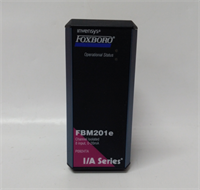
| Model | FBM201 |
| Part Number | P0914SQ |
| Product Type | 8-Channel Analog Input FBM |
| System Platform | Foxboro I/A Series, Compact 200-Series FBM |
| Input Type | 0–20 mA DC, 2-wire analog inputs |
| Channels | 8 isolated analog inputs |
| A/D Conversion | Sigma-delta per channel |
| Update Rate | New reading every 25 ms per channel |
| HART Compatibility | Electrically compatible with standard HART signals |
| Channel Isolation | Each channel isolated from other channels and earth ground |
| Isolation Rating | 600 V AC for 1 minute between channels/ground |
| Input Impedance | Nominal 61.5 Ω |
| Loop Protection | Current limiting; short-circuit current approximately 100 mA |
| Mounting | Compact 200-Series baseplate, DIN-rail cabinet |
| Environment | Suitable for ISA S71.04 G3 / harsh cabinet environments |
Product Introduction
If you have ever chased a noisy 4–20 mA loop in an old I/A Series cabinet, you know the FBM201 is one of those modules that either works quietly for years or becomes the reason your trend looks like a seismograph. The P0914SQ version is the standard 8-point 0–20 mA analog input. It is not a universal AI card. It is not a thermocouple module. It is not an RTD module. It is built for current loops.Engineers keep this module in rotation because each channel has its own sigma-delta converter and channel-to-channel isolation. That matters when one bad transmitter should not drag down the rest of the card. The 25 ms per-channel update is adequate for most process loops, and the HART electrical compatibility means it can sit on HART-capable loops without immediate hardware conflict. Just remember: HART compatibility is not the same as full HART device management. If you need HART diagnostics, verify whether FBM214/FBM216 or another HART-specific module is required.

Quality SOP & Tech Pitfalls
The Lab Report (SOP):
Every unit gets a real bench check. First, visual inspection for bent DIN pins, cracked housing, corrosion, and correct P0914SQ labeling. Then a live test on a 200-Series baseplate: verify power-up, module recognition, and analog channel response using a calibrated 4–20 mA source. After that, insulation and continuity checks with a Fluke 115 or equivalent. Firmware/revision data is logged. Finally, anti-static bag, moisture barrier, and rigid packing. Photos and a basic test report can be provided.The Engineer’s Warning (Pitfalls):
The most common mistake is confusing FBM201 with FBM201b, FBM201c, or FBM201d. The base FBM201 P0914SQ is a 0–20 mA input module. The “b/c/d” versions handle mV or voltage inputs. Swapping the wrong revision into a live baseplate will not magically scale the signal. I have seen a crew replace an FBM201 with a non-matching variant and spend two hours blaming the transmitter before noticing the part number on the label. Also check the terminal assembly. The TA determines how loop power, shielding, and field wiring land. Wrong TA, wrong day.
Installation & Configuration Guide
- Pre-Installation:
⚠️ Confirm whether the loop is tied to interlocks, ESD logic, or critical alarms. If yes, do not pull the module during operation unless your site procedure explicitly allows it. Photograph the module label, slot position, baseplate address, and terminal wiring. - Removal:
Label each field pair. Verify loop power status. Remove the two module retaining screws. Slide the FBM out without disturbing the baseplate or terminal assembly. - Installation:
Verify the replacement is Foxboro FBM201 P0914SQ. Seat it firmly into the correct Compact 200-Series baseplate position. Reconnect field wiring exactly as labeled. Confirm loop polarity and terminal-assembly type. - Power-On & Testing:
Verify 24 V DC baseplate power. Check module LEDs and I/A diagnostics. Inject 4 mA and 20 mA on at least one channel and confirm the controller reading. Test HART electrical compatibility only if the loop design allows it. Save documentation and update the spare-parts record.
Compatible Replacement Models
| Compatibility | Model | Notes |
|---|---|---|
| ✅ Drop-in Replacement | Foxboro FBM201 P0914SQ | Same 8-channel 0–20 mA AI; verify TA and baseplate slot |
| ⚠️ Software Compatible | Foxboro FBM201e P0924TR | Similar 8-point 4–20 mA AI; may require configuration/revision check |
| ❌ Hardware Mod Required | FBM201b/c/d, FBM202, FBM203 | Different signal types; not a direct swap for 0–20 mA loops |
Frequently Asked Questions (FAQ)
Is FBM201 P0914SQ a 4–20 mA or 0–20 mA module?
It is specified as an 8-channel 0–20 mA analog input. Many 4–20 mA transmitters will work because 4–20 mA sits within that range, but confirm scaling in the controller.Can it read HART devices?
It is electrically compatible with HART signals, but it is not a dedicated HART management module. If you need HART variable access or diagnostics, verify whether FBM214/FBM216 is required.Can I hot-swap it?
Compact 200-Series FBMs are designed for removal without disconnecting field terminal cables, but do not assume hot-swap is safe on critical loops. Follow your site procedure and Foxboro documentation.What terminal assembly does it need?
The correct TA depends on loop power, shielding, and wiring style. Match it to the existing installation or the current Foxboro manual.Is this module obsolete?
The I/A Series Compact 200-Series platform is legacy. Units typically circulate as new surplus or tested used. Verify current OEM availability with Schneider Electric / AVEVA.Do you provide test reports?
Yes. A basic test report can include module ID, power-up status, channel checks, insulation/continuity results, and photos. Final acceptance must follow your plant commissioning procedure.