 Tel:
 Email:
 WhatsApp:
Description
Key Technical Specifications
| Parameter | Value | Source Reliability |
|---|---|---|
| ABB part number | 3BSE002616R1 | High — consistent across listings |
| ABB model name | PFSK 130 | High |
| Description | Channel control unit | High |
| Product type | Control_System_Accessory | High |
| Net weight | 0.6 kg | High |
| Country of origin | Sweden (SE) | High |
| Operating voltage | 24 VDC | Low — reseller claim |
| I/O points | 4 (per one reseller) | Very low — contradicted elsewhere |
| Ambient temperature | 0–85 °C (one listing) / 0–50 °C (another) | Very low — conflicting |
| Program capacity | 64 MB / 19 MB (conflicting claims) | Very low |
| Mounting | Control room installation | Medium |
Product Introduction
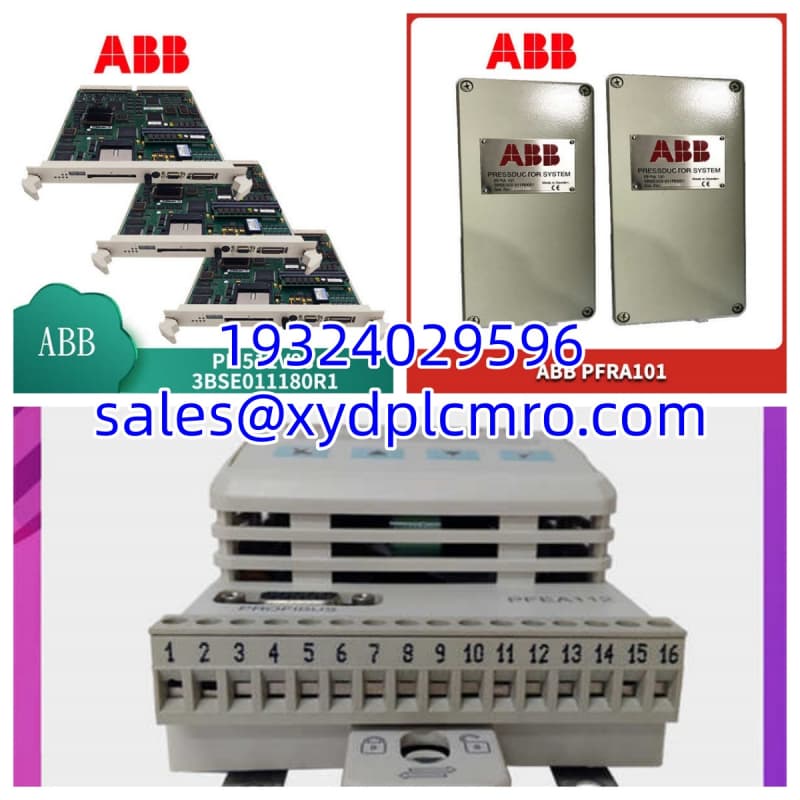
Here’s the honest version: nobody buys this part because they want to. They buy it because a board failed on a Saturday night and the plant is down.The PFSK130 (3BSE002616R1) is an ABB channel control unit from the Advant OCS generation of control systems. It sits in the control room, reads sensor data, and drives actuators based on configured logic — a workhorse I/O and channel control board rather than a processor. ABB’s own catalog now carries it under a spare-parts frame size, which tells you everything about where it sits in the product lifecycle.Why do engineers still fight for these? Because Advant OCS and AC450-based systems are still running in power plants, water treatment, and process lines around the world, and pulling a healthy legacy controller out of service costs far more than sourcing a board. The 0.6 kg form factor means it’s a card, not a chassis — swap time is measured in minutes, not shifts. My subjective note: the part itself is fine. The real risk is buying from a reseller who pasted the wrong spec sheet onto the listing. I’ve seen engineers order against “4 I/O points” and get a board that doesn’t match their slot configuration.
Quality SOP & Tech Pitfalls
The Lab Report (SOP).
Start with a visual and counterfeit check — nameplate font, part number etching, PCB edge condition, connector plating. A lot of “new” ABB surplus boards are cleaned-up used units with reprinted labels. Then verify the part number physically matches 3BSE002616R1 on the board itself, not just the box. Bench test where possible: power the board on a test rack, confirm the boot LED sequence, and check insulation resistance between signal terminals and chassis with a megohmmeter. Log the serial and any firmware revision. Photograph terminal and jumper settings. Then anti-static bag, desiccant, sealed box.The Engineer’s Warning (Pitfalls).Two mistakes cause most of the downtime I’ve seen with parts like this.First: buying on the listing, not the datasheet. The spec sheets floating around for PFSK130 are fabricated. One reseller claims 220 V, 5 A, 5 ohm. Another claims PCI Express 2.5 Gbps throughput. Neither is an ABB document. If you spec this into a shutdown plan based on a reseller page, you’ll be wrong.Second: not photographing the old board before you pull it. Jumper positions, DIP switches, slot number, and cable orientation all have to be replicated. Skip it and you’ll spend your shutdown troubleshooting a board that was never defective.Field story: a technician replaced a failed channel control board on an old Advant system during a planned outage. He didn’t photograph the jumper block. The replacement booted, the CPU saw it, and every analog output read zero. We lost four hours finding out the jumper bank was set to the wrong range. The board was fine. The paperwork was missing.
Installation & Configuration Guide
Phase 1 — Pre-Installation (⚠️)
- ⚠️ Put the controller into a safe state and isolate the process. Do not pull a channel control board from a running Advant OCS rack.
- ⚠️ Shut down the rack power supply and wait at least 60 seconds for stored energy to discharge.
- ⚠️ Photograph everything: slot position, jumper/DIP settings, terminal wiring, shield grounding, and the CPU’s I/O configuration screen.
Phase 2 — Removal
4. Label every cable at both ends before disconnecting.
5. Release the retention clips or screws. Pull straight out — do not rock the board or pry on the connector.
6. Bag the old board and keep it. If the replacement doesn’t work, you’ll want it back.Phase 3 — Installation
7. Set the jumpers and DIP switches to match your photographs exactly. This single step prevents most startup failures on legacy ABB boards.
8. Confirm the slot number matches the CPU’s I/O configuration. Wrong slot equals a CPU fault on power-up.
9. Seat the board fully into the backplane connector before tightening anything.
10. Reconnect signal cables and ground the shield at one end only.Phase 4 — Power-On & Testing
11. Restore rack power. Watch the boot LED sequence and confirm the CPU registers the board as present and healthy.
12. Apply a known test signal to one channel and read it back through the CPU.
13. Verify zero and span on analog channels.
14. Release to production only after two consecutive stable readings.

Compatible Replacement Models
- ✅ PFSK130 / 3BSE002616R1 (same part number). The only true drop-in. Confirm it’s new-in-box and that the board marking matches the part number. Surplus prices range widely — I’ve seen listings from roughly 92 up to about 1,600 equivalent for this part, which tells you the market is unregulated.
- ⚠️ Other PFSK-series channel control boards. Same family, different channel count or revision. Requires a datasheet comparison and likely a CPU I/O reconfiguration. Budget 2–4 hours and only attempt this with ABB technical support on the line.
- ❌ Migrating to ABB 800xA or a modern DCS. Correct long-term answer, but it means new hardware, new wiring, and a full control strategy rebuild. Do not attempt this as a repair — only as a planned capital project.
Frequently Asked Questions (FAQ)
Is the PFSK130 still available from ABB?
Not as an active catalog item. ABB’s own data lists it under a spare-parts frame size, and resellers describe it as a discontinued product. Expect to source it through the surplus channel.Why do the specs look different on every website?
Because most of them are wrong. I’ve seen this part listed at 4 I/O points, 220 V / 5 A, and with PCI Express bandwidth figures. None of those come from ABB. Trust the OEM datasheet.Can I hot-swap it?
No. Isolate the process, shut down the rack power, and wait 60 seconds before touching the board.What condition will I actually receive?
If a seller says “new original,” ask for photos of the actual nameplate and serial number. In the surplus market, “new” often means “cleaned used.”How long is the warranty?
One year is the common claim from surplus channels. Get it in writing — verbal promises don’t help when a board fails in month three.Do I need to reprogram the CPU after installing it?
No reprogramming, but you must match the jumper/DIP settings and slot number from the old board. Miss that and the CPU will fault at power-up.What’s the realistic lead time?
It depends entirely on who has stock. Some channels claim immediate availability; others quote three days. Confirm in writing before you schedule the outage.