Key Technical Specifications
| Parameter | Specification |
|---|---|
| Model | TRICONEX 3721 |
| Module Type | TMR Analog Input (AI) |
| Channels | 32 differential, DC-coupled |
| Input Range | 0–5 VDC (+6%) or ±5 VDC; 0–20 mA with external 250 Ω shunt |
| Update Rate | 10 ms (all channels) |
| Resolution | 12-bit or 14-bit programmable |
| Accuracy | <0.15% FSR from 0°C to 60°C |
| Input Impedance | ≥10 MΩ DC (typical) |
| Power-Off Resistance | ~140 kΩ DC (typical) |
| Leg-to-Leg Isolation | ~420 kΩ typical |
| Overvoltage Protection | 150 VDC / 115 VAC continuous |
| CMRR | −85 dB (DC to 100 Hz) |
| Safety Rating | SIL 3, IEC 61508, TUV AK6 |
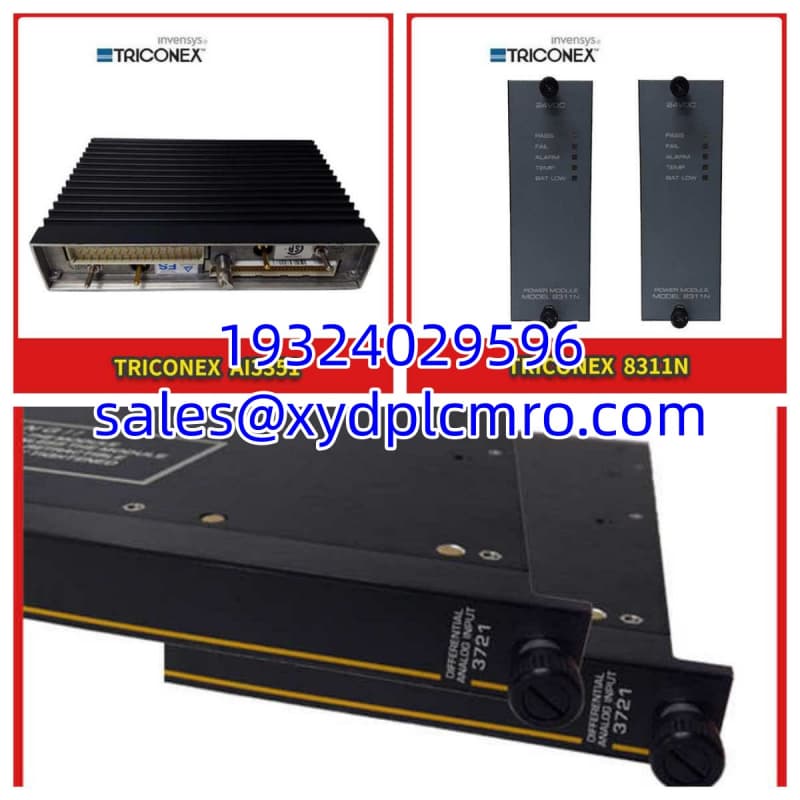
| Diagnostics | PASS, FAULT, ACTIVE, FIELD LEDs |
| Color Code | Yellow (Tricon analog AI family) |
| Mounting | Standard Tricon chassis slot, hot-swappable |
| Operating Temperature | 0°C to +60°C (verify against OEM datasheet) |
| Weight | ~2.0–2.2 kg |
Product Introduction
If you have ever chased a drifting temperature reading through a Tricon ESD rack, you know the 3721 is one of those modules that either saves your morning or ruins your week. It is a 32-channel differential analog input module for the Tricon TMR safety system, sitting in the same family as the 3720 and 3704E. Three independent channels sample the same transmitter signal, the controller takes the mid-value, and a single bad channel does not trip the plant. That is the entire value proposition.Engineers keep the 3721 in pressure, temperature, level, and flow safety loops because 0.15% FSR accuracy at 10 ms update is plenty tight for most SIL 3 applications, and the 150 VDC / 115 VAC overvoltage protection survives the kind of ground loops you find in older refineries. The differential, isolated design handles noisy transmitter runs better than the older single-ended 3720. One caveat: this module requires the correct 3700A-series terminal board and a Tricon main processor firmware that actually recognizes it. I have seen a perfectly good 3721 sit in a chassis for two days showing FAULT because the MP firmware was too old to initialize it. Check the firmware first.
Quality SOP & Tech Pitfalls
The Lab Report (SOP)
- Visual & Counterfeit Check: Inspect PCB, connectors, and label format. Verify “TRICONEX 3721” and yellow color code. Check for corrosion, reflow cracks, or bent backplane pins.
- Terminal Board Compatibility Check: Confirm the correct 3700A-series terminal board is available. Wrong terminal board = wrong pinout = bad readings or no readings.
- Live Test on Tricon Test Rack: Install in a known-good Tricon chassis with verified power supply (8311/8312). Confirm module initializes without FAULT.
- Channel Accuracy Spot Check: Inject known 0–5 VDC and ±5 VDC signals on multiple channels. Verify readings within <0.15% FSR at 12/14-bit resolution using TriStation 1131.
- TMR Voting Verification: Simulate a single-channel deviation and confirm mid-value voting holds without module FAULT.
- Isolation Check: Verify field-to-logic isolation and leg-to-leg resistance per OEM procedure.
- Firmware Logging: Record Tricon MP firmware version. The 3721 typically requires Tricon v10.2 or later for full support.
- ESD Packaging: Anti-static bag, foam, rigid carton. Test report available on request.
The Engineer’s Warning (Pitfalls)Two mistakes that waste days:
- Wrong terminal board or wiring map. The 3721 is differential. If you wire it like a single-ended 3720, half your channels read garbage and the other half read nothing. Photograph the old terminal board wiring before you touch a single screw.
- MP firmware too old for the module. The 3721 will not initialize cleanly on very old Tricon firmware revisions. I once watched a crew swap three “bad” 3721 modules before someone checked the MP firmware. It was v9.x. The module needed v10.2+. Check TriStation before you pull the old card.
Also: do not ignore the FIELD LED. PASS/ACTIVE tells you the module is talking to the backplane. FIELD tells you the analog signals are actually valid. If FIELD is off but PASS is on, your problem is in the wiring, the terminal board, or the transmitter — not the module.
Installation & Configuration Guide
30-Minute Swap Procedure
- Pre-Installation ⚠️
- Obtain work permit and MOC approval. This is a safety system.
- Open TriStation 1131 and record the current MP firmware version.
- Photograph the terminal board wiring, channel assignments, and LED states. This is your rollback.
- Confirm the replacement 3721 matches the original: 32-ch differential, yellow module, correct terminal board.
- Removal
- If the system supports online replacement, confirm the other TMR channels are healthy.
- Label all field wires at the terminal board.
- Loosen the module retainers and pull the 3721 straight out. Do not rock it.
- Installation
- Verify the terminal board matches the 3721 pinout. This is the most common failure point.
- Seat the new 3721 firmly into the correct slot.
- Tighten the retainers to OEM torque spec.
- Reconnect field wiring exactly as photographed.
- Power-On & Testing
- Verify PASS and ACTIVE LEDs illuminate. Check FIELD status.
- In TriStation, confirm all 32 channels report valid values with no FAULT.
- Spot-check at least four channels against known transmitter readings.
- Perform a partial stroke or loop check on at least one safety function if procedure allows.
- Document serial number, slot position, and firmware version in the maintenance log.
Compatible Replacement Models
| Tier | Model | Compatibility | Notes |
|---|---|---|---|
| ✅ Drop-in | TRICONEX 3721 (same revision) | 100% match | Same model, same terminal board. Plug-and-play. |
| ⚠️ Software Compatible | TRICONEX 3720 | Same family, fewer channels | 16-ch single-ended AI. Requires rewiring and TriStation reconfiguration. Not a direct swap. |
| ⚠️ System Upgrade | TRICON CX Analog Input | New platform | Requires full migration: new chassis, reprogramming, FAT/SAT. Not a module swap. |
| ❌ Not Compatible | TRICONEX 3704E | Different function | 8-ch isolated AI, different terminal board and pinout. |
| ❌ Not Compatible | TRICONEX 3625 / 3664 | Different function | Digital I/O modules. Do not substitute. |
| ❌ Not Compatible | TRICONEX 4352B / 4353 | Different function | Tricon Communication Modules (TCM), not analog I/O. |
Frequently Asked Questions (FAQ)
Q: Can I hot-swap a 3721 without tripping the process?
Yes. The Tricon TMR architecture allows online replacement as long as the remaining channels are healthy. But get your MOC approved first. And photograph the wiring. I cannot stress that enough.Q: What is the difference between the 3721 and the 3720?
The 3721 has 32 differential channels; the 3720 has 16 single-ended channels. Differential inputs reject common-mode noise much better. They are not wired the same way, and they use different terminal boards. Do not treat them as interchangeable.Q: Does the 3721 support 4–20 mA inputs?
Indirectly. The native input is voltage (0–5 VDC or ±5 VDC). For 4–20 mA, you typically use an external 250 Ω shunt resistor to convert current to voltage. Check your terminal board — some Tricon terminal assemblies include the shunt.Q: What firmware version do I need?
The 3721 generally requires Tricon MP firmware v10.2 or later. Verify in TriStation 1131 before you order a replacement. An old MP firmware is the fastest way to get a FAULT LED on a perfectly good module.Q: Is this module still available new from Schneider/Triconex?
The 3721 is a legacy Tricon module. Schneider provides lifecycle support, but new production availability is limited. Most units in the market are surplus or tested refurbished. Always request the serial number and confirm the terminal board type.Q: What warranty do you offer?
Standard 12-month warranty on tested units. New surplus may carry remaining OEM warranty where applicable. A test report is available on request.Q: Why is my 3721 showing PASS but no valid field readings?
PASS means the module is communicating with the Tricon backplane. If FIELD is off or readings are invalid, check: terminal board wiring, differential vs. single-ended configuration, shunt resistors for 4–20 mA loops, and whether the channel is configured correctly in TriStation. Ninety percent of the time, the problem is on the terminal board, not inside the module.