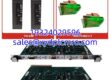
Product Introduction
In a process control loop, the integrity of your measurement data starts with the input module. The ABB AI820 (3BSE008544R1) is an 8-channel analog input module for the S800 I/O system, designed to digitize standard 0-20mA and 4-20mA current signals from field transmitters. It’s a workhorse component in thousands of installations, known for its reliability in handling critical process variables like pressure, flow, and level.This module features channel-to-channel isolation, which is a crucial design choice. It prevents ground loops and electrical noise from one faulty transmitter from corrupting data on adjacent channels. Honestly, in a noisy industrial environment, this isolation is often the difference between stable control and a headache you can’t diagnose. The module also supports HART signal pass-through, allowing you to connect and configure smart field devices without interrupting the process.

Key Technical Specifications
| Parameter | Value |
|---|---|
| Number of Inputs | 8, single-ended |
| Input Signal Type | Current, 0-20 mA or 4-20 mA |
| Resolution | 13 bits (including sign bit) |
| Channel Isolation | Yes, channel-to-channel and to bus |
| HART Protocol | Pass-through supported |
| Conversion Time | 20 ms for all 8 channels |
| Input Impedance | 50 Ω (typical) |
| Field Power Supply | 24 V DC (from TB820 terminal base) |
| Power Dissipation | 2.5 W (typical) |
| Status Indicators | Module status, I/O status LEDs |
Application Scenarios & Pain Points
The time this module earns its price is exactly when something goes wrong. I remember a commissioning issue at a pulp and paper mill where a flow transmitter’s reading was drifting wildly. The wiring was correct, and the transmitter tested fine. The problem was a lack of isolation in the I/O module, which allowed noise from a nearby variable frequency drive to bleed into the measurement. Swapping to an isolated module like the AI820 solved the problem instantly.
- Noisy Electrical Environments: When you have large motors, VFDs, or welding equipment nearby, electrical noise can corrupt analog signals. The AI820’s channel isolation acts as a barrier, protecting your control logic from false readings.
- Critical Process Monitoring: In applications where a single bad reading can trigger a costly shutdown—like monitoring reactor pressure in a chemical plant—this module’s reliability and diagnostic capabilities are essential.
- HART Device Integration: If your plant uses smart transmitters for predictive maintenance, the AI820’s ability to pass the HART signal through to the controller means you don’t need a separate multiplexer. It simplifies the architecture.
- Legacy System Upgrades: When replacing older, non-isolated I/O cards, the AI820 is often the direct solution to chronic noise issues that engineers have struggled with for years.
Case Study: The Phantom Signal
A water treatment facility was experiencing random high-level alarms in a clarifier. The on-call engineer spent hours checking the float switch and wiring. The issue was intermittent and frustrating. We suspected a ground loop. Replacing the existing I/O module with an ABB AI820 isolated the channel, and the phantom alarms stopped immediately. It wasn’t a process problem; it was an electrical one.
Quality Control Process
A module that passes a simple power-on test might still fail under load or introduce measurement errors. Our process is designed to catch those subtle issues.
- Inbound Inspection: We verify the model number (3BSE008544R1) and check the PCB for any signs of corrosion or physical damage. We pay close attention to the terminal block connections.
- Live Functional Test: The module is installed in an ABB S800 I/O station (typically with a CI801 communication interface). We confirm the controller recognizes the module without errors.
- Signal Accuracy Test: We use a calibrated loop calibrator to inject precise 4mA, 12mA, and 20mA signals into multiple channels. We then verify the digital value read by the controller matches the injected signal within the specified tolerance.
- HART Pass-Through Verification: We connect a HART communicator to one of the active channels to ensure the digital signal can pass through the module to a simulated field device.
- Final QC: After a 4-hour burn-in period, we perform a final visual check. The module is then packaged in an anti-static bag with appropriate cushioning.

Installation Pitfalls Guide
Don’t underestimate the importance of the terminal base unit. The AI820 module itself is only half of the equation. Keep these in mind and you’ll cut 90% of your rework time.
- ❗ Wrong Terminal Base: The AI820 requires a compatible terminal base unit, typically the TB820 V2. Using an incorrect base (like a TB800) will mean the module doesn’t get field power or the wiring doesn’t match. Check the hardware manual before ordering.
- ❗ Ignoring Power Consumption: Each AI820 module draws power from the ModuleBus. If you pack too many modules into a single I/O cluster, you can exceed the power supply’s capacity. Always calculate the total ModuleBus load.
- ❗ Forgetting the HART Resistor: While the module supports HART, the communication requires a minimum loop resistance (usually 250 Ω). If your loop resistance is too low, the HART communicator won’t be able to “see” the field device.
- ❗ Loose Wiring: Vibration can loosen terminal screws over time, leading to intermittent signal loss. A 4-20mA loop going open will read as 0mA, which often translates to a sensor fault or a dangerous low reading. Torque the screws to spec.
- ❗ ESD Damage: The internal electronics are sensitive. Always use a grounded wrist strap when handling the module, especially when removing it from its anti-static bag.