 Tel:
Tel:  Email:
  WhatsApp:
 Description
Technical Specifications (For Spare Parts Verification)
- Product Model: 9907-147
- Manufacturer: WOODWARD
- System Family: SPC (Simple Process Controller) / SPM (Speedtronic Process Manager)
- Module Type: Analog I/O interface card
- Input Channels: Typically 8 single-ended analog inputs (configurable for 4–20 mA or 0–10 V)
- Output Channels: Usually 4 analog outputs (4–20 mA)
- Isolation: Channel-to-channel and field-to-system isolation (typically 500 V AC)
- Mounting: Backplane-mounted in SPC/SPM chassis (e.g., 9907 series rack)
- Power Supply: +5 V DC and ±15 V DC from system backplane
- Connector Type: Edge connector compatible with 9907-series backplane
- Firmware Dependency: None (hardwired logic); but system-level configuration stored in master controller
System Role and Downtime Impact
The WOODWARD 9907-147 serves as a critical analog signal gateway in legacy SPC/SPM turbine control panels. It resides in the I/O chassis and interfaces field instruments—such as speed probes, pressure transmitters, and temperature sensors—with the central processing unit (e.g., 9905 CPU). If this module fails, the control system loses real-time analog feedback, forcing the turbine into manual mode or triggering a protective trip. In combined-cycle or cogeneration plants, such a failure can result in a full unit shutdown, leading to lost revenue, contractual penalties, and extended outage durations due to part scarcity.
Reliability Analysis and Common Failure Modes
Despite its age, many 9907-147 modules remain operational due to robust industrial design and stable operating environments. However, several inherent vulnerabilities contribute to field failures:
Common failure modes include degradation of electrolytic capacitors on the analog front-end, leading to signal drift or complete channel loss. The ±15 V linear regulators are also prone to thermal stress over time, especially in poorly ventilated cabinets. Additionally, corrosion on the edge connector fingers—caused by humidity or sulfur exposure—can create intermittent communication with the backplane, manifesting as sporadic I/O dropouts.
A key design weakness is the lack of redundant signal paths; each channel is single-point-of-failure. Furthermore, the module relies on stable backplane power; voltage sags or noise from aging power supplies can cause latch-up or erratic behavior.
For preventive maintenance, technicians should annually inspect the module for bulging capacitors, measure output offsets under known input conditions, and clean the edge connector with contact enhancer. Cabinet temperature and humidity logs should be reviewed to ensure operation within historical norms. Keeping a powered spare in a test rack is strongly advised to validate functionality before emergency installation.
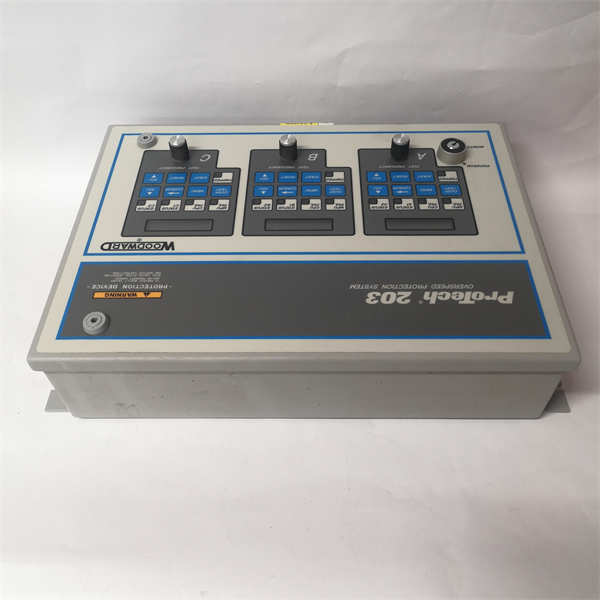
WOODWARD 9907-147
Lifecycle Status and Migration Strategy
WOODWARD officially discontinued the 9907-147 over a decade ago, with end-of-life notices issued in the late 2000s. Continued use carries significant risk: no new units are available from the manufacturer, secondary-market inventory is dwindling, and prices have increased substantially. Technical support for troubleshooting is limited to legacy documentation, with no firmware or hardware updates possible.
As a temporary measure, facilities may source tested, refurbished units from specialized industrial automation suppliers. Some organizations opt for board-level repair by qualified electronics labs, though component obsolescence (e.g., custom op-amps) complicates this approach.
The recommended long-term migration path is a full upgrade to WOODWARD’s current MicroNet Plus or SPC II platform. This transition requires replacing the entire I/O chassis, CPU, and operator interface, along with re-engineering control logic and I/O wiring. While capital-intensive, this modernization delivers improved diagnostics, cybersecurity features, remote access, and long-term parts availability. For budget-constrained sites, a phased approach—starting with critical turbine units—is often implemented to manage risk while deferring full replacement.