 Tel:
Tel:  Email:
  WhatsApp:
 Description
Technical Specifications (For Spare Part Verification)
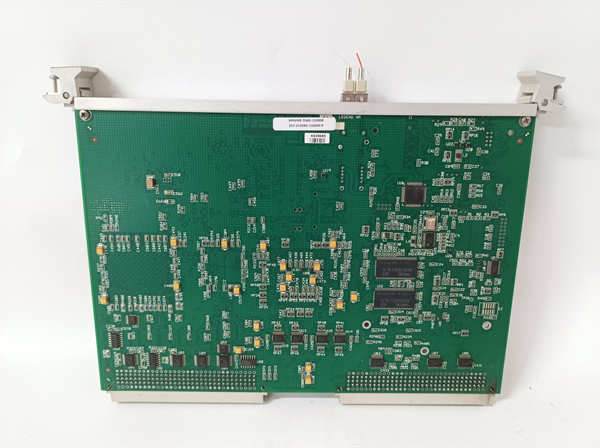
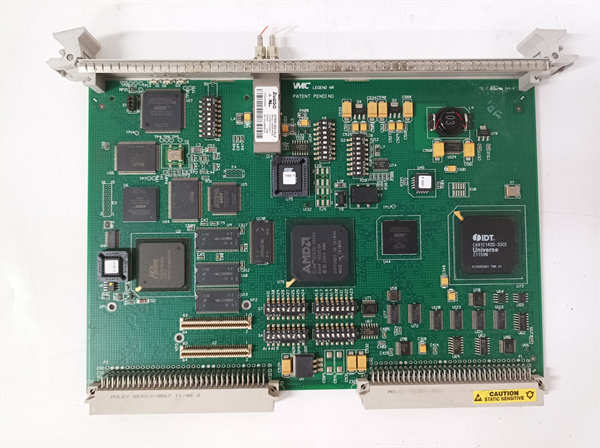
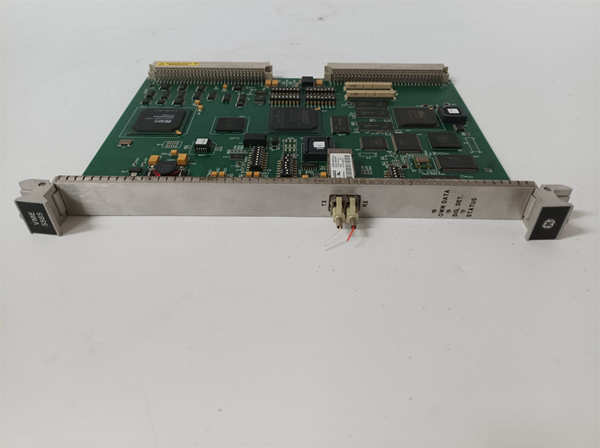
- Product Model: VMIVME-5565
- Manufacturer: VMIC / GE Intelligent Platforms
- Bus Interface: VME64 (6U VME form factor, 32-bit, 33 MHz)
- Memory Capacity: 128 MB SDRAM (shared reflective memory space)
- Network Interface: Fiber-optic ST connectors (dual redundant ports)
- Data Rate: Up to 170 MB/s sustained throughput
- Latency: < 500 ns node-to-node
- Protocol: Proprietary reflective memory protocol (VMIC RFM)
- Driver Support: Requires legacy drivers for VxWorks, Windows XP/7, or Linux kernel < 3.x
- Power Consumption: +5 V @ 3.0 A typical
- Physical Dimensions: 6U VME (233.35 mm H x 160 mm W)
System Role and Downtime Impact
The VMIVME-5565 serves as the backbone for deterministic data exchange in multi-processor VME-based systems, commonly found in hardware-in-the-loop (HIL) simulators, power grid stability test rigs, and nuclear plant training simulators. It creates a shared memory space that appears local to all connected nodes, enabling microsecond-level synchronization without traditional network stack overhead.
If this module fails—due to memory corruption, fiber port damage, or power surge—the entire reflective memory ring collapses. All participating systems lose access to critical shared variables (e.g., simulated grid frequency, actuator positions, or fault signals), triggering watchdog timeouts or safety interlocks. In a real-time simulator, this results in an immediate “freeze” of the scenario, requiring a full system reboot and re-initialization that can take hours. In operational control environments (e.g., legacy substation test beds), it may invalidate compliance testing or delay commissioning.
Reliability Analysis and Common Failure Modes
Despite its rugged industrial design, the VMIVME-5565 is susceptible to several age-related failure mechanisms. The most common is SDRAM cell degradation, leading to intermittent bit errors in the reflective memory space. These often manifest as sporadic data mismatches between nodes that are difficult to reproduce but cause logic divergence in simulation models.
A key vulnerability lies in its fiber-optic transceivers: early models used discrete optoelectronic components prone to aging, resulting in reduced optical output power or complete link loss. Additionally, the module’s +5 V power regulation circuitry—based on linear regulators—generates significant heat, accelerating capacitor dry-out and voltage drift over time.
For preventive maintenance, operators should:
- Perform periodic memory integrity tests using vendor-provided diagnostics (e.g., RFMUTIL)
- Inspect fiber cables for bends or contamination; clean connectors with approved kits
- Monitor chassis temperature to ensure it remains below 55°C ambient
- Avoid hot-plugging the module, as VME bus spikes can damage the FPGA configuration memory
VMIVME-5565-110000332-015565-110000 P VME-5565 GE
Lifecycle Status and Migration Strategy
There is no drop-in replacement for the VMIVME-5565. Spectrum Embedded Systems offers modern reflective memory solutions (e.g., SpectraDynamics RFM6G over PCIe or XMC), but these require a complete architectural overhaul—replacing VME chassis with modern backplanes, rewriting drivers, and revalidating timing-critical code.
Continued use carries severe risk: no functional testing by OEM, no spare parts manufacturing, and increasing incompatibility with modern operating systems. As temporary mitigation, facilities may:
- Secure 1–2 tested spares from trusted vendors with full loopback validation
- Implement redundant rings (if topology allows) to isolate single-node failures
- Archive original driver binaries and FPGA bitstreams for recovery
Long-term, migration to a modern reflective memory platform (e.g., GE Fanuc RX6i with RFM over Aurora, or commercial alternatives like Dolphin Express) is the only sustainable path. This typically involves:
- Re-hosting application code on newer real-time platforms (e.g., NI VeriStand, dSPACE)
- Replacing VME I/O with PCIe or PXI equivalents
- Conducting full timing analysis to ensure latency budgets are met
While costly, this transition eliminates obsolescence risk and enables integration with contemporary data acquisition and cloud analytics tools.