 Tel:
Tel:  Email:
  WhatsApp:
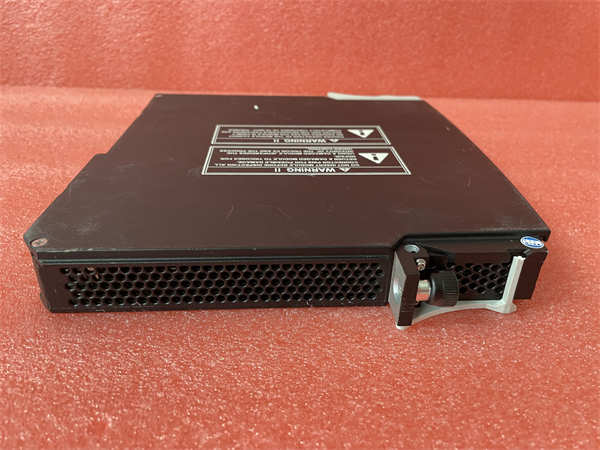
 Description
Technical Specifications (For Spare Parts Verification)
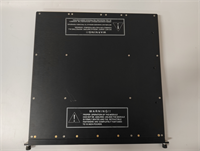
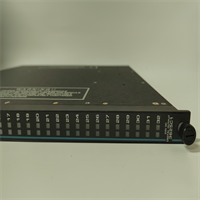
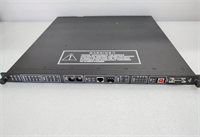
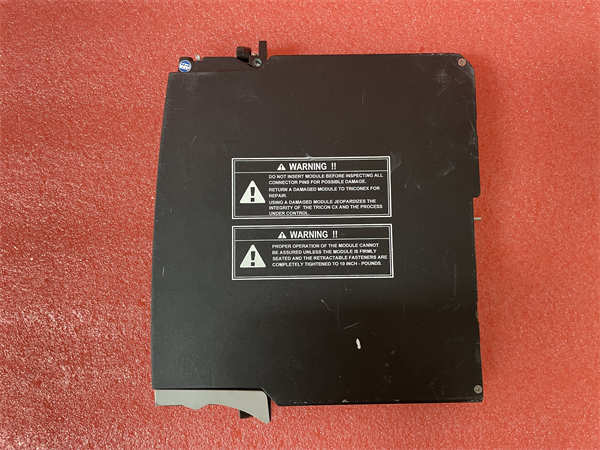
- Product Model: 3626X
- Manufacturer: TRICONEX / Schneider Electric
- System Platform: Tricon (Model 3008/3508/3700) and early Triconex platforms
- Module Type: Discrete Output (DO), triple-modular redundant (TMR) architecture
- Number of Channels: 16
- Output Voltage Range: 24–125 VDC (nominal 125 VDC operation common in North American power & oil/gas)
- Output Type: Sourcing (current flows from module to field device)
- Load Capacity per Channel: Up to 100 mA continuous
- Diagnostic Coverage: Full TMR voting with per-channel diagnostics; fault reporting via Trident software
- Redundancy: Integrated into Tricon’s triple-redundant backplane; no external redundancy required
- Isolation: Each channel optically isolated from logic and other channels
- Certifications: IEC 61508 SIL 3, IEEE 603, UL 61010-1
- Mounting: Pluggable into Tricon main chassis (backplane-powered)
System Role and Downtime Impact
The 3626X is a foundational output module in legacy Triconex safety systems deployed across nuclear power, refining, and chemical processing facilities. It resides in the main Tricon chassis and directly drives final control elements—such as ESD valves, turbine trip solenoids, or firewater pump starters—that must respond reliably during hazardous events.
Because it operates within a Triple-Modular Redundant (TMR) architecture, a single channel failure is typically masked by voting logic, allowing continued operation. However, if multiple channels degrade or the module suffers a common-cause fault (e.g., power supply anomaly), the Tricon may force a system halt or initiate a safe shutdown to maintain integrity. In non-redundant or partially degraded systems, a failed 3626X could result in failure to actuate a critical safety device—posing a direct process hazard. Replacement requires system downtime, physical module swap, and post-maintenance diagnostics via Trident workstation.
Reliability Analysis and Common Failure Modes
Despite its robust TMR design, the 3626X is susceptible to several aging and application-related failure mechanisms:
- Output transistor degradation: High-voltage switching under inductive loads (e.g., solenoids) causes cumulative stress on output drivers, leading to increased on-resistance, overheating, or open-circuit failure.
- Optocoupler wear: The isolation components between logic and output stages degrade over time, potentially causing signal delay or dropout under marginal voltage conditions.
- Backplane connector corrosion: Humidity ingress or thermal cycling can oxidize the edge connector pins, resulting in intermittent communication with the main processors or diagnostic errors.
- Capacitor aging on internal DC/DC converters: Affects local power stability for the TMR comparators, possibly triggering false mismatch faults.
A notable vulnerability is inductive kickback damage—if field devices lack proper flyback diodes or surge suppression, repeated voltage spikes can destroy output stages over time.
Preventive maintenance should include:
- Verifying flyback protection on all connected solenoids/relays
- Measuring channel leakage current during proof tests
- Monitoring Trident logs for “channel mismatch” or “output diagnostic fault” trends
- Performing periodic loop checks under load to confirm full actuation capability
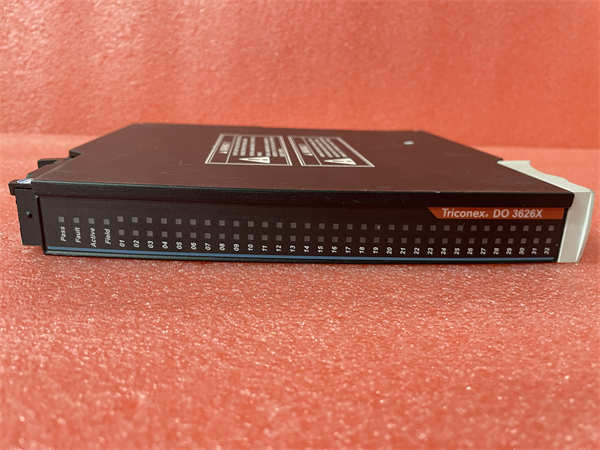
TRICONEX DO 3626X
Lifecycle Status and Migration Strategy
Schneider Electric has discontinued the 3626X as part of its evolution toward the Triconex eXP and eXPe platforms, which offer enhanced cybersecurity, higher density, and improved diagnostics. The 3626X is no longer supported under standard warranties, and factory repair services are unavailable. Continuing to operate on aging modules introduces compliance and reliability risks, especially in regulated industries.
Short-term mitigation requires:
- Securing functionally tested spares with documented load-test results at 125 VDC
- Implementing enhanced proof testing frequency (e.g., quarterly instead of annually)
- Isolating critical outputs onto dedicated modules to limit fault propagation
The official long-term migration path is to upgrade to the Triconex eXPe platform, using modern equivalents such as the MP3008 discrete output modules, which provide:
- Higher channel density (up to 32 channels)
- Built-in HART pass-through for smart valve diagnostics
- Secure remote access and audit logging per IEC 62443
- Continued SIL 3 certification under latest standards
This transition preserves the TMR safety architecture while modernizing hardware support and extending system life. For facilities unable to fund a full controller upgrade, partnering with specialized third-party service providers for board-level repair and burn-in testing may serve as an interim measure—but only with rigorous quality assurance.