
 Tel:
Tel:  Email:
  WhatsApp:
 Description
Technical Specifications (for Spare Verification)
- Product Model: T940X,XAPMM,BATT,ENG
- Manufacturer: Emerson Automation Solutions
- System Family: Ovation DCS (primarily used in power generation and water/wastewater)
- Module Type: XAPMM (eXpansion Application Processor Main Module)
- Language Firmware: English (ENG suffix)
- Backup Feature: Integrated lithium battery for SRAM retention (typically 3.6 V, non-replaceable without module disassembly)
- Mounting: Proprietary Ovation backplane slot (requires compatible chassis, e.g., T940 series rack)
- Communication: Dual redundant Ethernet (OvationNet) and serial links to I/O controllers
- Diagnostic Indicators: Front-panel LEDs for Power, Run, Fault, Network Activity
- Compatibility: Must match firmware revision and chassis configuration of existing Ovation system
System Role and Downtime Impact
The T940X XAPMM module functions as a scalable processing node within the Ovation DCS architecture, typically deployed in redundant pairs or as expansion units to offload I/O handling from the primary controller. In fossil fuel, nuclear, or hydroelectric power plants, it often manages critical subsystems such as boiler feedwater, condensate extraction, or auxiliary power distribution. If this module fails—due to battery depletion, firmware corruption, or hardware fault—the associated control loops may freeze, revert to last-known state, or trigger a failover to the redundant unit. In non-redundant or partially degraded configurations, loss of the XAPMM can result in loss of visibility and control over dozens of field devices, potentially forcing manual operation or initiating a controlled trip of the affected process segment. Recovery requires a verified spare with matching firmware and configuration, which is increasingly difficult to source.
Reliability Analysis and Common Failure Modes
Despite its rugged industrial design, the T940X XAPMM exhibits predictable aging vulnerabilities after 15–20 years of service. The most critical failure point is the internal lithium battery, which powers the SRAM storing runtime data and configuration checksums. Once depleted (typically after 10–15 years), the module may boot with corrupted memory, display “configuration mismatch” errors, or fail to synchronize with the Ovation network. The Ethernet PHY transceivers are also prone to degradation from thermal cycling, leading to intermittent network drops that destabilize the entire node. Additionally, the connector pins on the backplane interface can oxidize or bend over time, causing poor contact and spontaneous resets. Environmental stressors like high ambient temperature, humidity, or airborne contaminants accelerate these issues. Recommended preventive actions include: annual verification of module synchronization status in Ovation Station, visual inspection of front-panel LEDs for abnormal patterns, maintaining ambient temperature below 40°C in control rooms, and proactively replacing units showing unexplained network flapping or boot delays.
-

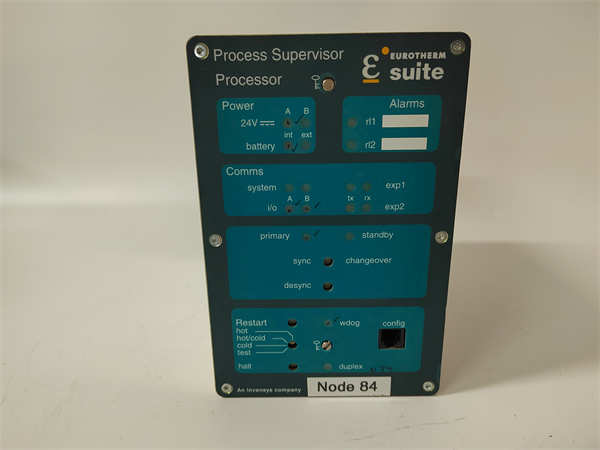
SUITE T940X,XAPMM,BATT,ENG
Lifecycle Status and Migration Strategy
Emerson has formally discontinued the T940X XAPMM platform, with no direct hardware replacement offered. Support for legacy Ovation firmware versions containing this module has been phased out, and new engineering workstations often cannot communicate with older revisions due to OS and driver incompatibilities. Continued operation introduces significant risk: secondary-market units may have unknown battery health, mismatched firmware, or latent hardware defects. As an interim measure, facilities should maintain at least one bench-tested spare per critical application and archive original system images using Ovation Backup utilities on isolated legacy PCs. For long-term sustainability, Emerson recommends migrating to the Ovation Expert 3.0+ platform based on modern server-class hardware and virtualized controllers. This transition typically involves:
- Replacing T940X racks with Ovation Server Nodes (OSN) or Virtual Controller Nodes (VCN)
- Rehosting existing control strategies using Ovation Engineering Studio
- Upgrading I/O to Ovation Smart I/O (e.g., DI/DO/AI/AO modules with Ethernet connectivity)
While not a drop-in replacement, this path preserves the core control logic while delivering enhanced cybersecurity (IEC 62443 compliance), remote diagnostics, and integration with modern asset performance management (APM) systems. Early engagement with Emerson or certified Ovation integrators is essential to scope the migration during planned outages and avoid unplanned downtime driven by hardware obsolescence.