 Tel:
Tel:  Email:
  WhatsApp:
 Description
Key Technical Specifications
| Parameter | Specification | Notes |
|---|---|---|
| Rated Power | 0.70 kW | At nominal speed |
| Stall Torque (M0) | 3.2 Nm | Continuous duty |
| Peak Torque (Mmax) | 9.0 Nm | Short term overload |
| Rated Speed (nN) | 2000 RPM | Base speed |
| Max Speed (nmax) | 4500 RPM | Mechanical limit |
| Voltage Rating | 400 – 480 VAC | 3-Phase supply via drive |
| Torque Constant (kt) | 0.48 Nm/A | Critical for tuning |
| Resistance (Rph-ph) | 4.8 Ohm | Phase-to-phase at 20°C |
| Inductance (Lph-ph) | 12.5 mH | Phase-to-phase |
| Encoder Type | Absolute (Hiperface DSL) | Integrated, multi-turn |
| Protection Class | IP65 | Shaft seal included |
| Mounting Flange | IM B5 / IM V1 | Standard IEC mounting |
Product Introduction
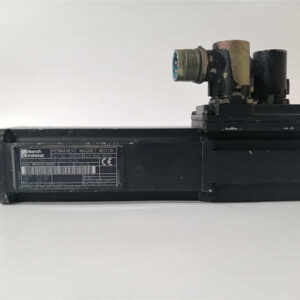
If you’ve ever chased a vibration issue on a high-speed pick-and-place robot only to find the motor was the culprit, you know why spec-ing the right servo matters. The Rexroth MSK040C-0450-NN-M1-UG1-NNNN is a staple in the IndraDyn S lineup, specifically engineered for applications needing rapid acceleration without sacrificing holding torque. I’ve installed hundreds of these in food processing lines where washdowns are brutal; the IP65 rating isn’t just marketing fluff here—the shaft seals actually hold up against caustic cleaners if you don’t blast them directly with a pressure washer from two inches away.The real reason engineers specify the “0450” variant is the speed headroom. While it’s rated for 2000 RPM continuous, pushing it to 4000+ RPM for short bursts gives you the cycle time reduction you need to meet production quotas. It pairs perfectly with HMV or HMS drives, provided your firmware matches. One thing to watch: the “M1” power connector configuration is specific. If you try to force a standard M23 pinout from a different manufacturer, you will smoke the encoder feedback instantly. This motor is bulletproof mechanically, but the electronics inside the connector block are sensitive to moisture ingress if the cap is left off during installation.
 Quality SOP & Tech Pitfalls (The Reality Check)
 Quality SOP & Tech Pitfalls (The Reality Check)
The Lab Report (SOP)
We don’t just spin these up and call it good. Every MSK040C undergoes a static resistance check first; if the phase-to-phase ohms deviate more than 5% from the datasheet (4.8 Ohm), we reject it as having shorted windings. Next, we mount it to a dynamometer and run a full torque curve test, verifying the 3.2 Nm continuous and 9.0 Nm peak without thermal runaway. We then hook up a Rexroth drive to test the Hiperface DSL encoder communication, ensuring absolute position data is retained after power cycling. Finally, we perform a hipot test at 1500V AC to verify insulation integrity and seal the connectors with fresh dielectric grease before vacuum-sealing the package.
The Engineer’s Warning (Pitfalls)
The number one killer of these motors isn’t electrical failure; it’s improper cable management causing encoder noise. The Hiperface DSL protocol is robust, but if you run the motor power cable parallel to the encoder cable for more than 10 feet without shielding separation, you will get “Following Error” alarms that look like mechanical binding. I once spent six hours troubleshooting a “bad motor” only to find the installer had zip-tied the feedback cable to the 480V power line. Also, beware of the brake option. This specific model number (NNNN at the end) indicates no mechanical brake. If your vertical axis relies on a brake to hold load during power loss, do not install this unit expecting it to hold position electrically forever; the drive will overheat trying to fight gravity.
Installation & Configuration Guide
Getting this motor running takes about 45 minutes if you respect the torque specs.
- Pre-Installation Safety: Lockout the main drive power. Wait 10 minutes for the DC bus capacitors to discharge. ⚠️ Verify the motor shaft is clean and free of rust before coupling; a rough shaft will shred the oil seal immediately. Photograph the existing wiring if replacing.
- Removal: Disconnect the M1 power connector and the feedback plug. Loosen the coupling clamp carefully; do not hammer on the motor shaft. Remove mounting bolts.
- Installation: Align the new MSK040C with the coupling. Insert mounting bolts and torque to 24 Nm (for M8 bolts) in a star pattern. Critical: Ensure the M1 connector keyway aligns perfectly before tightening the locking ring; cross-threading here ruins the housing. Connect the feedback cable first, then the power phases (U, V, W). Ground the motor frame directly to the cabinet ground bar with a short, fat strap.
- Power-On & Testing: Power up the drive. Navigate to the commissioning software (IndraWorks). Run the “Motor Identification” routine automatically; do not skip this. The drive will measure inductance and resistance. If it fails, check your wiring phase order. Once ID passes, run a low-speed jog (100 RPM) to check rotation direction. Ramp up to full speed and monitor current draw; it should be smooth, not jagged.
Compatible Replacement Models
Rexroth updates these part numbers frequently, but the physical dimensions remain stable.表格
| Compatibility Tier | Model Number | Details & Differences |
|---|---|---|
| ✅ Drop-in Replacement | MSK040C-0450-NN-M1-UG1-NNNN | Exact match. Ensure the revision code (last digits) matches your drive’s compatibility list. |
| ⚠️ Software Compatible | MSK040C-0450-NN-M1-UG0-NNNN | Same hardware, different encoder resolution or firmware map. Requires updating drive parameters and re-running motor identification. Labor: +30 mins. |
| ❌ Hardware Mod Required | MSK040B-xxxx | Older “B” series. Mounting holes might align, but the connector pinout and magnetic characteristics differ. Requires rewiring and extensive retuning. Not recommended for quick swaps. |
Frequently Asked Questions (FAQ)
Q: Can I use a generic servo cable instead of the expensive Rexroth one?
A: You can, but you’re gambling with uptime. Generic cables often have incorrect capacitance values that mess up the Hiperface DSL signal, leading to intermittent faults that disappear when you wiggle the wire. If you must use generic, verify the pinout and shield quality meticulously. For critical production, stick to OEM or certified third-party cables.Q: My drive says “Encoder Communication Error.” Is the motor dead?
A: Probably not. 9 times out of 10, it’s a bad connection at the M1 plug or a broken wire in the flexing section of the cable harness. Check the continuity of the feedback wires first. Only suspect the motor encoder if the cable tests perfect.Q: Does this motor have a holding brake?
A: No. The part number ends in “NNNN,” which explicitly means no brake. If you need a brake for a vertical axis, you need a model ending in “R” or similar brake designation. Using this without a mechanical brake on a Z-axis is a safety hazard.Q: How often do the bearings need greasing?
A: These are sealed-for-life bearings. You cannot re-grease them. If they start singing or grinding, the motor needs replacement. Typical life is 20,000 to 30,000 hours depending on radial load and speed. Don’t exceed the specified radial load limits on the shaft.Q: Can I run this motor at 6000 RPM?
A: No. The mechanical limit is 4500 RPM. Pushing it beyond that risks centrifugal failure of the rotor magnets or bearing collapse. Stick to the datasheet limits unless you want shrapnel in your machine guard.