 Tel:
Tel:  Email:
  WhatsApp:
 Description
Technical Specifications
- Product Model: PXI-6608
- Manufacturer: National Instruments
- Platform: 3U PXI (32-bit, 33 MHz PCI interface)
- Counters: 8 independent 32-bit general-purpose counters
- Timebase Options: Internal (10 MHz, 100 MHz), external (up to 100 MHz), or PFI lines
- Input Voltage Range: ±5 V (TTL/CMOS compatible)
- Max Input Frequency: 100 MHz (with 100 MHz timebase)
- Features:
- Quadrature encoder (A/B/Z) support
- Pulse train generation (up to 20 MHz)
- Buffered event counting
- Digital triggering and gating
- Connector: 68-pin VHDCI (via breakout cable, e.g., CB-68LP)
- Software Support: NI-DAQmx (fully supported), LabVIEW, MATLAB, Python (nidaqmx)
- Power Consumption: +3.3 V @ 1.5 A, +5 V @ 1.0 A typical
- Certifications: CE, FCC, RoHS
Core Performance and Selection Advantages
The PXI-6608 delivers exceptional value in applications requiring deterministic, hardware-timed counting without the overhead of software polling. Its eight dedicated counters operate independently, enabling simultaneous tasks such as:
- Tracking position from four dual-axis encoders
- Measuring PWM duty cycle and frequency on multiple motor drives
- Timestamping fault events across distributed subsystems
Compared to software-based timing or general-purpose digital I/O, the PXI-6608 offers sub-microsecond resolution, immunity to OS jitter, and zero CPU load during operation—critical in real-time test environments.
For system integrators, key advantages include:
- Seamless integration with existing PXI chassis (e.g., NI PXI-1042, PXI-1045)
- Extensive driver ecosystem: Fully supported in NI-DAQmx with pre-built examples for encoder, tachometer, and period measurement
- Cost efficiency: Often available at lower cost than PXIe equivalents when leveraging existing PXI infrastructure
- Backward compatibility: Works with legacy LabVIEW codebases (LV 7.0+) without major refactoring
System Integration and Scalability
The PXI-6608 integrates natively into NI’s measurement ecosystem:
- Configured via NI MAX (Measurement & Automation Explorer) for quick validation
- Programmed using NI-DAQmx API in LabVIEW, C/C++, Python, or .NET
- Synchronized with other PXI modules via PXI trigger bus and star trigger lines
For multi-chassis systems, it supports RTSI (Real-Time System Integration) bus connectivity for phase-coherent timing across up to 7 chassis—ideal for large-scale structural testing or multi-axis motion control.
While not PXI Express, the PXI-6608 can coexist in hybrid PXI/PXIe chassis (e.g., NI PXIe-1082) using legacy slots, offering a migration bridge for facilities upgrading incrementally.
When to Choose PXI-6608 vs. Newer Alternatives
| Scenario | Recommendation |
|---|---|
| Existing PXI system needing encoder inputs | ✅ PXI-6608 (lowest TCO) |
| New design requiring >100 MHz timing or streaming | ❌ Use PXIe-6614 or PXIe-6639 |
| Need IEEE 1588 or TSN synchronization | ❌ Requires PXIe platform |
| Budget-constrained retrofit with proven codebase | ✅ PXI-6608 is optimal |
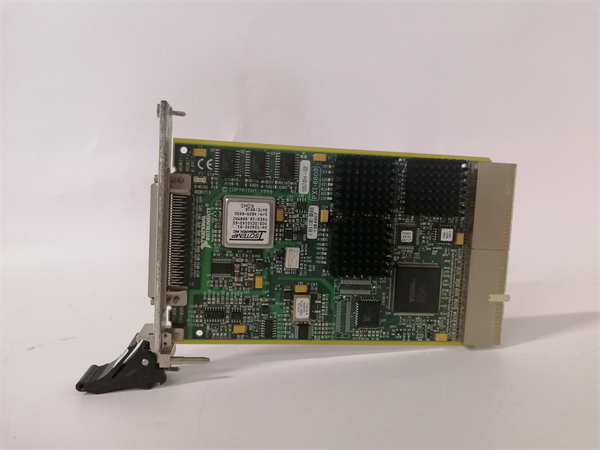
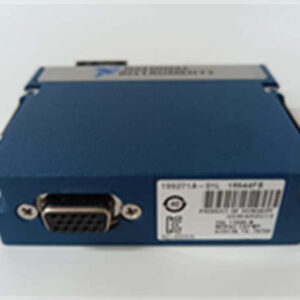
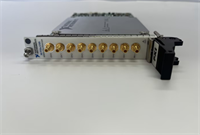
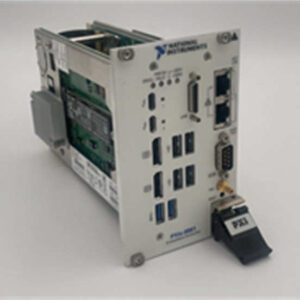
PXI-6608 185745H-02
Long-Term Considerations
Although still active, NI advises against using the PXI-6608 in greenfield projects due to:
- Limited future driver enhancements
- No path to higher bandwidth or modern protocols
- Eventual phase-out as PXI inventory depletes
For new designs, PXIe-6614 (8-channel, 100 MHz) or PXIe-6639 (4-channel, 1.25 GS/s timestamping) offer better longevity. However, for maintaining or expanding legacy test stands—especially in aerospace, automotive, or semiconductor equipment—the PXI-6608 remains a reliable, cost-effective, and fully supported solution with predictable availability through 2027–2028 based on current channel stock.