 Tel:
Tel:  Email:
  WhatsApp:
 Description
Technical Specifications (For Spare Parts Verification)
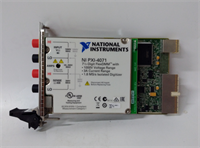
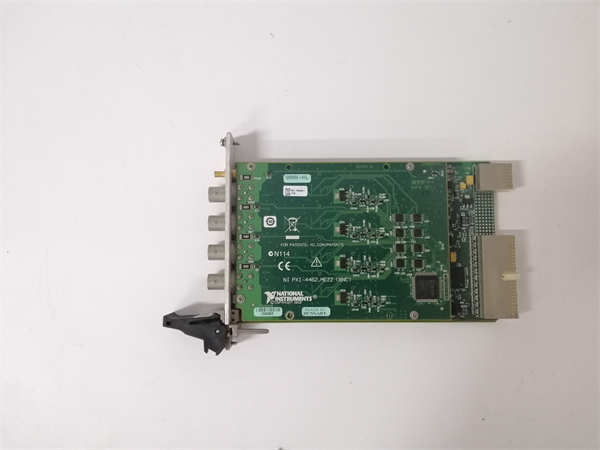
- Product Model: PXI-4462
- Manufacturer: National Instruments
- Platform: PXI (PCI eXtensions for Instrumentation), 3U form factor
- Channels: 4 simultaneously sampled analog input channels
- Resolution: 24-bit delta-sigma ADC
- Sampling Rate: Up to 204.8 kS/s per channel
- Input Type: AC-coupled, IEPE (Integrated Electronics Piezo-Electric) sensor compatible
- Input Range: ±0.316 V, ±1 V, ±3.16 V, ±10 V (software-selectable)
- Bandwidth: DC to 92 kHz (anti-aliasing filtered)
- Excitation: Built-in programmable IEPE constant current source (0–4 mA)
- Connector Type: Four BNC front-panel inputs
- Software Support: Originally supported in LabVIEW, NI-DAQmx, and Sound and Vibration Toolkit
System Role and Downtime Impact
The PXI-4462 was a cornerstone module in high-precision test systems for aerospace, automotive NVH (Noise, Vibration, and Harshness), and industrial machinery diagnostics. It enabled accurate capture of low-level dynamic signals from accelerometers, microphones, and strain gauges—often used in certification-grade validation. In such environments, a failed or drifting PXI-4462 does not merely cause downtime; it risks invalidating entire test datasets, leading to costly re-runs, delayed product releases, or non-compliance with standards like ISO 2041 or MIL-STD-810. Because these systems are typically integrated into custom LabVIEW applications with years of algorithm development, replacing the module requires exact functional equivalence to avoid software re-engineering.
Reliability Analysis and Common Failure Modes
Despite its precision design, the PXI-4462 is vulnerable to aging effects due to its analog-intensive architecture:
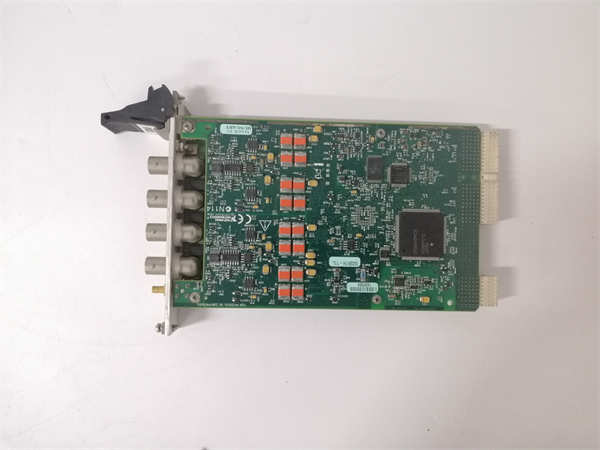
- ADC reference drift – long-term thermal cycling degrades the internal voltage reference, causing gain errors that affect measurement accuracy.
- IEPE excitation circuit failure – the constant-current source can degrade, leading to sensor bias errors or complete signal loss.
- BNC connector wear or solder joint fatigue – repeated cable insertion or vibration causes intermittent connections, especially in mobile test rigs.
- FPGA configuration corruption – though rare, flash memory degradation can prevent proper initialization in older units.
A key limitation is the absence of real-time analog path diagnostics; faults often manifest only as increased noise floor or inconsistent frequency response. For preventive maintenance:
- Perform annual end-to-end calibration using traceable shakers or signal generators
- Verify IEPE current output during routine checks
- Inspect BNC connectors for mechanical play or oxidation
- Store spare modules in climate-controlled conditions to minimize component aging
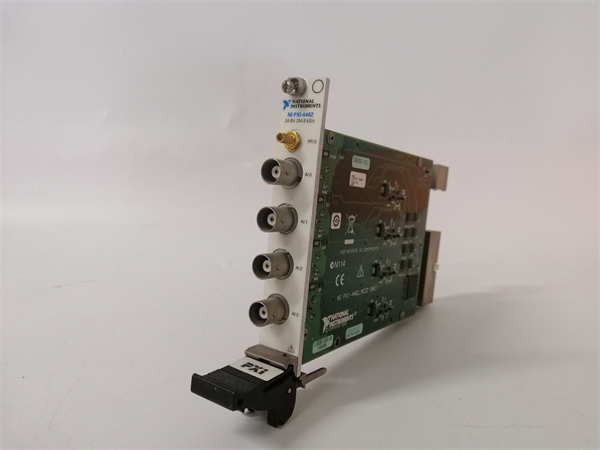
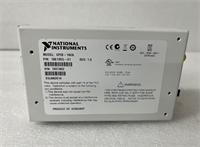
PXI-4462 188261H-11L
Lifecycle Status and Migration Strategy
National Instruments officially discontinued the PXI-4462 as part of its shift toward newer platforms like PXIe and CompactDAQ. The last shipments occurred several years ago, and NI no longer provides calibration services or repairs. Continuing to operate this module introduces significant risk: even if functional, it may fail audit requirements without a valid, recent calibration certificate from an accredited lab.
Short-term mitigation includes:
- Securing NIST-traceable calibrated spares from specialized legacy DAQ vendors
- Implementing system-level self-validation routines (e.g., injecting known test tones)
- Maintaining original driver versions in isolated virtual machines to ensure compatibility
For long-term sustainability, NI’s recommended migration path is to the PXIe-449x series (e.g., PXIe-4496 or PXIe-4499), which offer:
- Higher sampling rates (up to 200 kS/s or more)
- Improved anti-aliasing filters and lower noise floors
- Native support in modern NI-DAQmx and LabVIEW versions
Migration typically requires:
- A PXI Express chassis (not backward-compatible with legacy PXI)
- Rewiring BNC connections (pinout is similar but not identical)
- Minor updates to DAQmx configuration calls in existing code
Given the critical role of the PXI-4462 in data integrity–sensitive applications, organizations should conduct a full inventory audit, prioritize high-utilization systems, and execute a phased replacement plan to maintain compliance and operational continuity. Delaying action increases exposure to unplanned test interruptions and regulatory non-conformance.