 Tel:
Tel:  Email:
  WhatsApp:
 Description
Key Technical Specifications (For Spare Part Verification)
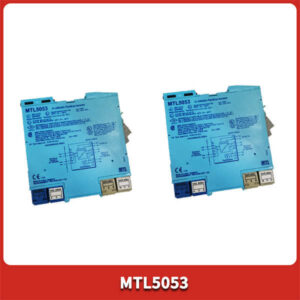
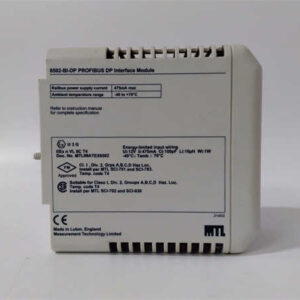
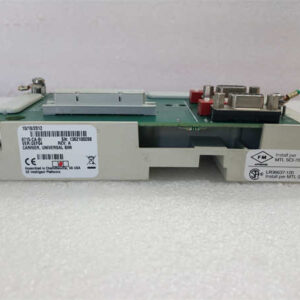
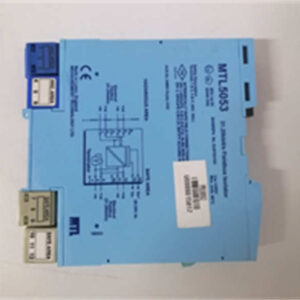
- Product Model: 8910-PS-DC
- Manufacturer: MTL Instruments (Eaton)
- System Family: MTL8000 Modular I/O Platform
- Input Voltage: 85–264 V AC or 100–370 V DC (universal input)
- Output Voltage: 24 V DC nominal
- Output Current: Typically 3 A or 5 A (verify label—varies by sub-variant)
- Redundancy Support: Designed for optional 1+1 redundancy using diode-oring modules (e.g., 8910-RM)
- Mounting: DIN rail within MTL8000 I/O cabinet
- Indicators: LED for Power OK and Fault status
- Certifications: ATEX, IECEx, FM, CSA for use in Zone 2 / Div 2 hazardous locations
- Backplane Compatibility: Supplies power to MTL8000 base units (e.g., 8110, 8210 series) via dedicated power rails
System Role and Downtime Impact
The 8910-PS-DC serves as the primary power source for MTL8000 I/O systems widely deployed in oil & gas, chemical, and pharmaceutical facilities—particularly where signals originate from explosive atmospheres. It powers both the safe-area logic side and, through associated IS isolators, enables intrinsically safe communication with field devices (e.g., transmitters, switches in Zone 0/1).
In non-redundant installations—which are common due to cost constraints—a failure of this power supply results in immediate loss of all I/O on the affected backplane segment. This can lead to:
- Loss of critical process measurements (e.g., pressure, level in reactors)
- Deactivation of emergency shutdown (ESD) inputs or fire/gas detection signals
- Tripping of safety instrumented systems (SIS) due to “signal loss” diagnostics
- Forced manual operation or complete unit shutdown until power is restored
Recovery depends entirely on spare availability, as the module is not hot-swappable and requires system de-energization for replacement.
Reliability Analysis and Common Failure Modes
Despite rugged industrial construction, aging 8910-PS-DC units exhibit predictable degradation:
- Electrolytic capacitor drying: Input and output filter capacitors lose capacitance over time, causing voltage ripple, thermal stress, and eventual shutdown under load.
- Switching transistor fatigue: High-frequency power semiconductors degrade after years of thermal cycling, leading to intermittent output or complete failure.
- Fan failure (if fan-cooled variant): Reduced airflow causes overheating and thermal shutdown—though many variants are convection-cooled.
- Terminal block corrosion: Especially in coastal or high-humidity plants, increasing contact resistance and voltage drop.
- Backplane connector wear: Repeated insertion/removal or vibration loosens connections, causing arcing or intermittent power delivery.
Recommended preventive maintenance:
- Measure output voltage and ripple annually under full load
- Inspect for bulging capacitors, burnt smell, or discoloration during cabinet access
- Verify redundancy switchover functionality if configured
- Maintain at least one tested spare per critical I/O cabinet
Lifecycle Status and Migration Strategy
MTL Instruments was acquired by Cooper Industries (later Eaton), and the MTL8000 platform—including the 8910-PS-DC—has been discontinued in favor of newer architectures like the MTL HART Interface Modules and integration into Eaton’s xEnergy portfolio. No new units are manufactured, and official support is minimal.
Short-term mitigation includes:
- Sourcing verified-used units from decommissioned sites or industrial surplus vendors
- Using compatible third-party DIN rail power supplies (e.g., Phoenix Contact, Weidmüller) with external isolation—though this may compromise intrinsic safety certification
- Implementing external monitoring (e.g., voltage sensors + PLC alarm) to detect early power degradation
Long-term, the recommended path is migration to a modern, supported I/O platform such as:
- MTL Advanced Solutions (e.g., MTL4851 HART multiplexer with remote I/O)
- Phoenix Contact AXC F 1152 with inline I/O for hazardous areas
- Rockwell ArmorBlock 1600 or Turck TBEN-L for Ethernet-based I/O in classified zones
Migration typically involves:
- Replacing MTL8000 cabinets with new I/O nodes
- Rewiring field cables (often reusing existing multi-pair infrastructure)
- Updating control logic in the host DCS/PLC
- Recertifying the installation for hazardous area compliance