 Tel:
Tel:  Email:
  WhatsApp:
 Description
Key Technical Specifications (For Spare Parts Verification)
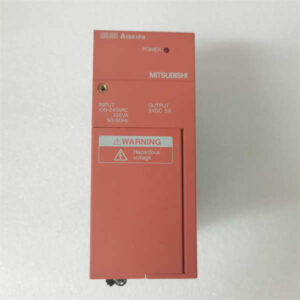
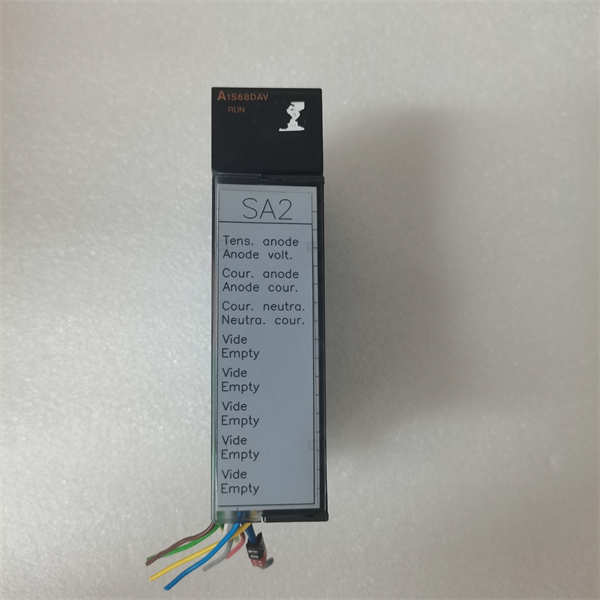
- Product Model: A1S68DAV
- Manufacturer: Mitsubishi Electric
- System Platform: MELSEC A1S series PLC (part of the legacy A-family)
- Output Type: Voltage only (0 to +10 VDC or 0 to +5 VDC, selectable per channel via internal DIP switches)
- Number of Channels: 8 independent outputs
- Resolution: 12 bits
- Output Accuracy: ±0.4% of full scale at 25°C
- Isolation: Channel-to-backplane isolation (no channel-to-channel isolation)
- Power Consumption: 0.35 A from 5 VDC PLC backplane
- Mounting: Snap-in to A1S base units (e.g., A1S38B, A1S68B)
- Operating Temperature: 0°C to +55°C
- Certifications: CE, UL, cUL (depending on production batch)
System Role and Downtime Impact
The A1S68DAV is typically deployed in legacy process control applications—such as chemical dosing, temperature regulation, or speed control—where precise analog voltage signals are required to drive field devices like variable frequency drives (VFDs), pneumatic positioners, or damper actuators. It resides in the I/O rack of an A1S PLC system, receiving digital setpoints from the CPU and converting them to real-world analog commands. If this module fails—due to DAC degradation, power regulation issues, or backplane communication errors—it may output zero, fixed, or erratic voltages, causing connected equipment to stall, overshoot, or operate outside safe limits. In closed-loop systems without redundancy, such a failure can lead to product quality defects, safety interlock activation, or complete line stoppage. Because the A1S platform lacks hot-swap capability, replacement requires a controlled shutdown, increasing the operational impact of unplanned failures.
Reliability Analysis and Common Failure Modes
Despite its robust design, the A1S68DAV is vulnerable to age-related component degradation common in early-generation analog I/O modules. The most frequent failure mode is drift or complete loss of output on one or more channels, often caused by aging digital-to-analog converter (DAC) chips or failing operational amplifiers in the output stage. Electrolytic capacitors in the local regulation circuitry can dry out over time, leading to unstable reference voltages and increased output noise. The module’s lack of per-channel diagnostics means such faults often go undetected until process performance degrades. A key design limitation is the absence of channel-to-channel isolation; a short circuit on one field device can potentially damage the entire module. For preventive maintenance, technicians should periodically verify output accuracy using a calibrated multimeter across all channels under loaded conditions, inspect for signs of overheating near the output terminals, and ensure secure seating in the base unit to prevent intermittent backplane contact. Keeping spare modules powered in a test rack can also help identify latent failures before deployment.
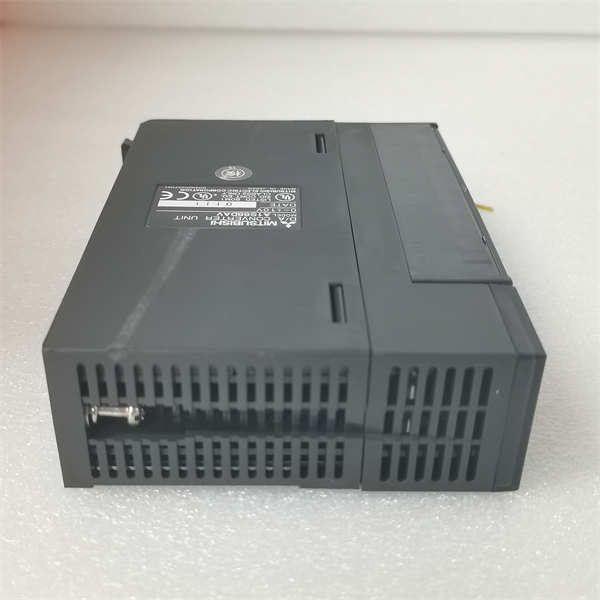
MITSUBISHI A1S68DAV
Lifecycle Status and Migration Strategy
Mitsubishi Electric has long since discontinued the A1S series, including the A1S68DAV, with official support and new-unit availability ceased for over a decade. Continued reliance on this module carries significant risk: spare parts are scarce, counterfeit units are increasingly common in the surplus market, and engineering expertise for troubleshooting is dwindling. As a temporary measure, facilities may use board-level repair services or maintain a stock of pre-tested spares—but these are not sustainable. The recommended migration path is a full upgrade to Mitsubishi’s current iQ-R or iQ-F series platforms. For example, the L60DA4 (for iQ-R) or FX5-8DA-ADP (for iQ-F) provide equivalent or superior analog output functionality with enhanced diagnostics, higher resolution, and support for modern networks like CC-Link IE Field Basic. Migration requires re-engineering the I/O layout, updating GX Works3 logic, and re-commissioning field wiring—but delivers long-term benefits in reliability, cybersecurity, and maintainability. For sites unable to justify a full PLC replacement, a “wrap-around” solution using a standalone analog gateway (e.g., ProSoft or Hilscher module) to interface a modern controller with legacy field devices may serve as an interim bridge. A risk-prioritized, phased migration plan is strongly advised.