 Tel:
Tel:  Email:
  WhatsApp:
 Description
Key Technical Specifications (For Spare Verification)
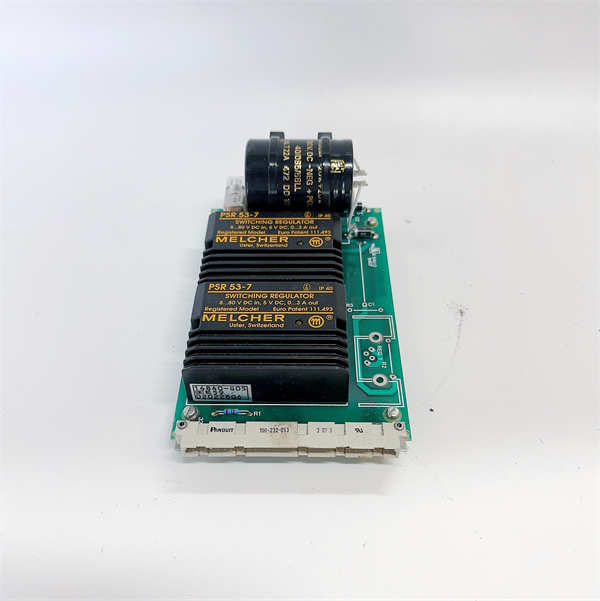
- Product Model: PSR-53-7
- Manufacturer: Melcher (historically a Swiss/German industrial power supplier, later absorbed into broader distribution networks)
- System Family: General-purpose industrial automation infrastructure
- Input Voltage: 85–264 VAC, 47–63 Hz (universal input range)
- Output Voltage: 24 VDC ±2%
- Rated Output Current: 5 A continuous
- Peak Current Capability: Typically up to 7.5 A for short duration (e.g., 5 seconds)
- Mounting Type: Standard 35 mm DIN rail (TS35/7.5 or TS35/15 compatible)
- Protection Features: Automatic recovery from overload, overvoltage, and short-circuit conditions
- Terminal Type: Screw-clamp terminals for line, neutral, and DC output
- Operating Temperature: -10°C to +60°C (derating above 45°C ambient)
System Role and Downtime Impact
The Melcher PSR-53-7 is commonly found in mid-to-late 1990s European industrial equipment—particularly in packaging, material handling, and process machinery—as the main 24 VDC power source for control logic. It typically powers PLC input/output modules, contactor coils, solenoid valves, and indicator circuits. In non-redundant configurations, which represent the vast majority of installations, failure of this unit results in an immediate and complete loss of control voltage. This forces machines into emergency stop states and disables safety interlocks that rely on energize-to-run logic. Recovery time depends entirely on spare availability; without a verified replacement on hand, unplanned downtime can extend beyond 24–48 hours, especially in facilities with limited local inventory.
Reliability Analysis and Common Failure Modes
This power supply employs a conventional flyback topology with electrolytic capacitors as the primary wear-out components. The most prevalent failure mode is gradual output voltage sag due to capacitor aging, particularly in environments with elevated ambient temperatures or poor cabinet ventilation. This often manifests as intermittent PLC resets, erratic sensor readings, or relay chatter before total shutdown. Secondary failure points include cracked solder joints at high-current terminals (from thermal cycling) and degraded varistors after repeated exposure to line transients.
A key design limitation is the absence of remote status signaling (e.g., “DC OK” relay contact), making predictive maintenance difficult. Additionally, the unit lacks active power factor correction, increasing susceptibility to instability on weak or noisy power grids.
Recommended preventive actions include: annual infrared thermography to detect abnormal heating, visual inspection for bulging or leaking capacitors, torque verification of terminal screws, and periodic load testing using a resistive dummy load to confirm stable 24 VDC output at 4–5 A for at least 30 minutes.
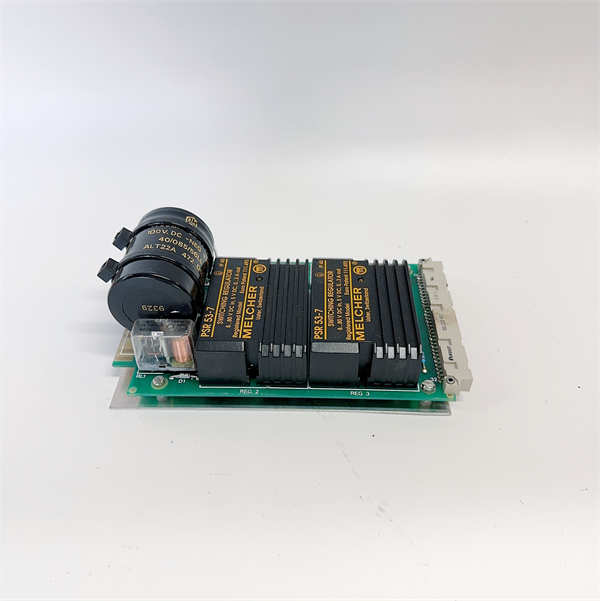
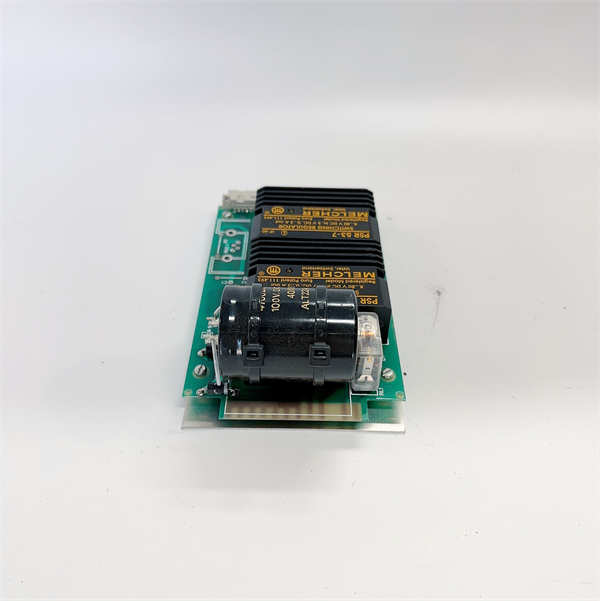
Melcher PSR-53-7
Lifecycle Status and Migration Strategy
Melcher as an independent brand is no longer active in the industrial power supply market, and the PSR-53-7 has been obsolete for over 15 years. No official successor exists under the original brand, and major manufacturers like Phoenix Contact, Weidmüller, or Mean Well do not list it in direct cross-reference databases. Continuing to operate on this unit carries significant operational risk: genuine new-old-stock is exhausted, and used units may have already exceeded their designed service life (typically 50,000 hours at 40°C). Counterfeit or re-marked units are increasingly common in online channels.
As an interim solution, only functionally tested units from reputable industrial asset support providers should be deployed—ideally those that perform a minimum 4-hour burn-in test at 80% load and verify output stability across line and load variations.
For long-term reliability, direct functional replacement with modern equivalents is straightforward and highly advisable. Suitable drop-in alternatives include:
- Phoenix Contact QUINT-PS/1AC/24DC/5 – offers higher efficiency (>88%), built-in DC OK signaling, and superior surge immunity (up to 6 kV)
- Weidmüller PRO ECO 24V 5A – similar mechanical footprint and terminal spacing, improved thermal performance
- Mean Well LRS-150-24 – cost-effective option, but requires verification of depth, mounting clip compatibility, and terminal wire capacity
Migration requires only mechanical and electrical validation—no software or system reconfiguration—making it one of the lowest-risk obsolescence mitigations in industrial control. Until replacement is executed, maintaining at least one validated spare per critical machine or production cell is essential for minimizing unplanned downtime and ensuring operational continuity.