 Tel:
Tel:  Email:
  WhatsApp:
 Description
Key Technical Specifications (For Spare Parts Verification)
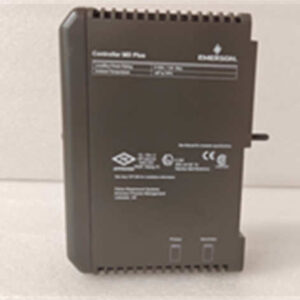
- Product Model: KJ4110X1-BA1
- Manufacturer: Emerson Automation Solutions
- System Platform: DeltaV Distributed Control System (Classic I/O architecture)
- Module Type: Analog Input (AI), 8 channels
- Input Signal: 4–20 mA (with optional 0–20 mA or 1–5 V via configuration)
- HART Support: Yes, multiplexed HART communication per channel
- Accuracy: ±0.05% of span (typical when new)
- Isolation: Channel-to-channel and field-to-system isolation
- Update Rate: ~100 ms per channel (system-dependent)
- Diagnostics: Open-circuit detection, sensor drift alerts, HART device status, module health LED
- Mounting: Plug-in module in DeltaV I/O carrier (e.g., KJ2221X1 or similar baseplate)
System Role and Downtime Impact
The KJ4110X1-BA1 is a foundational data acquisition component in legacy DeltaV systems, commonly used to interface smart transmitters measuring critical process variables like boiler drum level, reactor temperature, or pipeline pressure. It converts analog field signals into digital values used by control strategies, alarms, and safety instrumented functions (SIFs). Failure or drift in this module can result in incorrect process readings, leading to unstable control loops, nuisance trips, or—in worst cases—undetected hazardous conditions (e.g., overpressure). Since many installations use non-redundant I/O for cost reasons, loss of a single module can disable up to eight control or monitoring points simultaneously. Replacement requires chassis access, re-commissioning of affected loops, and validation of HART parameter consistency—activities that are significantly hindered by spare parts scarcity and the need for DeltaV Explorer expertise.
Reliability Analysis and Common Failure Modes
Although engineered for industrial environments, the KJ4110X1-BA1 is now subject to age-related degradation due to deployments dating back to the early 2000s. The most common failure modes include:
- A/D converter or front-end amplifier drift, causing consistent offset errors that manifest as biased process readings (e.g., temperature always reading 2°C high).
- Degradation of isolation barriers, reducing noise immunity and increasing susceptibility to ground loops—particularly in electrically noisy plants.
- HART modem circuit failure, resulting in loss of digital communication with smart transmitters while analog signal remains intact, complicating troubleshooting.
- Backplane connector fatigue, leading to intermittent contact and sporadic “bad quality” tags that are difficult to reproduce during bench testing.
A known vulnerability is the reliance on stable internal reference voltages; any drift here affects all channels uniformly. Preventive best practices include periodic loop calibration checks, trending process variable vs. redundant measurements, inspecting for dust accumulation or capacitor aging, and ensuring clean, stable 24 VDC power to the I/O carrier.
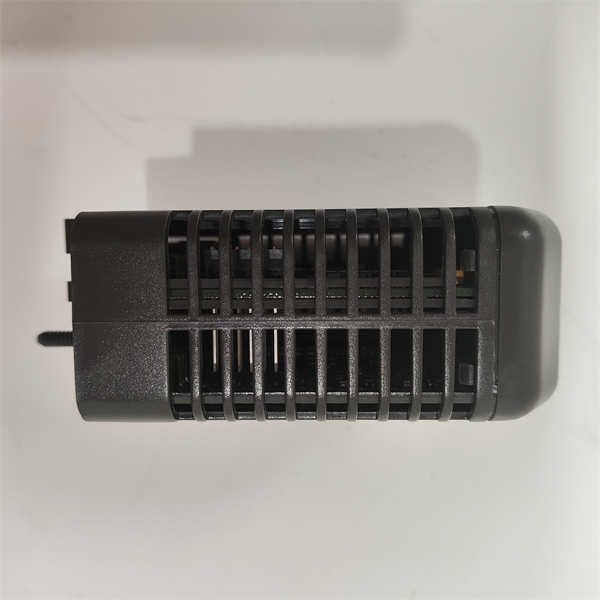
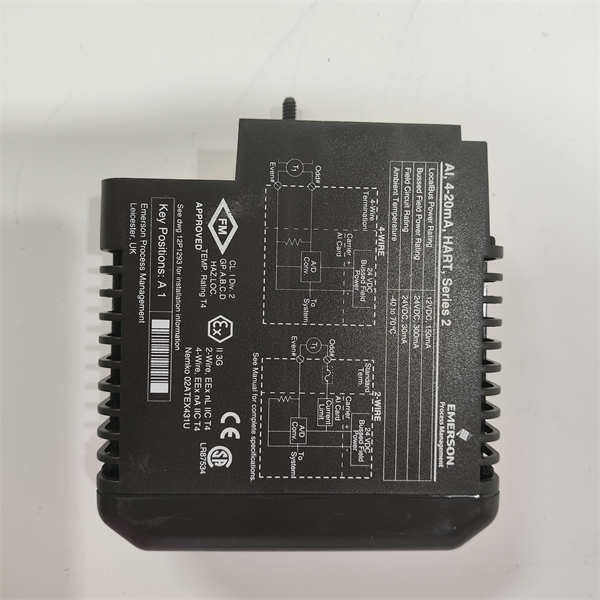
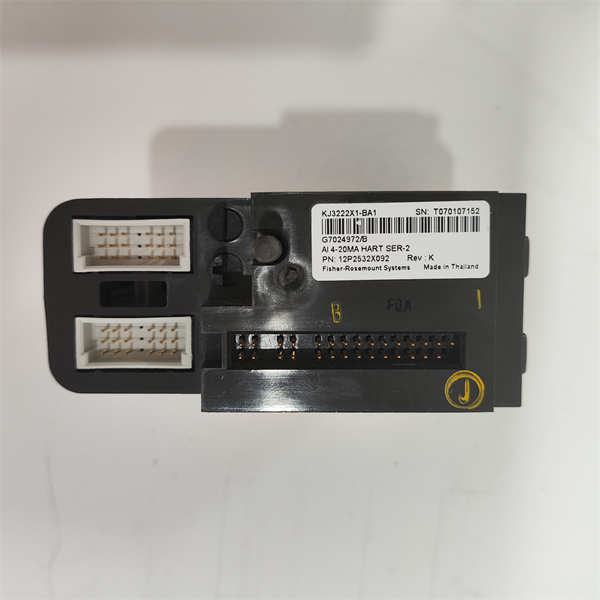
KJ4110X1-BA1 EMERSON
Lifecycle Status and Migration Strategy
Emerson has discontinued the KJ4110X1-BA1 as part of its transition to DeltaV S-series and Electronic Marshalling with CHARMs architectures. No new units are available through official channels, and technical support is limited to existing service agreements without engineering-level diagnostics. Continued use entails operational risk: surplus modules may have latent faults, firmware mismatches can cause HART communication failures, and regulatory audits increasingly question the use of unsupported hardware in safety-critical applications.
Short-term mitigation includes sourcing from certified vendors with full functional test reports (including HART pass-through verification and accuracy validation at multiple points), implementing pre-installation burn-in, and maintaining a strategic spare inventory for high-consequence loops.
The recommended long-term path is migration to DeltaV S-series AI modules (e.g., KJ4110X1-BA2 or KJ4110X1-BB1) or, more comprehensively, to CHARM-based Electronic Marshalling. This modern approach decouples field wiring from I/O type, enables remote I/O marshalling, supports advanced diagnostics, and integrates seamlessly with DeltaV 14+ and future releases. While migration requires upfront investment in hardware and reconfiguration, it eliminates obsolescence risk, reduces marshalling costs, and ensures ongoing compliance with cybersecurity standards such as IEC 62443—critical for operators managing process facilities beyond 2030.