 Tel:
Tel:  Email:
  WhatsApp:
 Description
Key Technical Specifications (For Spare Parts Verification)
- Product Model: TDM1.2-100-300-W1
- Manufacturer: Indramat (Bosch Rexroth)
- System Family: TDM1.2 Series Servo Drives
- Continuous Output Current: 30 A RMS
- Peak Output Current: 100 A (for up to 3 seconds)
- DC Bus Voltage: 300 V (requires external 300 V DC supply, typically from a separate power supply unit like TVM or TVE)
- Command Signal Type: ±10 V analog velocity/torque command
- Feedback Compatibility: Resolver (standard), incremental encoder (optional via adapter)
- Motor Compatibility: Indramat MAC series (e.g., MAC95, MAC112)
- Mounting: DIN rail (TS-35)
- Protection Features: Overcurrent, overtemperature, undervoltage, short circuit, motor overheat (via PTC input)
- Connector Type: Screw terminals for power and I/O; 15-pin D-sub for resolver
- Dimensions: 180 mm (W) × 260 mm (H) × 120 mm (D)
System Role and Downtime Impact
The TDM1.2-100-300-W1 is a high-power servo amplifier in Indramat’s legacy analog motion control architecture, widely used in metal forming, printing, and machine tool applications from the 1990s through early 2000s. It receives ±10 V analog commands from a motion controller and powers a compatible MAC servo motor using a 300 V DC bus supplied externally. If this drive fails—due to power stage damage, resolver interface fault, or thermal overload—the connected motor axis stops abruptly. In coordinated multi-axis machines (e.g., hydraulic press synchronizers or web handling lines), this can cause mechanical jamming, product scrap, or emergency shutdowns. Given its role in high-torque applications, replacement with non-identical units is not feasible without significant mechanical and control redesign.
Reliability Analysis and Common Failure Modes
Despite robust construction, the TDM1.2-100-300-W1 exhibits predictable aging after 15–20 years of service. The most frequent failure mode is power semiconductor degradation (IGBT modules or diode bridges) due to thermal cycling, especially if cooling is inadequate—leading to short circuits, open phases, or bus overvoltage faults. Second, resolver interface circuits are sensitive to vibration and contamination; cracked solder joints or failed isolation amplifiers cause position loss or runaway. Third, electrolytic capacitors on the logic and gate-drive supplies dry out, resulting in erratic behavior or failure to enable.
A key design limitation is its dependence on a stable, low-ripple 300 V DC bus—any instability from aging power supplies can trigger nuisance faults. Additionally, the analog command path is vulnerable to ground loops and EMI, particularly in plants with modern VFDs. Diagnostics are limited to front-panel LEDs, complicating troubleshooting.
For preventive maintenance, inspect heatsink cleanliness and ensure ambient temperature remains below 45°C. Verify DC bus voltage stability under load. Test resolver signal integrity with an oscilloscope—look for clean sine/cosine waveforms. Monitor for unusual fan noise or hot spots during operation. During planned outages, check for bulging capacitors and reseat internal connectors.
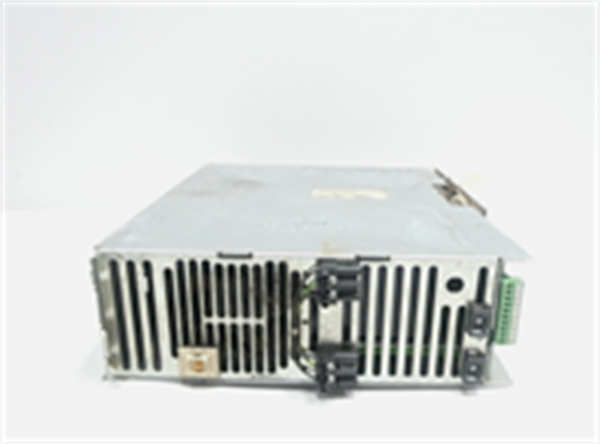
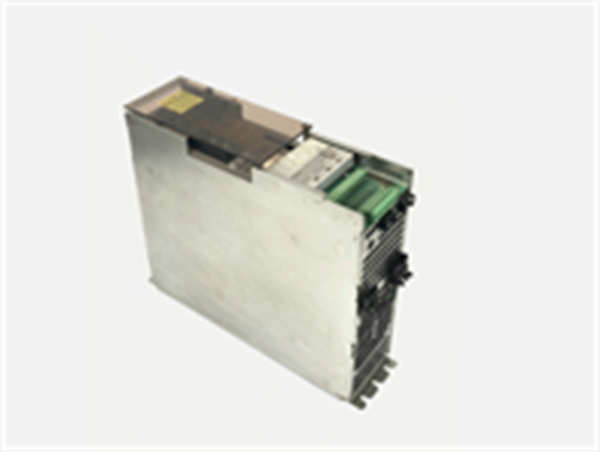
INDRAMAT TDM1.2-100-300-W1
Lifecycle Status and Migration Strategy
Bosch Rexroth discontinued the TDM1.2 series over a decade ago, replacing it with digital, fieldbus-based platforms like the IndraDrive family. No new TDM1.2-100-300-W1 units are produced, and official repair services have been phased out. Continued operation relies on diminishing spare inventory, posing increasing risk to production continuity.
As a short-term measure, maintain a tested spare unit and consider third-party repair services that perform full component-level restoration—including capacitor replacement and power module testing under load. Avoid untested surplus units.
For long-term sustainability, Bosch Rexroth’s recommended migration path is to the IndraDrive Cs or Hc series, such as the HCS03.1E-100-NNNN (100 A peak). This upgrade requires:
- Replacing the analog motion controller with a digital one supporting SERCOS III, EtherCAT, or PROFINET
- Rewiring power, feedback, and I/O (IndraDrive uses standardized connectors vs. terminal blocks)
- Replacing the MAC motor with a compatible MSK or MHD series motor (or retrofitting with encoder/resolver adapter)
- Retuning control loops due to differences in current loop dynamics
While migration demands significant engineering effort, it delivers higher efficiency, built-in diagnostics, network integration, and long-term supply assurance. A phased approach—starting with the most critical or failure-prone axes—is often the most practical strategy. Early consultation with a Bosch Rexroth-certified integrator is essential to evaluate feasibility, cost, and downtime impact.