Tel:
Tel:  Email:
  WhatsApp:
 Description
Technical Specifications (For Spare Part Verification)
- Product Model: T9481
- Manufacturer: ICS Triplex / Schneider Electric
- System Platform: Triconex® Tricon (V10/V11 architecture)
- Module Type: Triple-Modular Redundant (TMR) digital output module
- Output Channels: 16 channels, grouped in pairs (8 independent outputs, each driven by three redundant circuits)
- Output Type: Relay contact or solid-state (depending on variant; T9481 typically refers to the relay output version)
- Contact Rating: 2 A @ 30 V DC / 250 V AC (resistive load)
- Diagnostic Coverage: Continuous self-test of all three voting paths and output drivers per IEC 61508
- Redundancy Architecture: 2oo3 (two-out-of-three) voting with automatic fault bypass
- Backplane Interface: Proprietary Tricon high-integrity TMR bus
- SIL Certification: Certified for use in SIL 3 safety functions per IEC 61508 and IEC 61511
- Physical Form: Standard Tricon I/O module, front-panel LEDs for channel status, module health, and trip indication
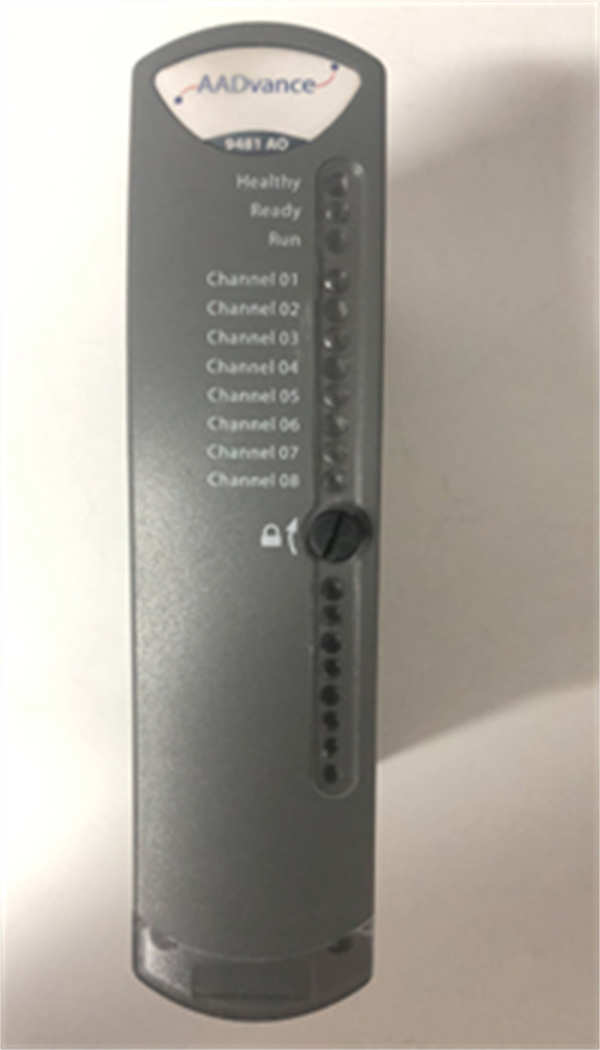
ICS Triplex T9481
System Role and Downtime Impact
The T9481 is a critical output interface within the Triconex® safety instrumented system (SIS), commonly deployed in oil & gas, petrochemical, and power generation facilities. It receives trip commands from the Tricon main processors and energizes/de-energizes field devices such as emergency shutdown valves, blowdown valves, or firewater pumps. Due to its TMR (Triple-Modular Redundant) design, the module ensures that even with one internal fault, the correct safety action is still executed—meeting the highest integrity requirements.
If the T9481 fails—particularly in a way that prevents output actuation—the safety function may not execute during a real process upset, creating a dangerous undetected failure. Conversely, an uncommanded output activation could cause a costly nuisance trip. In either case, regulatory bodies (e.g., OSHA PSM, EPA RMP) may cite the facility for inadequate SIS integrity. Because Triconex systems are often the last line of defense, the availability of functional T9481 modules directly impacts operational license and insurance compliance.
Reliability Analysis and Common Failure Modes
Although engineered for extreme reliability, the T9481 is subject to long-term wear mechanisms, especially in high-cycle applications. The most common failure point is electromechanical relay fatigue: after thousands of operations, relay contacts can weld shut (causing unintended activation) or develop high resistance (preventing proper de-energization). This risk increases in environments with frequent partial-stroke testing or vibration.
Another vulnerability lies in the output driver transistors and associated current-limiting circuitry. Over time, thermal stress can degrade semiconductor performance, leading to reduced drive capability or false diagnostics. The module’s reliance on precise timing across its three redundant lanes also makes it sensitive to power supply anomalies; voltage sags can desynchronize the voting logic, triggering a “module fault” and forcing the channel offline.
Preventive maintenance best practices include: performing regular partial-stroke tests on connected valves to verify output response; inspecting for error logs related to “OUTPUT FAULT”, “VOTER MISMATCH”, or “DIAGNOSTIC ERROR”; and ensuring ambient temperature in the I/O cabinet remains below 60°C. Any spare T9481 must be functionally tested on a certified Tricon test bench—including full TMR synchronization and output load validation—before being accepted into inventory.
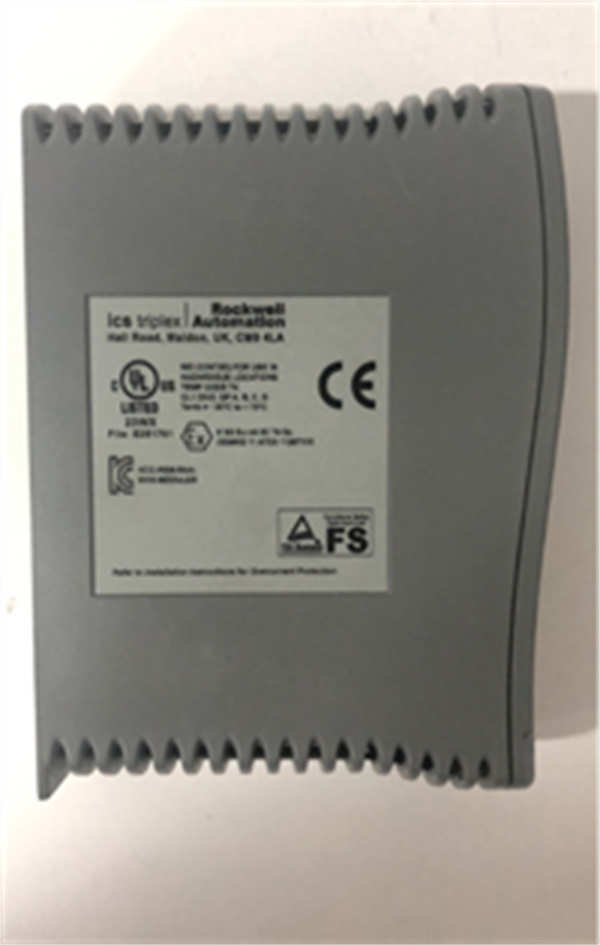
ICS Triplex T9481
Lifecycle Status and Migration Strategy
Schneider Electric has officially discontinued the T9481 as part of the broader end-of-life (EOL) roadmap for legacy Tricon V10/V11 hardware. While the Triconex platform remains supported, newer I/O modules (e.g., in the TCM series) have replaced older designs. The T9481 is no longer manufactured, and technical support is limited to existing service contracts.
Continued operation carries significant risk: genuine spares are scarce, counterfeit units have appeared, and prices have risen sharply. Unlike software-configurable modules, the T9481 cannot be repaired without violating its TMR certification.
Short-term mitigation includes securing only fully tested, traceable units from authorized surplus channels and implementing a rigorous burn-in protocol (minimum 72-hour hot standby test under load).
The strategic path forward is migration to the Triconex eXtended Architecture (TXS) or Tricon CX platforms. These support modern digital output modules (e.g., T9481X or T9482) with enhanced diagnostics, cybersecurity features, and compatibility with Triconex Enhanced Diagnostic Monitor (EDM). Migration requires re-engineering the application in Triconex Application Suite (TAS) but preserves the original safety logic structure. Schneider offers migration services, including FAT, site integration, and regulatory documentation support. For facilities with long operational horizons, this transition is essential to maintain functional safety integrity, comply with evolving standards (IEC 62443), and ensure spare parts availability beyond 2030.