 Tel:
Tel:  Email:
  WhatsApp:
 Description
Key Technical Specifications (For Spare Parts Verification)
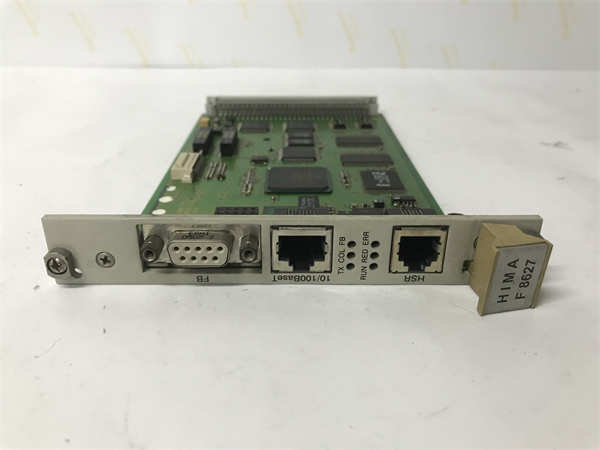
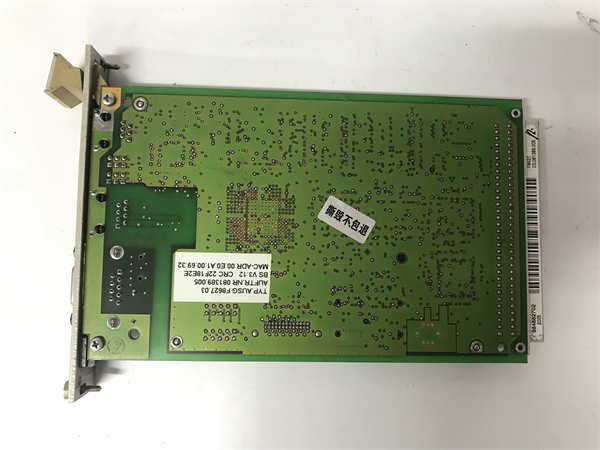
- Product Model: F8627
- Manufacturer: HIMA
- Order Number: 984862702
- Host System: HIMA H51q Safety System
- Function: Dual-channel fail-safe CPU with 2oo2 (two-out-of-two) voting architecture
- Safety Certification: Certified to IEC 61508 SIL 3, EN 50126/50128/50129 (rail), API RP 14C (oil & gas)
- Processor Type: Proprietary dual microprocessor with hardware-based comparison
- Memory: Onboard program and configuration memory (battery-backed SRAM or early flash variant)
- Backplane Interface: H51q-specific high-speed synchronous bus
- Diagnostic Coverage: >99% (per HIMA safety manual)
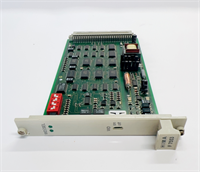
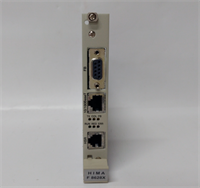
- Physical Form: Full-size module for H51q chassis, with status LEDs (RUN, STOP, FAULT, COM)
System Role and Downtime Impact
The F8627 is the central processing unit of the H51q safety controller. It executes the safety application logic, continuously compares results from its dual processors, and drives output modules only when both channels agree. It is typically deployed in critical applications such as:
- Offshore platform Emergency Shutdown (ESD)
- Gas compressor station Burner Management Systems (BMS)
- Chemical plant reactor protection
If the F8627 fails—due to internal fault, power anomaly, or firmware corruption—the entire H51q system enters a safe state (typically de-energizing all outputs). This leads to an unplanned plant trip, with potential consequences including:
- Production loss exceeding $1M/hour in hydrocarbon facilities
- Regulatory reporting obligations (e.g., EPA, OSHA)
- Extended restart time due to safety interlock resets and revalidation
Unlike standard PLCs, the H51q has no “degraded mode”; CPU failure equals total safety function loss.
Reliability Analysis and Common Failure Modes
Despite robust safety design, aging F8627 modules exhibit several failure trends after 15–20 years of service:
- Battery-backed memory failure: Early versions used SRAM with lithium batteries; battery depletion causes configuration loss on power cycle.
- Firmware corruption: Rare but possible due to EMI, power transients, or cosmic rays in high-altitude sites, leading to boot loops or unsafe states.
- Backplane connector fatigue: Repeated thermal cycling causes micro-cracks in edge connectors, resulting in intermittent communication faults.
- Capacitor aging: Onboard electrolytic capacitors degrade, causing voltage instability during processor-intensive cycles.
- Watchdog circuit malfunction: Internal timing circuits drift, triggering false safe-state transitions.
Design limitations include lack of remote diagnostics, dependence on obsolete semiconductor components, and inability to upgrade firmware beyond original release.
Preventive maintenance recommendations:
- Replace backup batteries every 5 years (if applicable)
- Perform annual proof tests that validate full logic execution and output response
- Monitor system logs for “Channel Mismatch” or “Internal Fault” events
- Maintain ambient temperature below 50°C to prolong component life
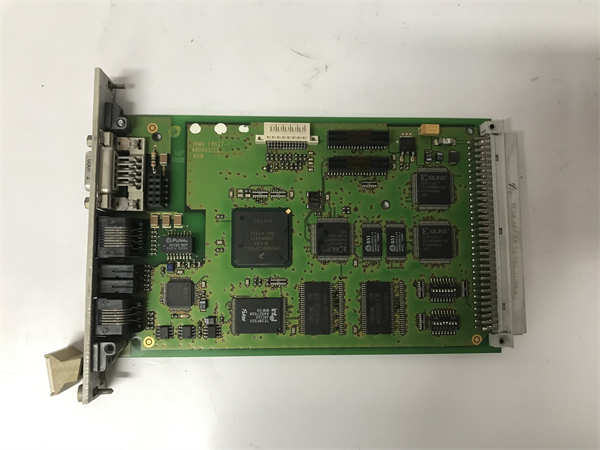
HIMA F8627 984862702
Lifecycle Status and Migration Strategy
HIMA officially discontinued the H51q platform, including the F8627 CPU, following the launch of the H51qX (enhanced H51q) and the fully modern HIMax series. No new F8627 modules are produced, and HIMA no longer provides repair services for this generation.
Continued operation carries significant risks:
- Inability to source certified, tested spares
- Loss of compliance with IEC 61511 Clause 11.2.5 (spare parts availability)
- Growing difficulty obtaining technical support or diagnostic tools
Interim mitigation measures include:
- Procuring units exclusively from HIMA-authorized legacy partners who provide full functional and safety validation
- Maintaining at least two tested spares per safety loop
- Implementing external health monitoring via auxiliary relays or digital I/O
For long-term resolution, HIMA recommends migrating to the HIMax platform, which offers:
- Full backward compatibility with H51q safety logic (via conversion tools)
- Enhanced cybersecurity (IEC 62443 compliant)
- Remote diagnostics and cloud integration
- Extended lifecycle commitment (20+ years)
Given its role as the core of a SIL 3 safety function, the obsolescence of the F8627 represents a high-severity risk. A structured migration plan—supported by formal risk assessment and capital planning—is essential to maintain process safety, regulatory standing, and operational continuity.