 Tel:
Tel:  Email:
  WhatsApp:
 Description
Key Technical Specifications (For Spare Parts Verification)
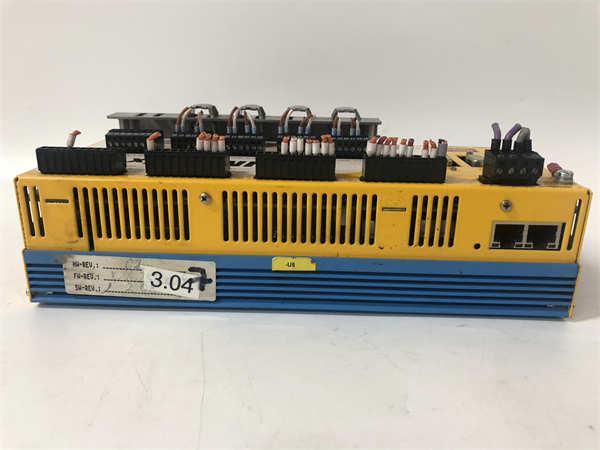
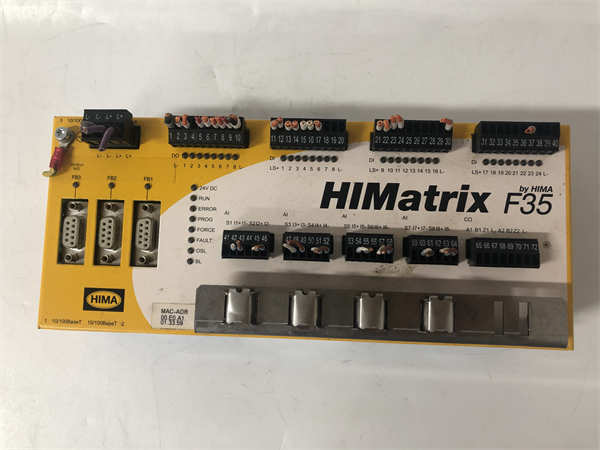
- Product Model: F35
- Manufacturer: HIMA Paul Hildebrandt GmbH
- System Family: HIMA H41q / H51q (Classic HIMatrix predecessor)
- Module Type: Fail-safe central processing unit (CPU)
- Safety Integrity Level: Certified up to SIL 3 (IEC 61508), TÜV certified
- Redundancy Architecture: 1oo2D (one out of two with diagnostics) dual-channel design
- Memory: Fixed program memory (non-expandable); configuration stored on removable PROM or EPROM cartridge
- Communication: Proprietary HIMA bus for I/O modules; RS232 for programming and diagnostics
- Power Supply: Requires +5 VDC and ±15 VDC from H41q/H51q backplane
- Mounting: Slot-specific insertion in H41q or H51q chassis (typically slot 1)
- Diagnostic Coverage: >99% via continuous self-tests (watchdog, memory CRC, channel comparison)
- Programming Environment: PAScal (HIMA’s proprietary safety programming tool, now deprecated)
System Positioning and Downtime Impact
The HIMA F35 CPU is the core of safety instrumented systems (SIS) deployed in oil & gas, chemical, and power generation facilities from the late 1990s through the early 2000s. It executes hardwired-equivalent safety logic—such as turbine overspeed shutdown, reactor high-pressure trip, or gas leak isolation—with deterministic response times typically under 100 ms. The module operates in a fault-tolerant 1oo2D architecture, where both internal channels execute the same logic and cross-check results. If a discrepancy is detected, the system safely de-energizes outputs.
A failure of the F35 module—whether due to hardware fault, configuration corruption, or power anomaly—will cause the entire safety system to enter a safe state (typically de-energizing all final elements like valves and motors). In a refinery or offshore platform, this can trigger a full process unit or facility shutdown. Given the safety-critical nature, regulatory frameworks (e.g., OSHA PSM, IEC 61511) often require immediate investigation and restoration, making spare availability not just an operational concern but a compliance imperative.
Reliability Analysis and Common Failure Modes
Despite its robust design, the F35 is susceptible to age-related degradation. The most common failure mode is loss of configuration due to battery-backed SRAM or EPROM cartridge failure—especially if backup batteries were not replaced during routine maintenance. Electrolytic capacitors on the internal DC/DC converters also dry out over time, leading to voltage instability and spontaneous reboots or diagnostic faults. Additionally, the front-panel connectors and backplane pins are prone to oxidation in humid environments, causing intermittent communication with I/O modules.
A key design limitation is the dependency on obsolete components: the custom ASICs and PROM chips are no longer fabricated, making board-level repair extremely difficult. The system also lacks modern cybersecurity features, posing integration risks in converged OT/IT networks.
Preventive maintenance recommendations include:
- Verifying backup battery voltage annually and replacing every 3–5 years
- Performing full system diagnostics using PAScal during scheduled outages
- Storing configuration backups in multiple secure formats (including printed logic diagrams)
- Keeping at least one verified spare F35 module powered in a test rack for burn-in validation prior to deployment
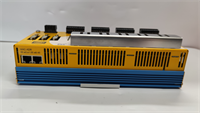
HIMA F35
Lifecycle Status and Migration Strategy
HIMA officially discontinued the H41q/H51q platform, including the F35 CPU, more than a decade ago. Support is restricted to documentation; firmware updates, repairs, and technical assistance are no longer available from the OEM. Continuing to operate this system carries significant risk: spares are scarce, expertise is dwindling, and compliance auditors increasingly question the sustainability of unsupported safety platforms.
Short-term mitigation includes sourcing tested surplus units from vetted suppliers and implementing rigorous preventive maintenance. However, these are temporary measures.
The official migration path endorsed by HIMA is a full upgrade to the HIMax or HIQuad X safety platform. Both support IEC 61508 SIL 3, offer modern programming in PAS4000 (based on IEC 61131-3), and provide Ethernet-based communication (PROFINET, Modbus TCP) with OPC UA for integration into digital safety ecosystems. Migration requires:
- Re-engineering safety logic (though HIMA offers conversion tools for simple logic)
- Replacing I/O modules and chassis
- Re-validating the entire SIS per IEC 61511
- Retraining maintenance personnel
While capital-intensive, migration eliminates obsolescence risk, enhances diagnostic coverage, and aligns with industry best practices for functional safety lifecycle management. Facilities should initiate feasibility studies immediately, as lead times for engineering and commissioning can exceed 12 months.