 Tel:
Tel:  Email:
  WhatsApp:
 Description
Key Technical Specifications (For Spare Parts Verification)
- Product Model: VMIVME-7459
- Manufacturer: GE Intelligent Platforms (ex-VMIC)
- Bus Standard: VME64 (IEEE 1014), 32-bit, A32/D32 addressing, 7U form factor
- Processor: PowerPC 750 (G3-class), typically 300–400 MHz
- Memory:
- Onboard DRAM: 128–512 MB (soldered or SO-DIMM)
- Flash Storage: 64–256 MB for boot firmware and OS
- I/O Interfaces:
- Dual 10/100 Mbps Ethernet (via PMC or onboard)
- Serial ports (RS-232/422/485)
- USB 1.1 (limited support)
- PMC site for mezzanine expansion (e.g., additional I/O or graphics)
- Real-Time Capabilities: Compatible with VxWorks, LynxOS, or Linux (real-time variants)
- Operating Temperature: Commercial (0°C to +55°C); extended temp versions may exist
- Power Consumption: ~25–35 W typical
- Diagnostic Features: LEDs for power, reset, HDD activity; watchdog timer; front-panel reset switch
System Role and Downtime Impact
The VMIVME-7459 was widely deployed as the main controller in VME-based industrial, power, defense, and test systems from the late 1990s through the 2000s. It runs real-time control logic, acquires data from VME I/O boards (e.g., VMIVME-2128), and communicates with HMIs or SCADA systems via Ethernet or serial links.
In non-redundant applications—common in legacy turbine controls, substation automation, or test rigs—a failure of the VMIVME-7459 results in:
- Complete loss of system control and monitoring
- Inability to execute safety interlocks or sequencing logic
- Extended downtime while sourcing and validating a replacement
Even in redundant setups, replacing a failed unit requires exact hardware/software version matching to avoid boot or compatibility issues.
Reliability Analysis and Common Failure Modes
Despite rugged construction, the VMIVME-7459 is now vulnerable due to its age and component obsolescence:
- Flash memory wear-out: Causes boot failures or corrupted OS images after repeated writes
- DRAM degradation: Leads to intermittent crashes or data corruption under load
- Capacitor aging in power regulation circuits: Results in voltage instability or spontaneous reboots
- PMC connector fatigue: Intermittent mezzanine card communication due to thermal cycling
- Firmware/bootloader corruption: Especially if battery-backed SRAM fails (used for boot parameters)
- Ethernet PHY chip failure: Common in early 10/100 controllers exposed to EMI
A critical weakness is the lack of modern cybersecurity features (no secure boot, unsigned firmware), making it a liability in connected environments.
Recommended preventive actions:
- Maintain full system image backups (including bootloader and OS)
- Monitor CPU temperature and utilization trends during operation
- Perform annual cold-boot validation during maintenance outages
- Store spares powered off in anti-static, dry, temperature-controlled environments
- Use external UPS to prevent power-cycle-induced flash corruption
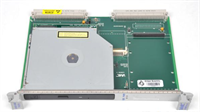
GE VMIVME-7459
Lifecycle Status and Migration Strategy
GE exited the embedded computing business in the 2010s; the VMIVME product line (including the 7459) was transferred to Curtiss-Wright Controls Embedded Computing, which did not continue production of this model. Official support ended years ago. Documentation is scarce, and software toolchains (e.g., older Tornado/VxWorks IDEs) are incompatible with modern development environments.
Short-term mitigation:
- Secure multiple tested, matched spares with verified OS images
- Implement board-level repair programs with specialized electronics restoration firms
- Isolate VME systems from corporate networks to reduce cyber exposure
Long-term migration path:
Modern alternatives include:
Modern alternatives include:
- Curtiss-Wright VPX or VME SBCs (e.g., VPX3-170 or SVME-780) with Power Architecture or Intel Xeon D
- Conduction-cooled 3U VPX systems for harsh environments
- Industrial PCs with PCIe-to-VME bridges (for gradual I/O migration)
However, migration requires:
- Porting or rewriting real-time application code
- Revalidating timing-critical control loops
- Updating drivers for new I/O modules
- Recertifying safety-related functions
Given the irreplaceable nature of remaining VMIVME-7459 units—and their role as system-critical processors—asset owners should initiate migration planning immediately. Delaying action risks catastrophic, extended outages when the last functional spare fails.