 Tel:
Tel:  Email:
  WhatsApp:
 Description
Technical Specifications (For Spare Parts Verification)
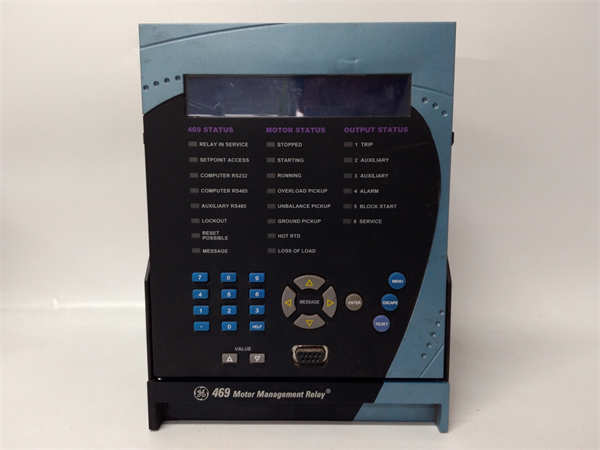
- Product Model: SR469-P5-HI-A20-E-H
- Manufacturer: General Electric (now part of Emerson Automation Solutions)
- System Family: GE Multilin SR469 Motor Management Relay Series
- Voltage Input: 3-phase AC voltage sensing (typically 120/240 V or PT-scaled)
- Current Input: 5 A nominal CT inputs (standard), with high-impedance differential option (HI suffix indicates High-Impedance Differential Protection)
- Protection Functions: Thermal overload, phase imbalance, ground fault, stall, under/overvoltage, differential protection (HI model), RTD monitoring (A20 = 8 RTD inputs)
- Communication Protocols: Modbus RTU (RS-485), front-panel EIA-232 port
- Output Contacts: 5 programmable Form C relays (P5 suffix)
- Enclosure Rating: Typically panel-mounted; no integral NEMA rating (installed in control cabinet)
- Firmware Version Dependency: Configuration files (.CFG) are version-specific; backup essential
System Role and Downtime Impact
The GE SR469-P5-HI-A20-E-H serves as the central protection and control unit for medium-voltage (typically 2.3–13.8 kV) induction motors in power generation, oil & gas, water treatment, and industrial facilities. It is commonly deployed on critical assets such as boiler feedwater pumps, main cooling water pumps, or compressor drives. If this relay fails—due to internal electronics degradation, configuration corruption, or power surge—the motor it protects will be automatically tripped or prevented from starting. Because these motors often support core process functions, a single SR469 failure can cascade into a partial or full plant shutdown, resulting in significant production loss and safety implications. Its role is not merely auxiliary; it is a frontline safeguard against catastrophic motor damage.
Reliability Analysis and Common Failure Modes
Although many SR469 units have operated reliably for 15–25 years, their age introduces predictable failure risks. The most common failure modes include: electrolytic capacitor drying-out on the power supply board, leading to intermittent resets or complete power loss; corrosion or oxidation on terminal blocks and internal connectors due to humidity exposure; and firmware corruption from battery-backed RAM failure (the SR469 uses a lithium coin cell for configuration retention—typically lasting 7–10 years). The high-impedance differential (HI) circuitry is particularly sensitive to grounding issues and CT mismatch, which can cause nuisance tripping if not meticulously maintained.
Design weaknesses include reliance on a non-replaceable (or difficult-to-replace) onboard battery and limited immunity to electrical transients on communication lines. As a maintenance best practice, teams should annually inspect terminal tightness, verify CT wiring integrity, measure backup battery voltage (>2.8 V recommended), and ensure the relay firmware configuration is backed up in both human-readable and binary formats. Cleaning dust from ventilation slots and verifying stable DC supply (±10% of nominal) also extend service life.
-

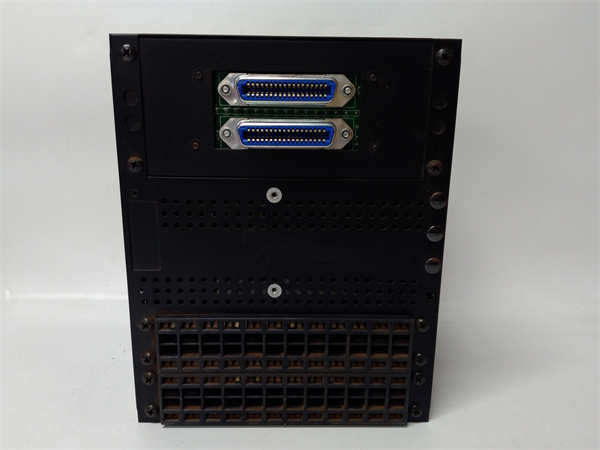
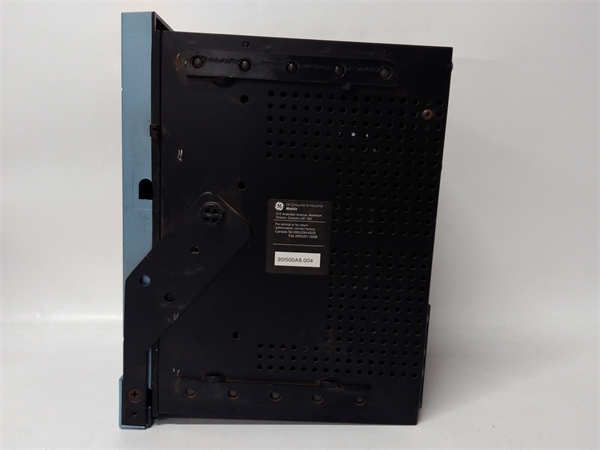
GE SR469-P5-HI-A20-E-H
Lifecycle Status and Migration Strategy
GE officially discontinued the SR469 series, with end-of-life notices issued over a decade ago. Continued use carries substantial risk: no new units are manufactured, genuine spare parts are scarce, and technical support from the OEM is extremely limited. While some refurbished or NOS (New Old Stock) units exist in the secondary market, authenticity and remaining service life are uncertain.
As a temporary mitigation, facilities may stock one or two verified working spares and implement rigorous preventive maintenance. Board-level repair by specialized third parties is possible but carries calibration and compliance risks.
For long-term sustainability, migration to a modern platform is strongly advised. Emerson (which acquired GE’s Multilin product line) recommends upgrading to the Multilin™ 469 or 869 series—both offer backward-compatible form factors and enhanced features like Ethernet, IEC 61850, and advanced diagnostics. However, migration requires re-engineering CT/VT wiring, updating protection settings, reconfiguring communications, and potentially modifying the control logic in the upstream PLC or DCS. A full migration study—including arc flash review and coordination study update—is essential before replacement. Planning this transition now avoids emergency decisions during an unexpected failure.