 Tel:
Tel:  Email:
  WhatsApp:
 Description
Key Technical Specifications (For Spare Parts Verification)
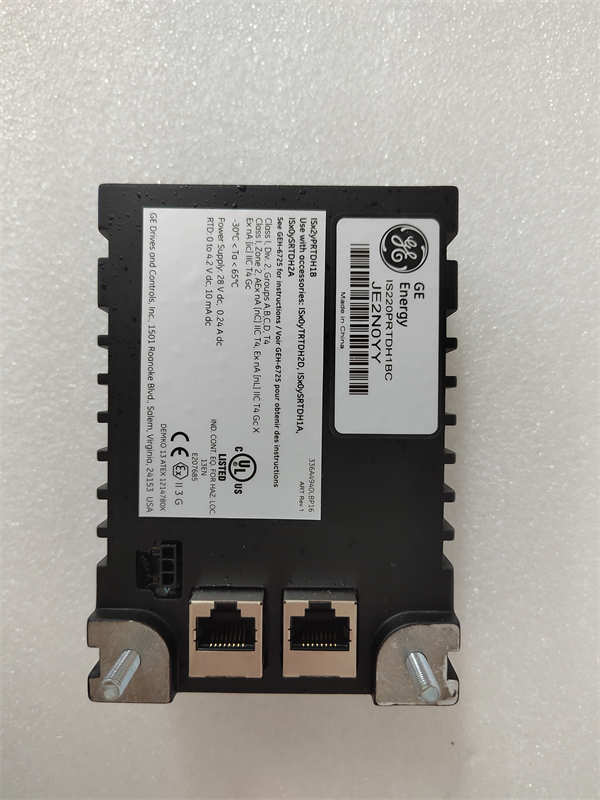
- Product Model: IS220PRTDH1BC
- Alternate Part Number: 336A5026ADP13
- Manufacturer: GE Power (now GE Vernova)
- System Platform: Mark VIe Turbine Control System (TMR architecture)
- Input Type: 6 differential channels for proximity probes or magnetic pickups (speed/phase signals)
- Signal Range: Compatible with -24 VDC to +24 VDC peak-to-peak inputs
- Redundancy: Full TMR (Triple Modular Redundant) – operates in voted I/O subsystem
- Backplane Interface: Connects to VME-based I/O terminal board (e.g., TBQP or TBSM series)
- Operating Temperature: 0°C to +60°C (requires forced air cooling in turbine enclosure)
- Diagnostic Features: Channel-level fault reporting via Mark VIe diagnostic bus
System Role and Downtime Impact
The IS220PRTDH1BC is a foundational safety-critical I/O module in GE’s Mark VIe control system for gas and steam turbines. It acquires real-time speed and shaft position data from multiple redundant sensors (typically magnetic pickups or eddy-current probes) and delivers synchronized, noise-immune signals to the three independent control processors (R, S, T) in the TMR architecture. This data drives critical functions including turbine startup sequencing, load control, grid synchronization, and—most importantly—overspeed trip logic. Failure of this module, or degradation in its signal integrity, can trigger a spurious trip or, worse, mask a genuine overspeed condition. In either case, the consequence is unplanned downtime of a multi-megawatt power generation asset, with potential revenue loss exceeding $500,000 per day in peaking plants.
Reliability Analysis and Common Failure Modes
Despite its robust design, the IS220PRTDH1BC is susceptible to age-related degradation due to its deployment environment—high ambient temperature, electrical noise, and continuous operation. The most prevalent failure modes include:
- Capacitor aging: Electrolytic capacitors on the analog front-end degrade over time, leading to signal drift, increased noise, or complete channel dropout. Units installed before 2015 are at elevated risk.
- Connector and solder joint fatigue: Thermal cycling causes micro-cracks in solder joints near high-power components or backplane connectors, resulting in intermittent faults that are difficult to diagnose.
- Input circuit vulnerability: The high-impedance differential inputs can be damaged by voltage transients from faulty sensor wiring or lightning-induced surges, especially if shield grounding is compromised.
- Firmware corruption (rare): Though primarily hardware-based, configuration data stored in non-volatile memory can degrade after extended service without power cycling.
As a maintenance best practice, facilities should:
- Perform annual infrared thermography on I/O modules to detect abnormal heating.
- Verify sensor signal quality (amplitude, waveform symmetry) during scheduled outages.
- Maintain spare modules in climate-controlled storage with periodic power-up cycles.
- Inspect terminal block connections for corrosion or loose wires, which can induce false readings.
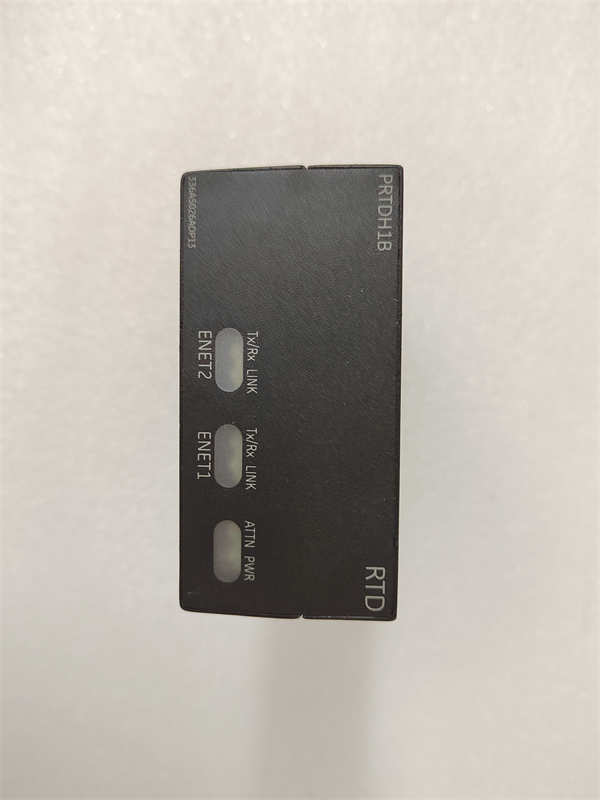
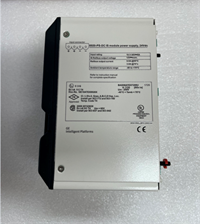
IS220PRTDH1BC 336A5026ADP13 GE
Lifecycle Status and Migration Strategy
GE has formally obsoleted the IS220PRTDH1BC as part of its broader transition toward the Mark VIeS and OpFlex platforms. No direct “drop-in” replacement exists, and new production has ceased. Continued reliance on this module carries significant operational risk: verified spares are scarce, prices have risen sharply, and counterfeit units have entered the secondary market.
Interim mitigation strategies include:
- Sourcing from qualified vendors who perform full functional retest and burn-in.
- Implementing board-level repair programs for units with localized failures (e.g., capacitor replacement).
- Deploying external signal conditioners to protect inputs from transients.
Long-term migration path:
GE’s recommended upgrade is to transition to the Mark VIeS platform, which uses the newer IS220SPDSH1B (or IS220SPDSH2B) speed and position module. This requires:
- Replacement of the I/O terminal board and associated cabling.
- Recommissioning of all speed/position sensors.
- Update of control application logic to align with new I/O mapping. While capital-intensive, this path restores OEM support, enhances cybersecurity, and extends asset life by 15–20 years. For plants not ready for full migration, maintaining a rigorously tested spare pool of IS220PRTDH1BC remains the only viable short-to-medium-term option.