 Tel:
Tel:  Email:
  WhatsApp:
 Description
Key Technical Specifications (For Spare Parts Verification)
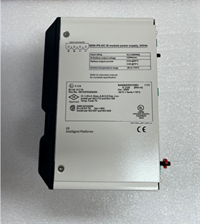
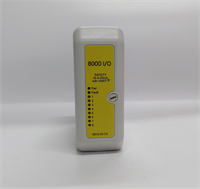
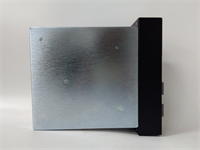
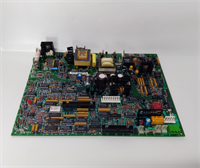
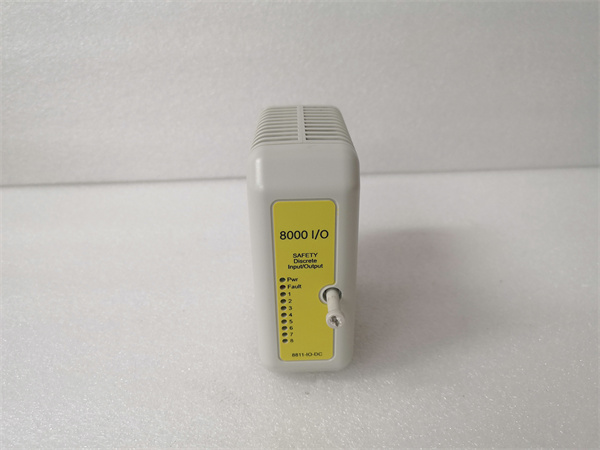
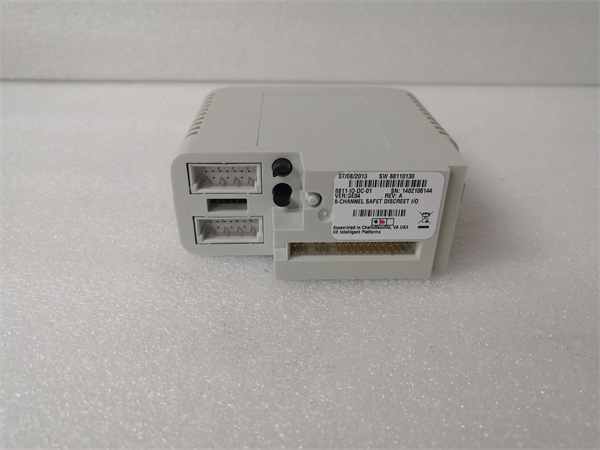
- Product Model: 8811-IO-DC-01
- Manufacturer: GE Vernova
- System Platform: Mark VIe (and Mark VIeS) turbine control system
- Module Type: Digital input (DI), sourcing type
- Number of Channels: 16
- Input Voltage Range: 24 V DC nominal (18–30 V DC acceptable)
- Input Isolation: Channel-to-channel and field-to-system isolation per IEC 61010
- Response Time: <5 ms per channel
- Diagnostic Coverage: Built-in open-circuit and short-circuit detection
- Backplane Interface: Proprietary high-speed serial bus to I/O controller (IOC)
- Mounting: Vertical slot in Mark VIe I/O terminal board (e.g., TB-IO-DC-xx)
- LED Indicators: Per-channel status and module health LEDs
- Firmware Dependency: Requires compatible IOC and controller firmware versions
System Role and Impact of Failure
The GE 8811-IO-DC-01 is a foundational I/O module within the Mark VIe control architecture, widely deployed in gas and steam turbine packages across power plants and industrial facilities. It acquires discrete status signals from field devices—such as limit switches on fuel valves, generator breaker auxiliary contacts, or emergency shutdown pushbuttons—and delivers them to the triple-modular redundant (TMR) or simplex Mark VIe controller for logic processing.
Because these inputs often feed directly into protection interlocks (e.g., “turbine trip on loss of lube oil pressure”), a failure in this module can have severe consequences. A stuck-on or stuck-off channel may cause a false trip (resulting in unplanned downtime) or, more critically, mask a real fault and prevent a necessary shutdown—posing safety and equipment integrity risks. Given that each module handles 16 independent safety-related signals, its reliability is paramount. Failure typically forces an immediate turbine trip or renders the unit unable to start, leading to significant operational and financial impact.
Reliability Analysis and Common Failure Modes
Although designed for industrial environments, the 8811-IO-DC-01 is now commonly operating beyond its intended service life (original deployments date to mid-2000s). The most frequent failure modes include degradation of input optocouplers due to sustained overvoltage or electrical transients from field wiring, leading to signal dropout or erratic state toggling. Internal DC/DC converter components—particularly electrolytic capacitors—dry out over time, causing voltage instability and module resets. Connector pins on the backplane interface are also prone to fretting corrosion in high-vibration turbine skids, resulting in intermittent communication faults.
A notable design vulnerability is its reliance on clean 24 V DC field power; noise or ripple beyond specification can cause false triggering. Additionally, while the module reports basic diagnostics, it lacks per-channel health trending, making latent failures hard to detect during routine checks.
For maintenance teams, recommended practices include:
- Periodically verifying input response using a calibrated switch simulator
- Inspecting terminal blocks for signs of arcing or overheating
- Ensuring proper shielding and grounding of field cables to minimize EMI
- Logging diagnostic alarms related to “input mismatch” or “module offline” events
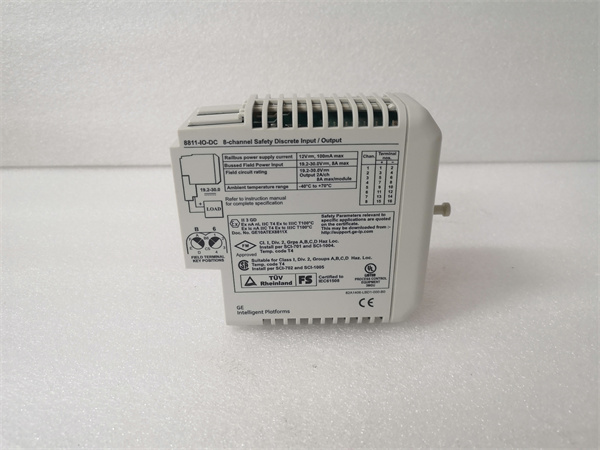
GE 8811-IO-DC 8811-IO-DC-01
Lifecycle Status and Migration Strategy
GE has formally discontinued the 8811-IO-DC series as part of the broader Mark VIe legacy hardware phase-out. No new production exists, and GE no longer offers repair or calibration services for this module. Continued use relies entirely on dwindling surplus inventory, often with unknown usage history and no performance warranty.
In the short term, operators may consider securing tested spares from certified resellers or implementing temporary redundancy via cross-wiring (where logic permits). However, the only sustainable solution is migration within the Mark VIe ecosystem. GE’s official path is to replace legacy I/O modules with the Mark VIeS (Safety-enhanced) platform components, which offer improved diagnostics, cybersecurity features, and long-term support. While the 8811-IO-DC-01 does not have a direct pin-compatible successor, the IO-DC-16V2 or equivalent modern DI modules in the VIeS terminal board family can fulfill the same function—though this requires retermination of field wires and update of I/O configuration in ToolboxST software.
For asset owners, a strategic approach includes: auditing existing spares, prioritizing replacement in non-redundant or high-risk loops, and planning I/O upgrades during major outages. This mitigates operational risk while extending the usable life of the overall turbine control system.