 Tel:
Tel:  Email:
  WhatsApp:
 Description
Key Technical Specifications (For Spare Parts Verification)
- Product Model: CPCI-680
- Manufacturer: FORCE Computers
- Form Factor: 6U CompactPCI (233.35 mm × 160 mm), compliant with PICMG 2.0
- Processor: Motorola (now NXP) MPC7410 PowerPC G4, typically 400–500 MHz
- Memory: Up to 512 MB soldered SDRAM (non-expandable via DIMM)
- Storage: Onboard flash (typically 32–64 MB); supports PMC site for SCSI/SATA/IDE expansion
- PMC Site: One IEEE P1386.1-compliant PMC slot (rear I/O via J3/J4/J5)
- Cooling: Air-cooled or conduction-cooled variants available (check part number suffix)
- Operating Temperature: Commercial (0°C to +55°C) or extended (-40°C to +70°C) depending on revision
- I/O Interfaces: Dual Fast Ethernet (10/100), dual RS-232/422, USB 1.1, VGA
- Backplane Interface: 32-bit/66 MHz PCI on P1/P2; 64-bit optional on P3/P4
- Power Consumption: ~25–35 W typical, depending on configuration
System Positioning and Downtime Impact
The FORCE CPCI-680 was widely deployed in early-2000s defense and aerospace programs as a high-reliability computing engine for real-time signal processing, command and control, and data acquisition. It commonly resides in 3U or 6U CompactPCI chassis alongside specialized I/O or DSP boards, often interfacing with radar, sonar, or electronic warfare payloads. Due to its role as the primary application host, a failure of the CPCI-680 typically halts all software execution—leading to loss of situational awareness, sensor data processing, or weapon system coordination. In military platforms, this may degrade mission capability; in test or simulation environments, it can halt certification activities with cascading schedule impacts.
Reliability Analysis and Common Failure Modes
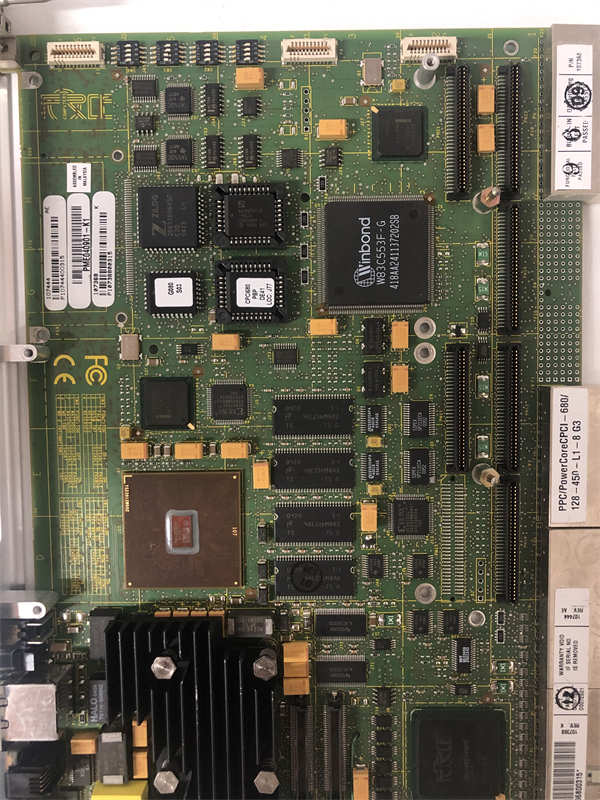
Although built to MIL-STD standards, the CPCI-680 exhibits predictable aging issues. The most frequent failure point is the onboard electrolytic capacitors in the power regulation circuitry, which degrade after 15–20 years, causing voltage droop, spontaneous reboots, or failure to POST. The MPC7410 processor’s ball grid array (BGA) package is also susceptible to thermal fatigue in cyclic environments, leading to intermittent crashes or complete CPU failure. Additionally, the PMC connector and rear transition module (RTM) pins are prone to corrosion or mechanical wear, especially in field-deployed systems.
A critical design limitation is the lack of modern error-correcting code (ECC) memory and reliance on soldered RAM—making memory faults unrecoverable without board replacement. The absence of watchdog timers in some firmware revisions further reduces fault resilience.
Recommended preventive actions include:
- Performing periodic power-on burn-in tests (minimum 72 hours) on spares before deployment
- Inspecting PCB for capacitor bulging, solder cracks, or trace delamination under magnification
- Verifying PMC site integrity with continuity testing
- Maintaining full system images and boot media compatible with legacy VxWorks or Linux kernels
FORCE CPCI-680
Lifecycle Status and Migration Strategy
FORCE Computers was acquired by Emerson in 2005, and the CPCI-680 was phased out shortly thereafter. Artesyn (successor to Emerson Embedded Computing) does not offer a direct replacement, and technical documentation is no longer distributed by the OEM. Continued use is increasingly untenable due to component obsolescence, software incompatibility with modern toolchains, and inability to meet current cybersecurity requirements (e.g., lack of secure boot, TPM).
Interim solutions include sourcing tested surplus units with full functional validation or engaging third-party firms that perform “re-balling” of the CPU or capacitor rework—but success rates decline as original components age.
The strategic path forward is migration to a modern, supported 6U CompactPCI or VPX platform. Vendors such as Kontron, Curtiss-Wright, or Abaco offer PowerPC- or x86-based SBCs with long-term availability guarantees, enhanced reliability (conduction cooling, ECC memory), and support for modern RTOS (e.g., VxWorks 7, Linux LTS). Migration requires:
- Rehosting or recompiling legacy application code
- Updating device drivers for new I/O architectures
- Potentially redesigning backplane or chassis if moving to VPX
- Revalidating real-time performance and safety certifications
Given the complexity, organizations should initiate a technology insertion study now. Even if immediate replacement isn’t feasible, establishing a verified spare pool and formal migration roadmap is essential to manage operational risk over the next 3–5 years.