 Tel:
Tel:  Email:
  WhatsApp:
 Description
Key Technical Specifications (For Spare Parts Verification)
- Product Model: TB820-2V2
- Manufacturer: ABB
- System Family: AC 800M / S800 I/O (part of 800xA architecture)
- ABB Order Code: Typically associated with 3BSE013208Rxxxx variants
- Function: Dual-slot redundant baseplate for S800 I/O modules requiring redundancy (e.g., CI854 Profibus, CI864 Modbus)
- Mounting: DIN rail (TS-35) in I/O cabinets
- Field Wiring: Screw-terminal blocks (2.5 mm² max) with common wiring for both slots
- Backplane Interface: Proprietary connectors for two identical I/O modules in redundant configuration
- Redundancy Support: Automatic switchover between primary and backup module
- Power and Signal Routing: Passive carrier—routes power, field signals, and module status between I/O modules and field wiring
- Operating Temperature: 0°C to +55°C
System Role and Downtime Impact
The TB820-2V2 is a specialized passive carrier used in high-availability ABB AC 800M systems where redundant I/O communication is required—commonly for gateway modules like the CI854 (Profibus DP) or CI864 (Modbus RTU/TCP). It allows two identical I/O modules to share the same field wiring while operating in a primary/backup configuration. If the baseplate fails—due to mechanical damage, terminal corrosion, or backplane connector wear—the redundant pair loses its shared interface, potentially causing communication loss to an entire field network (e.g., all Profibus slaves). This can result in loss of control over multiple process units, triggering alarms, manual interventions, or partial plant shutdowns. Replacement requires de-energizing the I/O rack and re-terminating all field wires, which is time-consuming and error-prone without proper documentation.
Reliability Analysis and Common Failure Modes
As a passive component, the TB820-2V2 has no active electronics, but it remains vulnerable to environmental and mechanical stress over 10–20 years of service. The most frequent issue is terminal block degradation, where vibration or thermal cycling causes loosening, leading to intermittent signals or increased resistance—particularly problematic for low-level digital communications. Second, plastic housing cracking occurs due to material embrittlement from prolonged heat exposure, compromising module retention and alignment. Third, backplane connector fretting from repeated module insertion or cabinet vibration results in poor electrical contact, causing module fault indications or failed redundancy handover.
A key design constraint is the shared field wiring: any wiring error or terminal fault affects both redundant modules simultaneously, negating the benefit of redundancy. Additionally, dust and moisture ingress in inadequately sealed cabinets accelerates terminal corrosion.
For preventive maintenance, inspect terminal torque during planned outages using a calibrated screwdriver. Look for discoloration, pitting, or white/green oxidation on terminals. Ensure both I/O modules seat fully and click into place without wobble. Verify redundancy status in Control Builder M diagnostics. Keep cabinets clean, dry, and within temperature limits.
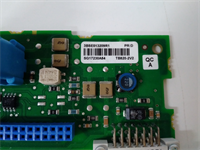
TB820-2V2 ABB
Lifecycle Status and Migration Strategy
ABB has discontinued the TB820-2V2 as part of the broader obsolescence of legacy S800 I/O hardware. No new units are manufactured, and official support is no longer available. Continued use relies on dwindling spare inventory, posing increasing risk to system availability—especially in safety-critical or continuously operated facilities.
As a short-term mitigation, secure at least one verified spare unit for each redundant I/O group. Confirm compatibility by matching the exact physical layout and terminal numbering. Avoid untested surplus stock, as cracked housings or worn connectors may not be visible externally.
For long-term sustainability, ABB’s strategic direction favors migration to modern I/O architectures such as:
- S800 I/O with newer baseplates (e.g., TK85x series) that support enhanced diagnostics
- Integrated communication gateways within the AC 800M CPU (e.g., built-in Modbus TCP)
- Edge-based protocol converters that reduce dependency on dedicated I/O modules
In practice, many users replace the entire redundant I/O function with a single modern Ethernet-based gateway (e.g., HMS Anybus, Softing) connected directly to the control network, bypassing the need for CI854/CI864 and their TB820 bases altogether. This simplifies architecture, reduces footprint, and improves remote diagnostics—though it requires reconfiguration of field device addressing and network segmentation.
Any migration must be carefully validated for cybersecurity and functional equivalence. Early consultation with an ABB-certified system integrator is recommended to evaluate options, manage change, and ensure compliance with operational and regulatory requirements.