 Tel:
Tel:  Email:
  WhatsApp:
 Description
Key Technical Specifications (For Spare Part Verification)
- Product Model: SM810K01
- Manufacturer: ABB
- System Family: AC 800M / Control System 800 (CS800)
- Processor Type: Embedded real-time processor (PowerPC-based, ABB proprietary)
- Memory: Integrated program and data memory (non-expandable)
- Redundancy Support: Yes – supports dual-redundant configuration with hot standby
- Backplane Interface: Proprietary high-speed bus to I/O modules via TK8xx chassis
- Communication Ports: Dual Ethernet (for HMI, engineering station, and I/O network), serial port (RS-232 for diagnostics)
- Operating System: ABB Extended Real-Time Kernel (ERTK)
- Firmware Dependency: Tightly coupled with Control Builder M application version
- Mounting: Slot-based insertion into AC 800M rack (e.g., TK801A, TK811A)
System Role and Downtime Impact
The ABB SM810K01 is the primary controller in early-generation AC 800M systems deployed widely in thermal power plants, combined-cycle facilities, and heavy process industries from the late 1990s through the 2000s. It executes all control logic—from boiler drum level regulation to turbine speed governors—and manages communication with remote I/O, operator stations, and plant-level SCADA. In a redundant setup, it operates in sync with a backup unit; in non-redundant configurations, it is a single point of failure. If the SM810K01 fails due to hardware fault or firmware corruption, the entire control station ceases to function. This typically triggers emergency turbine trips, boiler flameouts, or process isolation, resulting in unplanned outages that can cost tens of thousands of dollars per hour in lost production and grid penalties.
Reliability Analysis and Common Failure Modes
Despite its robust industrial design, the SM810K01 exhibits predictable aging issues due to its vintage electronics architecture:
- Flash memory wear-out: The onboard flash storing firmware and configuration degrades after repeated write cycles or prolonged operation, leading to boot failures or corrupted application loads.
- Battery-backed RAM failure: Older units rely on lithium batteries to retain real-time clock and critical parameters during power loss. Battery leakage or depletion causes time drift or configuration loss upon restart.
- Ethernet PHY chip degradation: The integrated Ethernet transceivers are sensitive to electrical overstress. Repeated surge events (common in plant environments) can damage link negotiation circuitry, causing intermittent or total communication loss.
- Connector fatigue: Repeated thermal cycling leads to micro-cracks in backplane connector solder joints, resulting in intermittent bus errors or module dropout.
Preventive maintenance recommendations include:
- Monitoring system logs for “memory parity errors” or “bus timeout” warnings.
- Replacing onboard battery every 5–7 years, even if voltage appears normal.
- Verifying Ethernet link stability under load using network diagnostics in Control Builder M.
- Keeping a fully configured spare unit powered periodically to refresh memory cells and validate boot integrity.
 Lifecycle Status and Migration Strategy
 Lifecycle Status and Migration Strategy
ABB officially discontinued the SM810K01 in favor of the PM86x series (e.g., PM864, PM866). No new units are produced, and ABB no longer provides repair services or firmware updates for this hardware generation. Continuing to operate systems with SM810K01 carries significant risk: verified spares are scarce, counterfeit units exist in the gray market, and compatibility with modern cybersecurity requirements (e.g., secure boot, encrypted communication) is nonexistent.
Interim Mitigation:
- Secure at least one tested, fully configured spare unit with matching firmware and application checksum.
- Implement rigorous environmental controls (temperature, humidity, EMI) in the control room to extend remaining service life.
- Avoid unnecessary power cycles, which accelerate flash wear.
Migration Path:
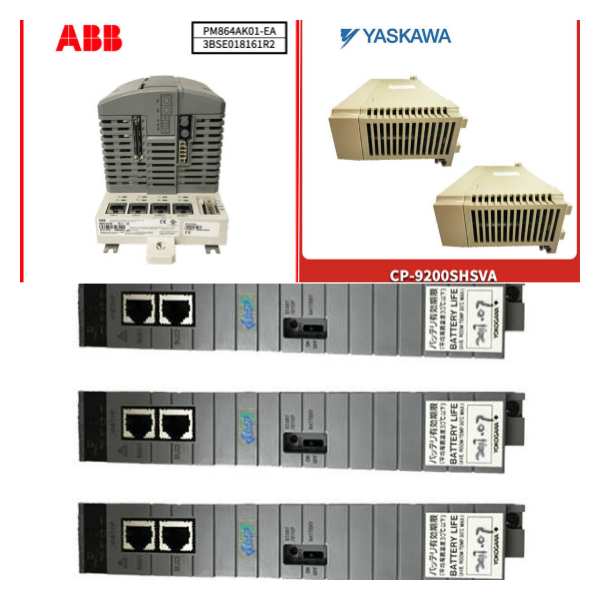
ABB’s official upgrade path is to replace the SM810K01 with a PM864A or PM866 CPU in a compatible AC 800M chassis (e.g., TK811A). This migration requires:
- Re-compilation of the existing Control Builder M application for the new CPU target.
- Potential re-validation of safety-critical logic due to timing differences.
- Possible I/O module upgrades if using legacy TB8xx terminal bases incompatible with newer CPUs.
For facilities planning full DCS modernization, alternatives include migrating to ABB Ability™ System 800xA with AC 900F or third-party platforms like Siemens PCS 7 or Emerson DeltaV. However, such projects demand extensive engineering effort, including loop revalidation, HAZOP reassessment, and operator retraining. Until then, disciplined spare management and proactive health monitoring remain essential for operational continuity.