 Tel:
Tel:  Email:
  WhatsApp:
 Description
Key Technical Specifications (For Spare Parts Verification)
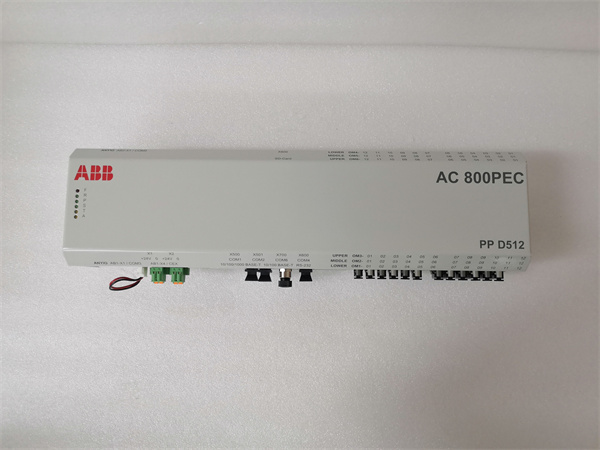
- Product Model: PPD512A10-150000
- Manufacturer: ABB
- System Platform: SATT 190 (Serial Advanced Turbine Technology)
- Module Type: Digital input (DI), isolated
- Number of Channels: 16
- Input Voltage: 48 V DC nominal (common in legacy power plant control schemes)
- Input Threshold: Typically 30–60 V DC for “ON” state
- Isolation: Galvanic isolation between field circuits and system logic
- Response Time: <10 ms per channel
- Diagnostic Capability: Basic LED indication per channel; no advanced self-diagnostics
- Mounting: Proprietary rack-mounted backplane in SATT 190 I/O chassis
- Connector Type: Screw-terminal or plug-in connector (depends on chassis variant)
- Compatibility: Requires matching SATT 190 CPU (e.g., PCD530 series) and I/O carrier
System Role and Impact of Failure
The ABB PPD512A10-150000 is a foundational component in SATT 190 control systems, historically deployed in fossil fuel, hydro, and nuclear power plants for turbine, boiler, and auxiliary system monitoring. It interfaces directly with field devices such as generator breaker auxiliary contacts, emergency shutdown pushbuttons, and mechanical limit switches on critical valves.
Because these signals often feed into hardwired or programmable protection logic—such as “turbine trip on high vibration” or “boiler master fuel trip”—a failure in this module can have severe operational consequences. A stuck-low input may mask a real fault (e.g., a closed isolation valve reported as open), while a stuck-high input could cause a false trip. Given that a single module handles 16 discrete inputs, its failure can compromise multiple safety interlocks simultaneously, potentially leading to forced outages, regulatory reporting events, or—in extreme cases—equipment damage.
Reliability Analysis and Common Failure Modes
The PPD512A10-150000 was designed for rugged service but is now commonly operating 20–30 years beyond its original design life. The most prevalent failure mechanisms include:
- Input optocoupler degradation: Long-term exposure to voltage transients or sustained overvoltage causes slow leakage or complete failure, resulting in erroneous signal states.
- Terminal block corrosion: In humid or corrosive environments (e.g., near cooling towers), screw terminals oxidize, increasing contact resistance and causing intermittent readings.
- Backplane connector fatigue: Thermal cycling and mechanical vibration lead to micro-cracks in solder joints or pin wear, disrupting communication with the SATT 190 processor.
- Internal power regulation drift: Aging components in the DC/DC converter section reduce noise immunity, making the module susceptible to EMI from nearby motor starters or relays.
A key design limitation is the absence of per-channel diagnostic feedback to the controller—failures are often only detected when the process behaves unexpectedly.
Recommended preventive actions:
- Perform periodic “wiggle tests” on field wiring during outages
- Measure input impedance and response with a calibrated switch simulator
- Inspect for discoloration or pitting on terminal blocks
- Maintain detailed logs of any unexplained logic anomalies that correlate with I/O modules
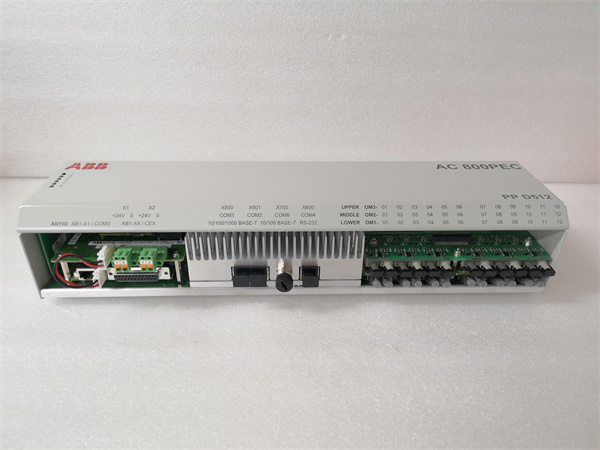
ABB PPD512A10-150000
Lifecycle Status and Migration Strategy
ABB discontinued the entire SATT 190 platform decades ago, and the PPD512A10-150000 has been obsolete for many years. No factory support, repairs, or new units exist. Remaining inventory consists of New Old Stock (NOS) or pulled units with unknown operational history—posing significant risk for critical applications.
Short-term strategies include:
- Securing multiple tested spares from trusted industrial asset resellers
- Implementing external relay-based redundancy for the most critical inputs
- Avoiding unnecessary module handling to preserve fragile connectors
For long-term sustainability, ABB’s official migration path is replacement with the System 800xA platform, using modern I/O modules such as the CI854 or DI810 series. This transition requires:
- Full re-engineering of the I/O cabinet (new racks, power supplies, cabling)
- Rewiring of all field connections (though existing conduits can often be reused)
- Complete reprogramming of control logic in AC 800M or Freelance controllers
- Recommissioning and regulatory re-qualification (especially in nuclear or utility settings)
Given the age and criticality of SATT 190 installations, many operators adopt a “life extension with migration planning” approach: maintain current systems with rigorous spares management while funding and scoping a full digital modernization project over a 3–5 year horizon. This balances immediate operational needs with long-term reliability and cybersecurity compliance.