 Tel:
Tel:  Email:
  WhatsApp:
 Description
Key Technical Specifications (For Spare Part Verification)
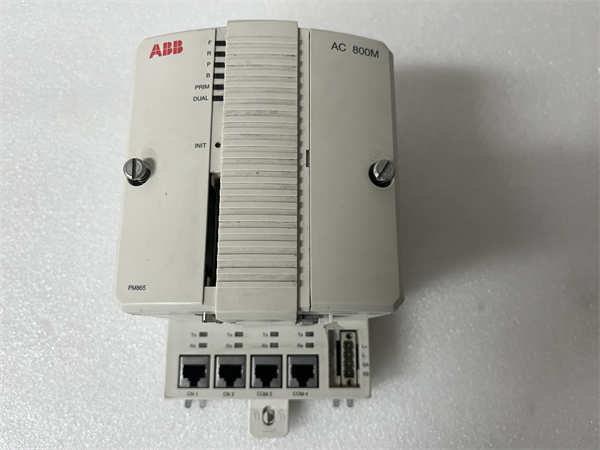
- Product Model: PM865K01 3BSE031151R1
- Manufacturer: ABB
- System Family: AC 800M within 800xA Distributed Control System (DCS)
- Processor Type: PowerPC-based, 32-bit
- Memory: 16 MB program memory, 8 MB data memory (non-expandable)
- Communication Interfaces: Dual redundant Profibus DP ports, serial service port (RS-232)
- Redundancy Support: Yes – supports 1:1 hot standby with PM865K01 peer via fiber-optic sync link
- Backplane Compatibility: Requires AC 800M baseplate (e.g., TB820V1 or TB840A)
- Firmware Dependency: Must match project-specific firmware version (e.g., 5.1.x or 6.0.x); mismatch causes boot failure
- Power Consumption: Approx. 8 W
- Diagnostic Indicators: LED status for RUN, STOP, I/O COMM, and REDUNDANCY SYNC
System Role and Downtime Impact
The ABB PM865K01 serves as the central processing unit in an AC 800M controller station within the 800xA architecture. It executes all control logic—PID loops, interlocks, sequences—for its assigned process area. In redundant configurations, it operates in hot standby with a second PM865K01, automatically taking over if the primary fails. However, if no spare is available and both units fail (or a single non-redundant unit fails), the entire controlled section—such as a boiler, compressor train, or reactor skid—loses automatic control. Operators may retain manual HMI access, but safety-critical automatic shutdowns and regulatory loops are disabled, typically forcing a full process unit trip. In continuous-process industries like chemicals or power, this can result in production losses exceeding $500,000 per hour.
Reliability Analysis and Common Failure Modes
Despite its robust industrial design, the PM865K01 exhibits predictable aging-related failure patterns due to its early-2000s semiconductor technology. The most frequent failure mode is firmware corruption or boot loop, often triggered by battery-backed SRAM degradation. The module relies on an internal lithium battery (typically 10-year life) to preserve program and configuration during power loss; once depleted, data loss occurs upon next outage. A second common issue is fiber-optic redundancy link failure, caused by aging transceivers or connector contamination, leading to unnecessary switchover or split-brain scenarios. Additionally, the Profibus DP communication ports are susceptible to ground-loop-induced damage in poorly grounded installations, manifesting as intermittent I/O dropouts.
Design weaknesses include the non-replaceable internal battery and lack of modern cybersecurity features (e.g., secure boot, encrypted firmware). As a maintenance best practice, sites should: (1) verify battery voltage annually via diagnostic logs; (2) clean and inspect fiber connectors every 24 months; (3) ensure proper grounding of the 800xA cabinet to minimize Profibus noise; and (4) maintain at least one tested spare in climate-controlled storage with firmware pre-loaded.
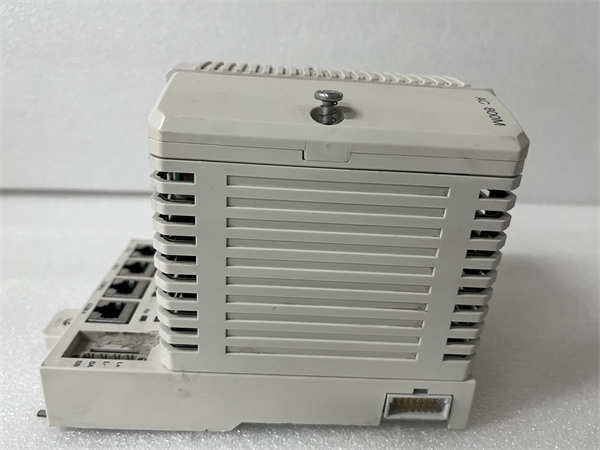
ABB PM865K01 3BSE031151R1
Lifecycle Status and Migration Strategy
ABB officially marked the PM865K01 as obsolete under its Product Lifecycle Management policy, with last-time buy opportunities closed years ago. Continued use carries significant risk: no new units are manufactured, firmware updates are frozen, and ABB support is limited to break-fix advice without hardware replacement. Spare parts now exist only in the secondary market, where authenticity and prior usage history are often unverifiable.
As a temporary measure, facilities can pursue board-level repair (e.g., battery replacement, capacitor rework) or source vetted used units with full functional testing. However, the sustainable path is migration. ABB’s recommended upgrade is to the PM866AK01 (or newer PM867 series), which offers higher memory, faster processing, and compatibility with 800xA V6+ environments. This migration requires: (1) hardware replacement of the CPU and baseplate; (2) project conversion using ABB’s legacy import tools; and (3) re-validation of control logic. While capital-intensive, this eliminates single-point obsolescence risk and extends system life by 10–15 years. For organizations unable to fund full migration, a phased approach—prioritizing critical units first—is strongly advised.