 Tel:
Tel:  Email:
  WhatsApp:
 Description
Technical Specifications
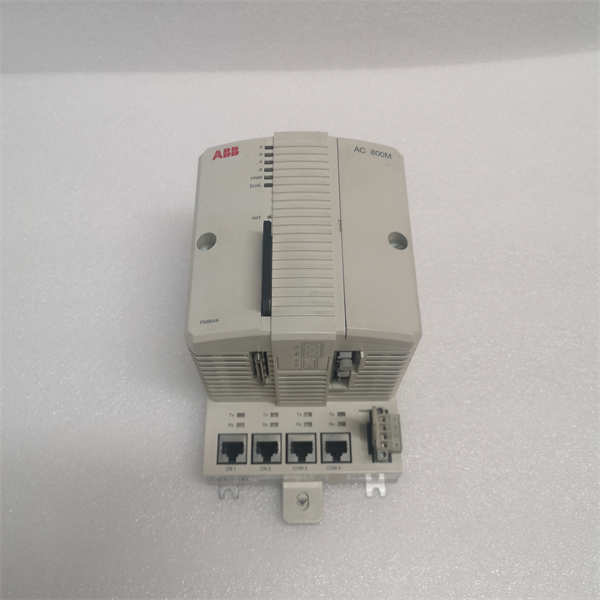
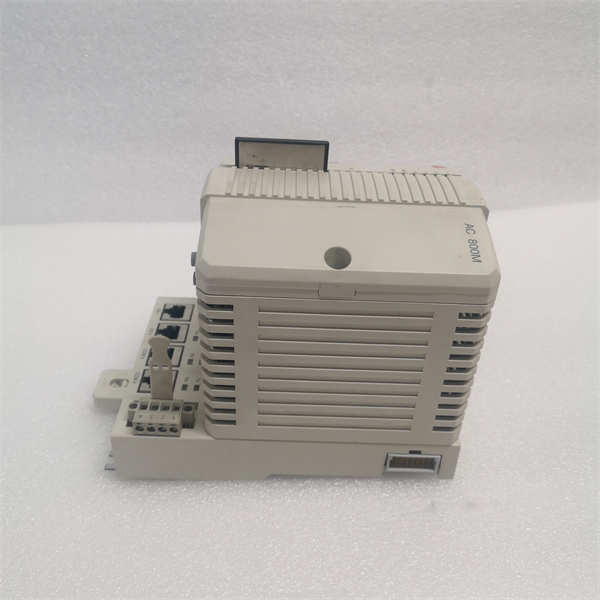
- Product Model: PM864AK01 (3BSE018161R1)
- Manufacturer: ABB
- System Family: AC 800M Controller Platform
- Processor Type: 32-bit RISC, real-time operating system
- Program Memory: 4 MB (non-volatile flash)
- Data Memory: 4 MB
- Execution Speed: 0.15 µs per Boolean instruction
- Communication Interfaces: 2 × RS-485 (for PROFIBUS DP or MODBUS RTU), 1 × Ethernet (for engineering, diagnostics, and peer-to-peer communication)
- Redundancy Support: Full controller redundancy (requires PM864AK01 pair and synchronization module)
- Power Consumption: 3.5 W typical
- Mounting: DIN rail in AC 800M rack (compatible with CI854/CI864 communication modules)
Core Performance and Selection Advantages
The PM864AK01 delivers a balanced combination of performance, reliability, and lifecycle stability for mid-scale automation tasks. Compared to earlier PM860-series CPUs, it offers faster scan times, larger memory capacity, and enhanced diagnostic capabilities—enabling more complex control strategies without escalating to high-end models. Its deterministic execution ensures consistent response in safety-critical loops, such as boiler protection or compressor sequencing.
A key functional advantage is its native support for multiple industrial protocols without requiring additional gateway hardware. The built-in RS-485 ports can be independently configured for PROFIBUS DP master/slave or MODBUS RTU, simplifying integration with legacy field devices, third-party analyzers, or auxiliary PLCs. Additionally, the Ethernet port supports OPC UA server functionality (via Automation Builder), enabling direct data exchange with SCADA, MES, or cloud platforms—reducing reliance on external protocol converters.
From a total cost of ownership (TCO) perspective, the PM864AK01 reduces engineering effort through seamless integration with ABB’s Automation Builder suite. Engineers can reuse libraries across HMI, PLC, and drive configuration, minimizing testing cycles. The module’s long-term availability roadmap (committed through at least 2035) also mitigates future obsolescence risk, making it a prudent choice for infrastructure projects with 15–20 year operational horizons.
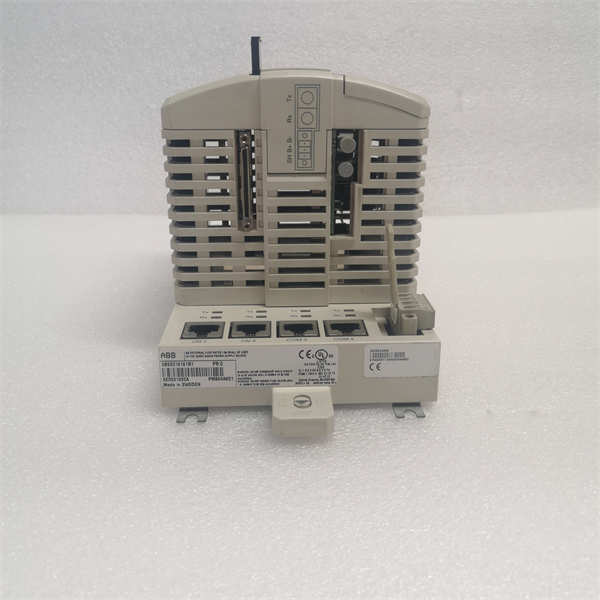
ABB PM864AK01 3BSE018161R1
System Integration and Expandability
The PM864AK01 is programmed exclusively within ABB Automation Builder, a unified engineering environment that supports IEC 61131-3 languages, graphical configuration of networks, and version-controlled project management. Automation Builder’s integrated simulation and online change capabilities significantly shorten commissioning time and reduce on-site debugging.
For networking, the CPU natively supports PROFIBUS DP, MODBUS RTU, and Ethernet/IP (when paired with CI864 communication module). Through Automation Builder, it can expose real-time data via OPC UA or MQTT (with optional edge runtime), enabling secure connectivity to enterprise systems or IIoT platforms without middleware. This simplifies compliance with digitalization initiatives while maintaining cybersecurity through role-based access and encrypted communication.
In terms of scalability, a single PM864AK01 can manage up to 1,024 local I/O points across up to 12 racks using redundant optical fiber links (via CI854 modules). It supports mixed I/O types—including analog, digital, pulse, and specialty modules—for applications ranging from water treatment to batch pharmaceutical production. For high-availability requirements, full hot-standby redundancy is achievable with a second PM864AK01 and synchronization link, ensuring zero downtime during controller faults. This modular architecture allows projects to start modestly and expand I/O or processing capacity as needed, aligning capital expenditure with operational growth.