 Tel:
Tel:  Email:
  WhatsApp:
 Description
Technical Specifications (For Spare Part Verification)
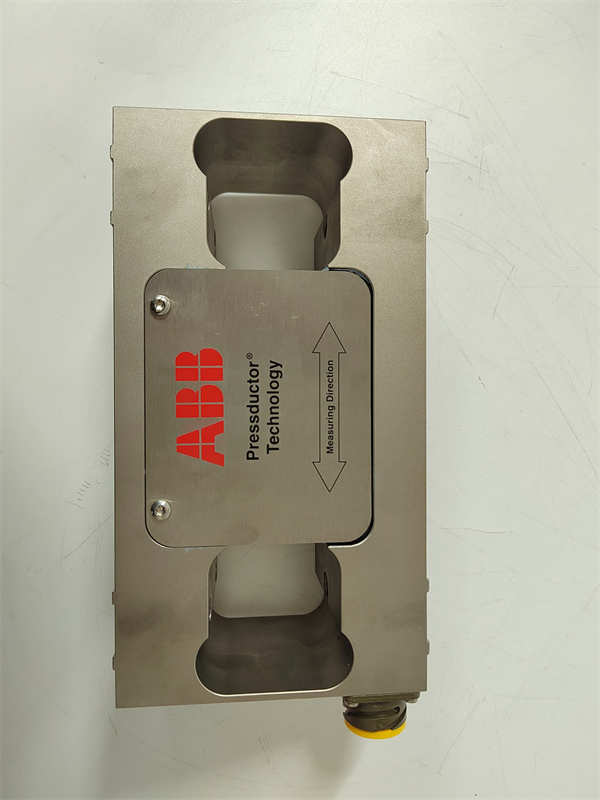
- Product Model: PFTL101A
- Rated Capacity: 1.0 kN (kilonewton) tension only
- Manufacturer: ABB
- Part Number: 3BSE004166R1
- Output Signal: 4–20 mA, 2-wire loop-powered
- Supply Voltage: 10–30 VDC (typically powered via S800 I/O or external loop supply)
- Accuracy: ±0.25% of full scale
- Nonlinearity & Hysteresis: <±0.1% F.S.
- Operating Temperature: –20°C to +70°C
- Ingress Protection: IP66 (dust-tight and protected against powerful water jets)
- Electrical Connection: 2 m PVC cable (standard), shielded twisted pair
- Mechanical Interface: M12 threaded ends (standard for PFTL101 series)
- Safety Certification: Certified for use in SIL 2 applications per IEC 61508 when integrated into compliant architecture
System Role and Downtime Impact
The ABB PFTL101A 1.0KN (3BSE004166R1) is commonly deployed in industrial cranes, winches, and automated lifting systems where real-time tensile force monitoring is required to prevent overloading. It feeds critical load data into ABB’s safety controllers—such as the AC 800F or System 800xA with S800 safety I/O—to enable functions like automatic hoist cutoff, speed reduction, or alarm annunciation. Because it operates within safety instrumented functions (SIFs), its reliability directly impacts personnel and asset safety. If the load cell fails open-circuit, it typically defaults to 0 mA (interpreted as “no load”), which may mask an actual overload condition—a dangerous failure mode. Conversely, a short-circuit or drift-induced high output could trigger a spurious trip, halting production. In either scenario, absence of a calibrated, verified spare prolongs downtime and increases operational risk, especially in facilities with zero-tolerance safety policies.
Reliability Analysis and Common Failure Modes
Despite its rugged IP66 housing, the PFTL101A is vulnerable to mechanical and environmental stress over time. The most common failure mode is strain gauge fatigue due to cyclic loading near or above rated capacity, leading to signal drift, nonlinearity, or complete loss of output. Moisture ingress—despite IP66 rating—can occur if cable glands are improperly sealed or if the unit is exposed to prolonged high humidity, causing corrosion on internal Wheatstone bridge circuits. Additionally, electromagnetic interference (EMI) from nearby VFDs or welding equipment can induce noise in the 4–20 mA loop if shielding is compromised.
Key design limitations include:
- No built-in self-diagnostics—failure detection relies entirely on external logic (e.g., out-of-range checks in PLC)
- Sensitive to side loads or bending moments; improper installation accelerates mechanical wear
- Loop-powered design offers no redundancy; single cable fault disables the sensor
Preventive maintenance recommendations:
- Perform annual calibration using traceable deadweight or hydraulic tester
- Inspect cable jacket and gland seals for cracks, abrasion, or moisture
- Verify 4–20 mA output under known load conditions during scheduled outages
- Ensure proper routing away from high-noise sources and use grounded shield terminations
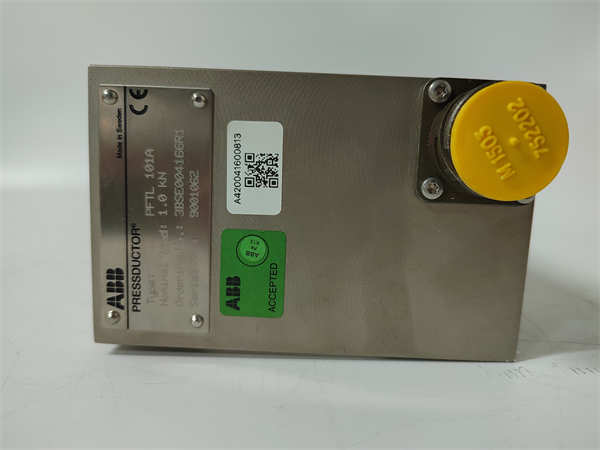
ABB PFTL101A 1.0KN 3BSE004166R1
Lifecycle Status and Migration Strategy
ABB has discontinued the PFTL101A series, including part number 3BSE004166R1, as part of its portfolio rationalization. Official manufacturing has ceased, and technical documentation is no longer actively maintained. Continuing to operate on this hardware carries notable risk: lack of factory calibration support, inability to source genuine replacements during emergencies, and potential non-compliance with updated functional safety audit requirements.
As a temporary measure, facilities may:
- Acquire and calibrate one or more spares under accredited conditions
- Implement external loop monitors to detect signal loss or out-of-range values
- Enforce strict load-limiting procedures to reduce mechanical stress
For long-term sustainability, ABB recommends migration to the PFTL201C series or integration with the Ability™ Smart Sensor ecosystem for force measurement. The closest functional replacement is the PFTL201C 1.0KN (e.g., 3BSE022540R1), which offers:
- Higher accuracy (±0.15% F.S.) and improved temperature stability
- Optional HART or IO-Link communication for enhanced diagnostics
- Continued lifecycle support through 2030+
Migration typically involves:
- Replacing the mechanical load link (same M12 interface simplifies retrofit)
- Updating I/O configuration in System 800xA or AC 800F engineering tools
- Revalidating the SIF per IEC 61511, including proof test intervals
In parallel, strategic sites are adopting wireless-enabled smart sensors that provide cloud-based health monitoring—though these require gateway infrastructure. Until then, proactive sparing, rigorous calibration, and careful handling remain essential to maintaining safety integrity in legacy ABB force measurement applications.