 Tel:
Tel:  Email:
  WhatsApp:
 Description
Key Technical Specifications (For Spare Parts Verification)
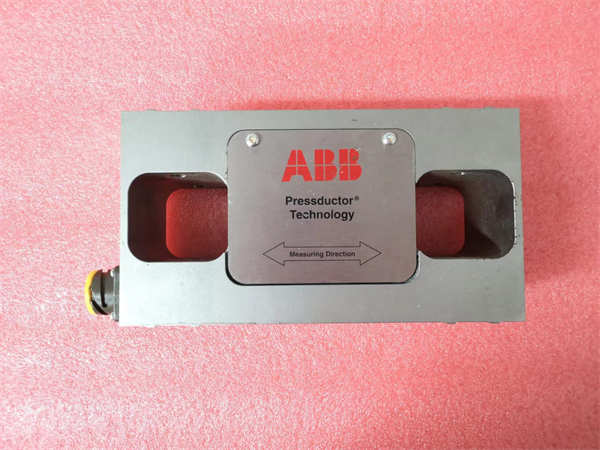
- Model Number: PFTL101A 0.5KN
- Manufacturer: ABB
- System Family: Standalone industrial sensor (commonly integrated into ABB AC 800M, MasterPiece, or third-party PLC systems)
- Measuring Range: 0.5 kN (500 N) full scale
- Output Signal: 4–20 mA, 2-wire loop-powered
- Supply Voltage: 10–30 VDC
- Accuracy Class: ±0.25% of full scale (typical for original units)
- Protection Rating: IP65 (dust and water jet resistant)
- Cable Entry: Integrated 5-meter PUR cable (standard), with M12 connector optional
- Mounting Configuration: Dual through-holes for shaft mounting in idler roll applications
- Operating Temperature: -10°C to +70°C
- Material: Stainless steel sensing element, aluminum housing
System Role and Downtime Impact
The PFTL101A 0.5KN is a critical field device in web handling systems, typically installed on idler rolls in paper machines, printing presses, or plastic film lines. It measures the actual tension force exerted by the moving web and provides a real-time analog signal to the drive controller or PLC, which adjusts motor torque to maintain consistent tension. In high-speed lines, even minor signal drift or complete sensor failure can cause web flutter, wrinkles, or catastrophic web breaks—resulting in material waste, cleaning downtime, and potential damage to downstream rollers or coating heads. Because these sensors operate in harsh environments (exposed to moisture, dust, and mechanical shock), their reliability directly impacts overall equipment effectiveness (OEE). A failed PFTL101A often forces operators into manual tension mode, drastically reducing line speed and product quality.
Reliability Analysis and Common Failure Modes
Despite its rugged design, the PFTL101A is prone to age- and environment-related failures after 10–20 years of service. The most frequent issues include:
- Strain gauge fatigue or delamination: Repeated cyclic loading beyond elastic limits causes micro-cracks in the bonded foil gauges, leading to nonlinearity, hysteresis, or zero-shift.
- Cable damage at strain relief: Flexing during roll maintenance or vibration-induced abrasion compromises conductor integrity, causing intermittent signal loss or noise.
- Moisture ingress: Degraded cable jacket seals or compromised IP65 rating allow condensation into the electronics compartment, corroding terminals and altering calibration.
- Electronics board failure: The internal 4–20 mA transmitter circuit (often using older op-amps) suffers from component aging, resulting in output saturation or drift.
Design vulnerabilities include reliance on precise mechanical alignment during installation and sensitivity to side loads or bending moments not aligned with the primary axis. For preventive maintenance, technicians should:
- Perform quarterly zero/span checks with known dead weights
- Inspect cable sheath for cuts, kinks, or UV degradation
- Verify grounding continuity to avoid ground loops
- Ensure mounting bolts are torqued evenly to prevent housing distortion
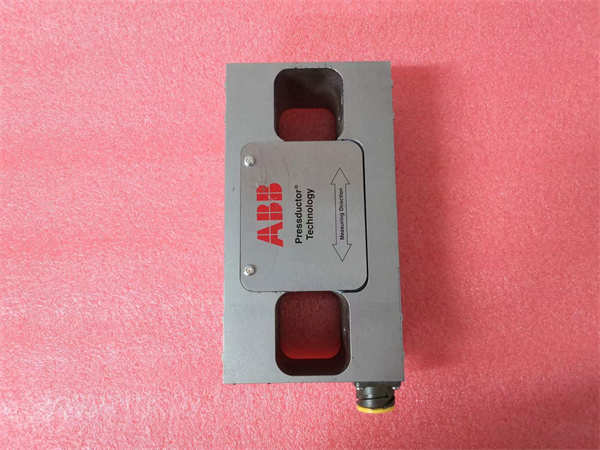
ABB PFTL101A 0.5KN 3BSE004160R1
Lifecycle Status and Migration Strategy
ABB has discontinued the PFTL101 series, with no direct drop-in replacement offered under the same form factor or signal specification. Official support is limited to repair services (where feasible) or migration guidance. Continuing to operate with legacy units carries significant risk: calibration traceability is lost, spare parts are scarce, and newer control systems may lack compatible analog input scaling.
As a short-term mitigation, facilities may:
- Source verified used units with recent calibration certificates
- Implement redundant tension measurement using ultrasonic or optical methods as backup
- Repair cables or recondition housings in-house (if strain gauges remain intact)
For long-term sustainability, ABB recommends transitioning to modern alternatives such as the PFTL301 series (if mechanical envelope allows) or third-party equivalents from reputable manufacturers (e.g., HBM, Kistler, or FMS) that offer digital outputs (IO-Link, Modbus RTU) and enhanced diagnostics. Migration typically requires:
- Mechanical adaptation brackets to fit existing roll assemblies
- Recalibration of tension control loops in the drive or PLC
- Update of I/O mapping and scaling parameters in the control software
Given its role as the “eyes” of the tension control system, proactive management of PFTL101A obsolescence is essential to maintain production stability and product quality in continuous process industries.