 Tel:
Tel:  Email:
  WhatsApp:
 Description
Technical Specifications (For Spare Part Verification)
- Product Model: LD800HSE
- Manufacturer: ABB
- System Family: AC 800F / AC 800M (Industrial IT 800xA compatible)
- Communication Standard: FOUNDATION Fieldbus HSE (IEC 61804)
- Physical Interface: 1 × 100 Mbps RJ-45 Ethernet port (for HSE backbone)
- Fieldbus Support: Connects to multiple FF-H1 segments via external H1/HSE linking devices
- Protocol Services: Supports VFD (Virtual Field Device), LAS scheduling, and alarm/event reporting over HSE
- Installation: DIN-rail mounted or panel-mounted; connects to controller via serial or proprietary backplane (depending on base system)
- Power Supply: 24 V DC ±10%
- Diagnostic Indicators: LEDs for power, link status, and communication activity
- Configuration Tool: Requires ABB Control Builder F or Asset Optimization Portal (legacy versions)
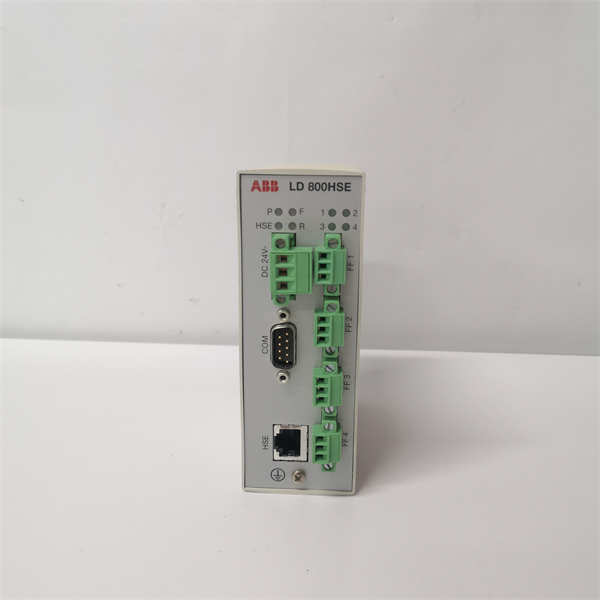
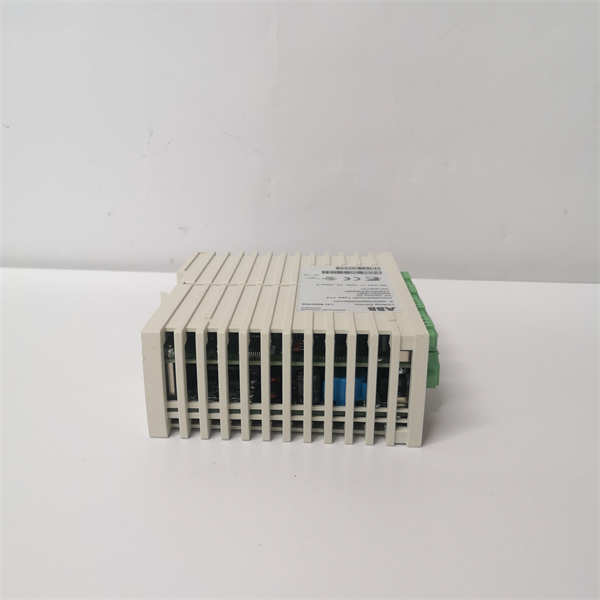
ABB LD800HSE 3BDH000320R0101
System Role and Downtime Impact
The LD800HSE functions as the high-level network gateway in FOUNDATION Fieldbus architectures, aggregating data from multiple H1 segments (each hosting up to 32 smart field devices) and routing it to the AC 800F or AC 800M controller within an 800xA system. It enables centralized monitoring of device diagnostics, real-time process values, and function block execution status across the fieldbus network. If this module fails, all connected H1 segments lose upstream communication—meaning the DCS can no longer read measurements, send setpoints, or receive alerts from those devices. While local control may persist within each H1 segment (via Link Active Scheduler redundancy), the loss of supervisory visibility and remote configuration capability often forces operators into manual mode. In continuous-process industries like oil & gas or chemicals, this significantly increases operational risk and typically triggers a management-of-change review, potentially leading to partial or full plant derating until service is restored.
Reliability Analysis and Common Failure Modes
Despite its industrial-grade design, the LD800HSE is now vulnerable to component aging. The most prevalent failure mode involves degradation of the switching power supply circuitry, particularly the input capacitors, which leads to unstable 3.3V/5V rails and intermittent reboots under thermal load. Another common issue is corruption of the firmware image due to repeated power cycling without proper shutdown—this renders the module unresponsive during startup. A known architectural weakness is the lack of redundant power inputs; a single 24V supply failure takes the entire HSE link offline. Additionally, the Ethernet magnetics can be damaged by ground loops or lightning-induced surges if surge protection is not installed at the network entry point.
Recommended preventive maintenance actions include:
- Measuring ripple voltage on the 24V DC supply feeding the module (should be < 200 mVpp)
- Verifying firmware version matches the system baseline to avoid compatibility mismatches
- Installing Ethernet surge protectors on the HSE backbone cable runs
- Performing annual backup of the module’s configuration file via Control Builder F
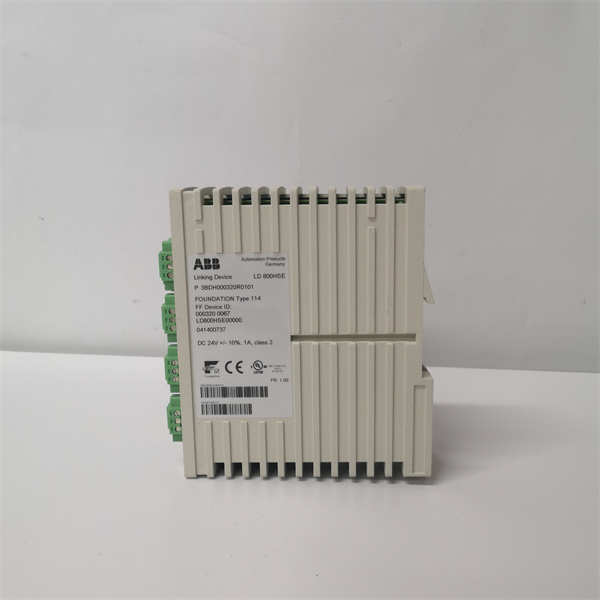
ABB LD800HSE 3BDH000320R0101
Lifecycle Status and Migration Strategy
ABB has officially discontinued the LD800HSE, with no factory-new replacements available. Continued use carries substantial risk: spare parts are scarce, technical support is limited to extended maintenance contracts, and newer 800xA software releases may drop driver support entirely. Short-term mitigation includes sourcing tested surplus units or engaging specialized third-party vendors capable of board-level repair and firmware recovery.
The recommended long-term strategy is migration away from FOUNDATION Fieldbus HSE toward modern Ethernet-based architectures. ABB’s current path involves:
- Replacing FF-H1 devices with PROFIBUS PA or HART-over-Ethernet instruments where feasible
- Upgrading controllers to AC 800M with PROFINET or ABB Ability™ System 800xA Gen 7
- Using OPC UA PubSub or MQTT for secure, scalable device integration into cloud or edge platforms
For facilities retaining FF infrastructure, a transitional approach uses FF-to-OPC UA gateways (e.g., from Softing or Helmholz) to bridge legacy fieldbus data into modern SCADA systems without replacing field devices. However, this adds complexity and latency. Ultimately, planning a phased decommissioning of the LD800HSE—starting with non-critical loops—and consolidating onto a unified Ethernet fabric delivers improved cybersecurity, reduced lifecycle costs, and future readiness for advanced analytics.