 Tel:
Tel:  Email:
  WhatsApp:
 Description
Key Technical Specifications (For Spare Part Verification)
- Product Model: NMTU-21C
- Manufacturer: ABB
- System Family: AC 800M (part of System 800xA architecture)
- Function: PROFIBUS DP fieldbus termination and coupling unit
- Bus Standard: PROFIBUS DP (IEC 61158/61784)
- Data Rate Support: Up to 12 Mbps (auto-detect)
- Termination: Integrated switchable 220 Ω termination resistor
- Isolation: Galvanic isolation between controller backplane and fieldbus
- Connector Type: 9-pin D-SUB (male) for fieldbus cable
- Mounting: DIN rail or mounted directly on AC 800M baseplate
- Power Supply: Powered via backplane from connected module (e.g., NMPC/NMFC)
- Diagnostic Indicators: LED for BUS ON, TERMINATION ACTIVE, and FAULT status
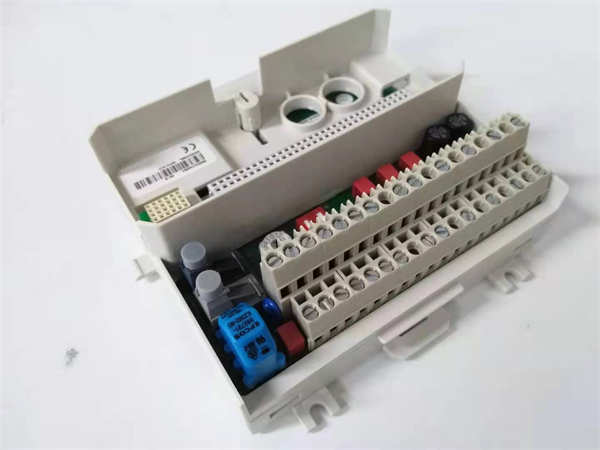
ABB 3BSE017429R1 NMTU-21C
System Role and Downtime Impact
The NMTU-21C serves as the physical and electrical interface between the AC 800M controller (via a master module such as NMPC-01C) and the PROFIBUS DP field network. It ensures signal integrity by providing correct end-of-line termination and isolating the controller from ground loops or transients on the fieldbus. In typical deployments—such as power plants, pulp & paper mills, or mining conveyors—it connects distributed I/O stations (e.g., ABB CI854-based), drives, or valve terminals. If the NMTU-21C fails or is missing proper termination, the entire PROFIBUS segment may experience cyclic communication errors, leading to loss of I/O updates, control loop instability, or emergency shutdowns. Because PROFIBUS is deterministic and time-critical, even minor signal reflections from unterminated ends can cause repeated retries and eventual watchdog timeouts.
Reliability Analysis and Common Failure Modes
While mechanically simple, the NMTU-21C is vulnerable to environmental and electrical stress over time. Common failure modes include:
- D-SUB connector corrosion or mechanical wear: Repeated plugging/unplugging or vibration loosens pins, increasing contact resistance.
- Termination resistor drift or open-circuit: Thermal cycling degrades the precision resistor, reducing termination effectiveness.
- Isolation barrier breakdown: Voltage surges from nearby lightning or switching transients can compromise internal optocouplers or DC/DC converters.
- LED or indicator circuit failure: Masks true operational status, complicating troubleshooting.
A key limitation is the lack of advanced diagnostics—no bus error counters, signal quality metrics, or remote health reporting. Technicians must rely on external tools (e.g., PROFIBUS tester or oscilloscope) to validate signal integrity. Preventive maintenance should include:
- Periodic inspection of D-SUB connector tightness and oxidation
- Verifying that termination is enabled only at segment ends (not mid-line)
- Measuring bus voltage (typically 3–5 Vpp differential) during operation
- Ensuring shield continuity and proper grounding of the PROFIBUS cable
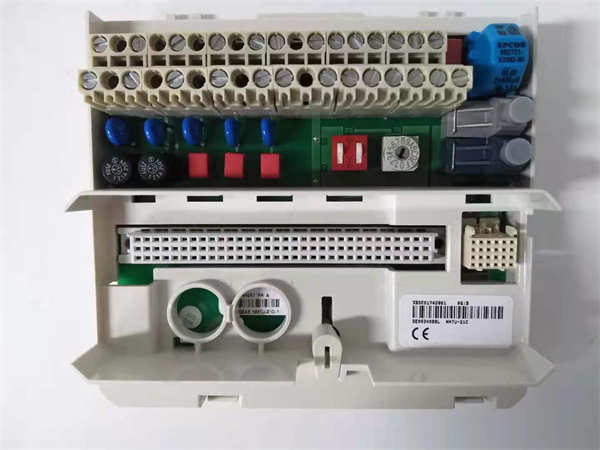
ABB 3BSE017429R1 NMTU-21C
Lifecycle Status and Migration Strategy
ABB has discontinued the NMTU-21C as part of the broader phase-out of legacy AC 800M PROFIBUS interfaces. It is no longer listed in official catalogs, and factory support—including repair or replacement—is unavailable. Remaining units are found only in secondary markets, often without test documentation.
Short-term risk mitigation includes:
- Stocking verified functional spares with documented test results
- Using external passive terminators as a temporary workaround (though this bypasses isolation and diagnostics)
- Implementing redundant PROFIBUS segments where feasible
For long-term sustainability, ABB recommends migrating to modern communication architectures. The preferred path is transition to PROFINET using current AC 800M modules such as the NMEI-01C (PROFINET IO Controller). This requires replacing field devices or using PROFINET-to-PROFIBUS gateways (e.g., ABB TB5xx series), reconfiguring network topology in System 800xA, and updating device GSD files. While this involves engineering effort, it delivers improved bandwidth, built-in diagnostics, cybersecurity features, and alignment with ABB’s active product roadmap. Prioritizing migration for high-availability or safety-related segments is advised to manage risk effectively.