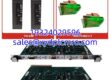
Key Technical Specifications
- Product Model: CDIO 16/16-0,5
- Manufacturer: BERGHOF
- I/O Configuration: 16 Digital Inputs / 16 Digital Outputs
- Output Type: Relay (Potential-Free)
- Output Rating: 0.5A per channel
- Input Voltage: Typically 24V DC (Verify with nameplate)
- Isolation: Optical isolation between inputs and logic
- Mounting: DIN Rail or Panel Mount
- Diagnostics: Individual LED indicators per channel
Product Introduction
I’ve pulled these BERGHOF modules out of control panels that were older than some of my apprentices. The CDIO 16/16-0,5 isn’t trying to be fancy; it’s a workhorse designed to take a beating on the factory floor. You get 16 inputs and 16 relay outputs in a single package, which saves you rack space and reduces wiring headaches when you’re trying to cram logic into a cramped cabinet.Engineers stick with this specific 0.5A relay version because it handles solenoids and small contactors without needing external interposing relays for every single point. The 0.5A rating is the sweet spot—enough to drive a standard 24V coil, but low enough that if you accidentally short a wire, you usually just kill the fuse and not the whole backplane. Just remember, these are mechanical relays. They click. They wear out. If you’re switching high-frequency signals, go find a transistor output module instead.
Quality SOP & Tech Pitfalls
The Lab Report:
We don’t just ship these because they look pretty. Every CDIO 16/16-0,5 goes through a mandatory bench test.
- Visual/Counterfeit Check: I inspect the PCB for cold solder joints and verify the BERGHOF silkscreen. Fakes are out there.
- Live Rack Test: Module gets seated in a test chassis. We cycle all 32 points. If an LED doesn’t light or a relay doesn’t click, it’s scrap.
- Load Test: We pull 0.5A on the outputs to check for voltage drop across the relay contacts. High drop = pitted contacts = reject.
- Insulation Check: Fluke 115 on the channels to ensure no leakage to ground.
- Sealing: Anti-static bag, bubble wrap, and a test report in the box.
The Engineer’s Warning:
Here is where people mess up. Do not ignore the 0.5A limit. I’ve seen guys wire up a 2A motor starter coil directly to these outputs because “it worked on the bench.” It works until the inductive kickback welds the relay contacts shut or arcs the PCB trace. Always use a snubber or flyback diode on inductive loads. Also, check your DIP switches or configuration software. If the module is configured as “Sinking” but you wired it “Sourcing,” nothing will work, and you’ll waste three hours blaming the PLC logic.
Installation & Configuration Guide
- Pre-Installation Safety: ⚠️ LOCKOUT/TAGOUT. Verify 0V with a meter. Wait 60 seconds for capacitors to discharge. Take a photo of the old wiring and DIP switch settings before touching a single screw.
- Removal: Label every wire. Release the DIN clip gently; these plastic tabs get brittle with age and heat. Don’t pry with a screwdriver unless you want to crack the housing.
- Installation: Copy those DIP switches exactly. This step prevents 90% of “it won’t boot” calls. Slide the CDIO 16/16-0,5 onto the rail. Push down until it clicks. Tighten the mounting screws, but don’t strip them.
- Power-On & Testing: Apply 24V DC. Watch the “PWR” LED. If it flickers or is dim, check your power supply; you might have a short in the field wiring. Force a test bit in your PLC. Listen for the click. Verify the LED matches the PLC state.
Compatible Replacement Models
| Status | Model / Action | Notes |
|---|---|---|
| ✅ Drop-in | CDIO 16/16-0,5-1131 | Same specs, newer revision. Check suffix compatibility. |
| ⚠️ Software Compatible | BERGHOF CDIO 16/16-1,0 | Higher current (1A). Same footprint, but verify load requirements. |
| ❌ Hardware Mod | Modern PLC I/O | Requires new backplane/wiring. Only do this during a full panel rebuild. |
Frequently Asked Questions (FAQ)
Can I hot-swap this module?
No. Unless your specific BERGHOF backplane explicitly supports hot-swapping (and most older ones don’t), you risk frying the backplane or the new module. Power down first.Why is my relay clicking but the load isn’t working?
Check the common wire. You’d be shocked how many times I’ve seen a loose common on the output side. Also, verify your 24V supply isn’t sagging under load. Relays need juice to pull in.Is the CDIO 16/16-0,5-1131 the same thing?
Usually, yes. The “-1131” is often a revision or date code. Physically they fit the same, but double-check the input logic (NPN/PNP) in the manual before swapping.How long do these relays actually last?
Mechanical life is rated for millions of cycles, but electrical life at 0.5A is closer to 100k-300k depending on the load. If you’re switching a contactor coil 10 times a second, you’ll kill this module in a month. Use an SSR or transistor output for high-frequency stuff.Do I need a snubber across the relay?
If you’re switching inductive loads (solenoids, contactors, valves), absolutely. Without it, the back-EMF will eventually destroy the relay contacts or cause EMI that resets your PLC. A simple RC snubber or flyback diode costs pennies and saves headaches.What if the “ERR” LED is solid?
That usually means a configuration mismatch or a backplane communication fault. Check your DIP switches first. If those are right, reseat the module. If it persists, your backplane connector pins might be bent or corroded.